

 Español
 русский
 Français
 Português
 Deutsch
 عربى
عربى italiano
-1.jpg)

Content
- 1 The Paradox and Technical Realities of Solar Air Conditioning
- 2 High Initial Capital Investment
- 3 Intermittency and Energy Storage Struggles
- 4 Space Requirements and Structural Limitations
- 5 Environmental Adaptation: The Irony of Heat vs. Efficiency
- 6 Maintenance and Long-term Operational Costs
- 7 Logic Conflicts in Hybrid Systems
- 8 Hidden Complexity: Why After-Sales is Challenging
- 9 FAQ: What Users Care About Most
- 10 Science Literacy: Advanced Knowledge on Solar Air Conditioners
The Paradox and Technical Realities of Solar Air Conditioning
In the surge of green energy and the desire to slash electricity bills, the solar air conditioner sounds like a perfect solution: using peak sunlight to offset the most intense cooling demands. However, in practical application, this technology is not without its flaws. The adoption of the solar air conditioner is constrained by a series of technical bottlenecks, economic hurdles, and physical environmental limitations. For most consumers, understanding the disadvantages of a solar air conditioner is the first step in avoiding an "energy saving trap."
Limitations of Core Technology Types
The current solar air conditioner market primarily follows three technical paths, each with its inherent shortcomings:
1. Off-Grid DC Systems: While offering the highest efficiency, they rely entirely on expensive battery banks and can become completely paralyzed during consecutive cloudy or rainy days.
2. Grid-Tied AC Systems: Essentially a standard air conditioner paired with a PV system; these cannot operate independently during a power outage.
3. Hybrid AC/DC Systems: Though they can switch between solar and grid power, the system complexity is high, and the initial investment is substantial.
The following table lists the key technical parameters and performance differences of the three mainstream solar air conditioner systems:
| Parameter | Off-Grid DC | Grid-Tied AC | Hybrid AC/DC |
| Energy Source | Pure PV / Battery | Grid + PV Inverter | Direct Solar + Grid Supplement |
| System Efficiency (DC-DC) | High (>95%) | Medium (85-90%) | High (>92%) |
| Battery Dependency | Extremely High | None (Uses Grid) | Optional |
| Initial Cost | Extremely High | Medium | High |
| Grid Dependency | 0% | 100% (Stops if grid fails) | 10% - 50% |
| Typical Power (12k BTU) | 600W - 900W | 800W - 1100W | 700W - 1000W |
High Initial Capital Investment
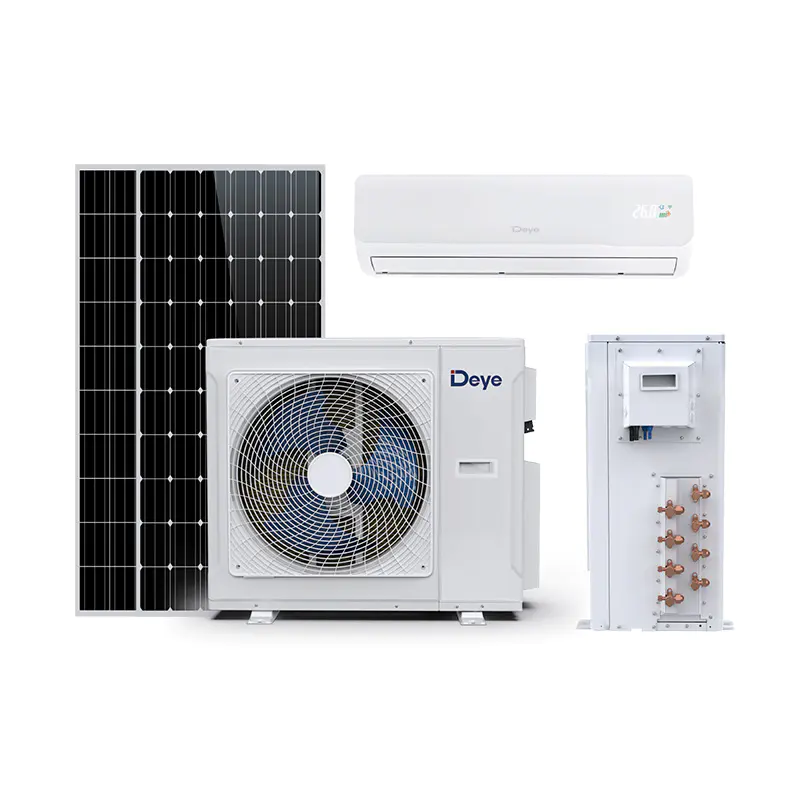
The most direct disadvantage of a solar air conditioner is its daunting "entry price." Compared to traditional units, a qualified solar air conditioner system is not just an appliance; it is a miniature power plant.
Hardware Premium
A standard solar air conditioner often utilizes more precise and expensive Brushless DC (BLDC) motors and high-performance inverter compressors. These components are specially designed to handle the fluctuations of solar current. The price of the main unit alone is typically 2 to 3 times that of a conventional inverter air conditioner.
Balance of System (BOS) Costs
Beyond the main unit, a solar air conditioner requires:
* Photovoltaic Modules: To drive a 1.5 HP unit, 4 to 8 high-power solar panels are usually required.
* Mounting and Wiring: Rooftop installation requires anti-corrosion brackets, professional DC surge protectors, and thick copper-core DC cables.
* Installation Labor: Installing a solar air conditioner requires technicians certified in both HVAC and electrical work. The labor costs for these specialists are significantly higher than standard installations.
Return on Investment (ROI) Realities
While electricity prices are rising, a complete solar air conditioner system usually takes 6 to 10 years to reach a break-even point. Considering the depreciation of electronic components and battery lifespan, many users may need to replace core parts before they have even recouped their investment.
Intermittency and Energy Storage Struggles
The performance of a solar air conditioner is heavily dictated by the weather. This uncertainty creates a sense of "usage anxiety."
Peak Misalignment
While the strongest sunlight usually coincides with the hottest temperatures, the peak demand for cooling often extends into the evening after sunset. At this time, a solar air conditioner without an expensive storage system must switch back to grid power, losing the benefit of "free cooling."
The Heavy Burden of Battery Banks
For users wanting to run a solar air conditioner completely off-grid, batteries are the biggest pain point:
* High Costs: Lithium battery costs can account for nearly 40% of the total off-grid system budget.
* Lifespan Limits: Even advanced LiFePO4 batteries degrade year by year under frequent high-power discharge cycles caused by heavy AC startup loads.
* Energy Density: Supporting a solar air conditioner for 8 hours at night requires massive physical space for batteries, which is unrealistic for small apartments or urban dwellings.
Space Requirements and Structural Limitations
Installing a solar air conditioner involves more than just hanging an indoor unit and placing an outdoor compressor. Due to the massive demand for solar panels, space becomes a core constraint.
Real Estate Scarcity on Roofs
To drive a typical 12,000 BTU solar air conditioner, a PV capacity of 1,200W to 2,000W is usually needed. This results in:
* Area Footprint: Based on current panel efficiencies, each panel is roughly 1.7 to 2 square meters. Driving one AC unit requires at least 4 to 6 large panels, occupying 8 to 12 square meters.
* Urban Dilemmas: Users in high-rise apartments or restricted residential spaces lack the sun-facing area to deploy these panels, making the solar air conditioner difficult to popularize in urbanized regions.
Structural Loads and Aesthetic Challenges
* Roof Weight: The weight of extra brackets, ballast, and PV panels puts pressure on older building structures.
* HOA and Aesthetics: In many neighborhoods with Homeowners Associations or historical protections, large-scale panel installations may be restricted due to visual impact.
Environmental Adaptation: The Irony of Heat vs. Efficiency
The solar air conditioner faces a physical paradox: the hotter the weather, the higher the cooling demand, but the lower the efficiency of the solar system.
Temperature Derating Effect
Solar panel ratings are measured at a standard 25°C. However, as the ambient temperature rises, the voltage of the PV cells drops.
* Efficiency Loss: Typical monocrystalline panels have a temperature coefficient of roughly -0.35% to -0.5% per degree Celsius.
* Actual Performance: On a scorching summer afternoon, rooftop panel temperatures can reach 65°C. Compared to standard conditions, the actual output of the solar air conditioner power source can drop by 15% to 20%.
Output efficiency reference at different temperatures:
| Ambient Temp | Estimated Panel Temp | Efficiency Retention | Actual Output (1000W Array) |
| 25°C (STC) | 25°C | 100% | 1000W |
| 35°C (Summer) | 50°C | 88% - 91% | 880W - 910W |
| 45°C (Extreme) | 70°C | 78% - 82% | 780W - 820W |
This means when you need the solar air conditioner to run at full capacity, its energy supply is actually at its weakest.
Maintenance and Long-term Operational Costs
Owning a solar air conditioner means maintaining both a cooling system and a small power plant, bringing double the maintenance concerns.
Dual System Complexity
* Inverter Lifespan: The inverter is the heart of the solar air conditioner, converting DC to AC (or vice-versa). Due to long-term heat exposure, these electronic components age faster than the compressor. While an AC might last 15 years, the inverter often needs replacement around year 10.
* Impact of Dust: Dust, bird droppings, or fallen leaves significantly reduce PV output. For users who cannot easily access their roof, hiring professionals to clean panels quarterly is a recurring expense.
Professional Repair Barriers
If a standard AC fails, any local technician can fix it. However, if the control logic or DC circuitry of a solar air conditioner fails, general repairmen may lack the expertise. This "system specificity" leads to slower response times and higher service fees.
Logic Conflicts in Hybrid Systems
For common hybrid solar air conditioner units, the internal switching logic is sometimes less smooth than advertised.
1. Conversion Losses: Despite claims of high efficiency, energy is still lost (3% to 8%) as heat during the conversion from DC to AC or during grid supplementation.
2. Switching Jitter: Cheaper hybrid controllers may flip-flop between solar and grid power frequently when clouds pass, causing voltage fluctuations that can shorten the lifespan of the compressor's magnetic components over time.
Hidden Complexity: Why After-Sales is Challenging
A solar air conditioner integrates two complex systems. This complexity buried within the machine increases maintenance risks over long-term operation.
Component Failure Risk Comparison
| Core Component | Traditional AC | Solar Air Conditioner | Potential Impact |
| Compressor | AC Compressor | BLDC DC Compressor | Higher cost; requires specific DC parts. |
| Control Logic | Simple Thermostat | Complex PV/DC Logic | If damaged, the unit cannot run on solar. |
| External Hardware | None | PV Array + Racking | Vulnerable to typhoons, hail, or debris. |
| Inverter/Converter | None | DC-DC or DC-AC Module | High heat; the most likely part to age. |
FAQ: What Users Care About Most
Q1: Can a solar air conditioner really work at night?
Answer: It depends on the system.
* Off-Grid: Requires massive battery storage to save daytime energy for night use, which adds significant cost.
* Hybrid: Automatically and seamlessly switches to grid power at night. While it works, it is no different from a standard AC at that time and does not save electricity.
Q2: Does the solar air conditioner stop if it is cloudy?
Answer: Modern units can work under low light, but power output drops sharply. On a cloudy day, the panels might not provide enough current to run the compressor at full speed. A hybrid system will pull from the grid to fill the gap, while an off-grid system might downshift frequency or shut down to protect the battery.
Q3: Why is the cooling of my solar air conditioner less stable than a standard one?
Answer: This is often because the DC compressor frequently adjusts its speed to match fluctuating solar input. When a cloud passes, the change in voltage can cause the fan or compressor to fluctuate, leading to inconsistent air temperatures.
Q4: Does installing a solar air conditioner require special permits?
Answer: Yes. Standard HVAC installers may not have experience with high-voltage DC (often over 300V). Improper installation increases the risk of DC arcing, which is a fire hazard. Always ensure the installer is certified for both solar and HVAC.
Science Literacy: Advanced Knowledge on Solar Air Conditioners
1. "More Sun" doesn't always mean "Better Performance"
Due to the negative temperature coefficient of solar panels, the hotter the panel gets, the less voltage it produces. On a 40 Celsius day, the panel surface can reach 70 Celsius, causing a 20% drop in generation efficiency compared to standard test conditions.
2. The Deception of SEER Ratings
Many solar air conditioner manufacturers advertise extremely high SEER values (e.g., SEER 35+). Be aware that these numbers often treat "free solar energy" as zero consumption. If you use the unit primarily at night on grid power, the actual efficiency may only be comparable to a standard SEER 18-20 unit.
3. DC Corrosion in Coastal Areas
In coastal regions, the external wiring of a solar air conditioner faces tougher challenges. Due to the electrolytic nature of DC current, electrochemical corrosion on terminals happens much faster in salty, humid air than in AC systems. Coastal users must check the sealing of DC junction boxes regularly.
