

 Español
 русский
 Français
 Português
 Deutsch
 عربى
 italiano


Content
- 1 Direct Question: Can Solar Air Conditioning Work Without Battery Storage?
- 2 Three Ways to Run an Air Conditioner on Solar Without Batteries
- 3 How a Hybrid ACDC Solar Air Conditioner Works Without Batteries
- 4 What Are the Real Benefits of Skipping Batteries
- 5 When Batteries Are Still the Better Choice
- 6 Sizing a Battery-Free Solar System for Your Air Conditioner
- 7 What Happens in Cloudy Weather or at Night
- 8 Is a Battery-Free Solar Air Conditioner Really More Economical
- 9 Factory Perspective: Why Manufacturers Design Battery-Free Solar Air Conditioners
- 10 Built-In Protection and Safety in Battery-Free Solar AC Systems
- 11 Installation Differences Compared with Conventional Air Conditioners
- 12 Charging the Refrigerant and Compressor Behavior Without Batteries
- 13 How to Verify Environmental Suitability for Battery-Free Solar Operation
- 14 Frequently Asked Questions
- 14.1 Can a normal air conditioner run directly from solar panels without batteries?
- 14.2 How many solar panels are needed to run a 1.5-ton solar air conditioner without batteries?
- 14.3 What happens when the sky is overcast and the solar air conditioner has no battery?
- 14.4 Does a battery-free solar air conditioner need a separate solar inverter?
- 14.5 Can I add batteries later to a battery-free solar air conditioner system?
- 14.6 Will a hybrid solar air conditioner without batteries still reduce my electricity bill at night?
- 14.7 What cooling capacity should I choose for a battery-free solar air conditioner?
Direct Question: Can Solar Air Conditioning Work Without Battery Storage?
Yes. A solar air conditioner can run without batteries if the unit is designed for direct photovoltaic supply or hybrid ACDC operation. Standard air conditioners require stable AC power, which is why most people assume battery storage is mandatory. Solar-specific air conditioners, however, use DC inverter compressors that accept fluctuating solar input and switch to grid power when sunlight is insufficient. This approach reduces upfront cost, removes battery maintenance, and still delivers meaningful electricity savings during daylight hours.
The key is not the solar panel itself, but the air conditioner's internal power architecture. A conventional mini-split needs a pure sine wave inverter and a stable voltage source. A solar-ready air conditioner, by contrast, contains a built-in MPPT controller or a hybrid AC/DC power module that prioritizes solar energy automatically. For a factory-direct manufacturer like Deye, this distinction is the core of every solar air conditioner we produce.
Three Ways to Run an Air Conditioner on Solar Without Batteries
There are three distinct technical paths for battery-free solar air conditioning. Each path suits different installation scenarios, and the right choice depends on whether you want full off-grid operation, grid backup, or maximum energy savings.
Direct DC Solar Air Conditioner
This type uses a DC compressor and accepts power directly from solar panels. The panels connect through an MPPT controller, and the air conditioner runs only when solar radiation is strong enough. When clouds pass or sunlight fades, the unit slows down or stops. This is the simplest battery-free solution for remote cabins, sheds, and daytime cooling in off-grid locations.
Hybrid ACDC Solar Air Conditioner
A hybrid unit can switch between solar DC power and grid AC power automatically. During the day, it prioritizes solar. At night or on cloudy days, it draws from the grid without interruption. This is the most practical solution for homes and businesses that need 24-hour cooling but want to minimize electricity bills.
Grid-Tied Solar with a Dedicated AC Line
This approach uses a standard air conditioner but powers it through a grid-tied solar inverter. The solar panels feed the grid, and the grid supplies the air conditioner. No battery is involved, but the air conditioner cannot run during a grid outage unless you add a hybrid inverter with off-grid capability.
For most real-world installations, the hybrid ACDC approach is the strongest fit. It delivers the highest utilization of solar energy while preserving the reliability of grid power. Direct DC units are valuable for off-grid daytime cooling, but they do not provide nighttime comfort unless paired with a different cooling strategy.
How a Hybrid ACDC Solar Air Conditioner Works Without Batteries
Understanding the internal architecture of a hybrid ACDC solar air conditioner makes the battery-free concept easy to grasp. The unit contains three key subsystems that work together automatically.
- Solar input stage: Photovoltaic panels connect directly to the air conditioner's DC input. A built-in MPPT controller extracts maximum power from the panels, even when irradiance fluctuates due to passing clouds.
- Dual-power switching logic: The control board continuously compares solar DC voltage with grid AC availability. If solar power covers the compressor demand, the unit runs entirely on PV. If solar input is insufficient, the controller blends in grid power or switches completely to AC.
- DC inverter compressor: The compressor adjusts its rotational speed to match available solar power. Instead of fixed-speed start-up peaks, the inverter compressor ramps up gradually, which reduces the sudden current draw that would otherwise collapse a battery-free solar supply.
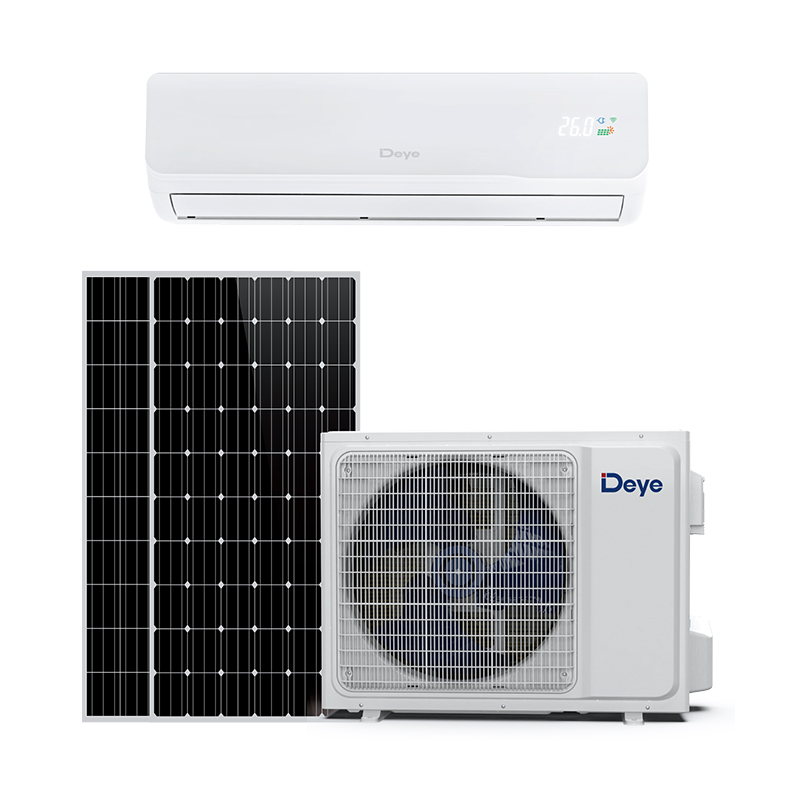
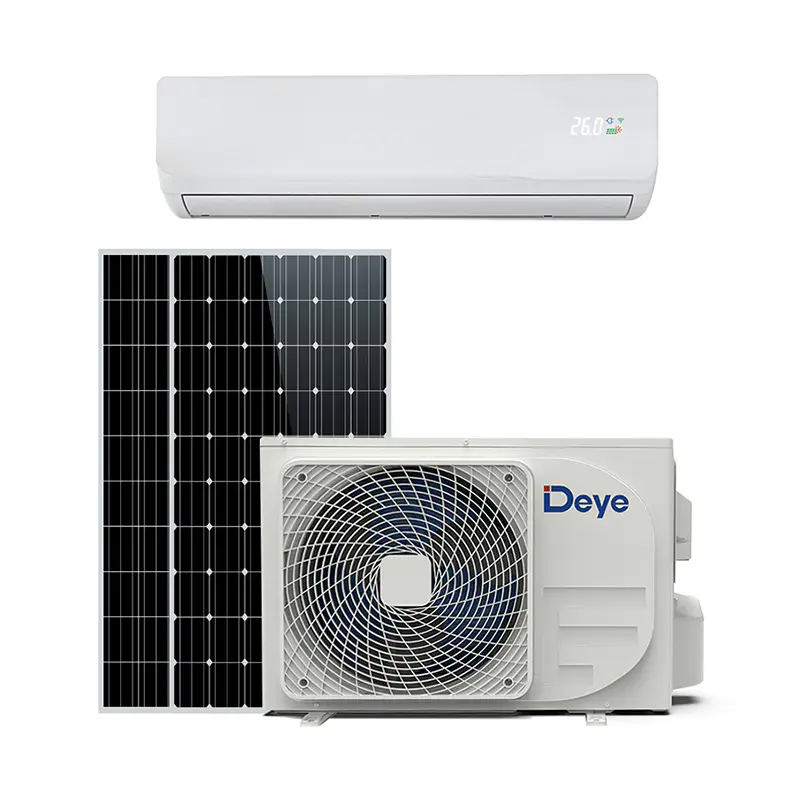
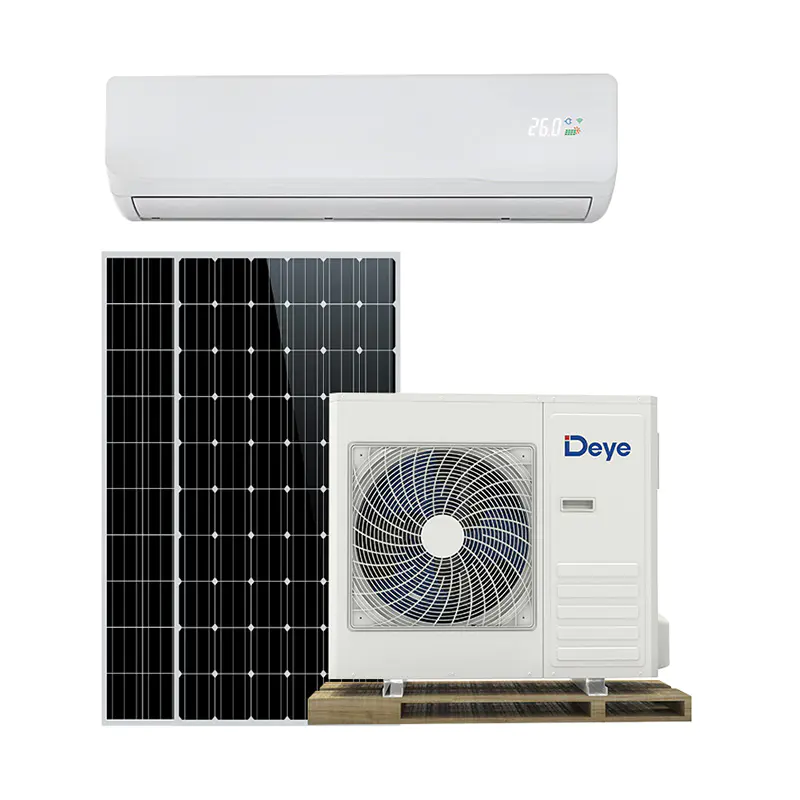
This architecture matters because an ordinary inverter air conditioner cannot handle the voltage variations of a solar array. A solar-specific hybrid unit, such as a Deye wall-mounted hybrid ACDC solar air conditioner, is engineered from the start to accept wide DC voltage ranges and prioritize solar consumption before touching grid power.
What Are the Real Benefits of Skipping Batteries
Battery storage is often the most expensive and shortest-lived component in a solar cooling system. Removing it changes the cost structure, maintenance schedule, and operational logic of the entire installation.
Lower Initial Investment
A battery bank adds 40 to 60 percent to the total system cost. Without batteries, the same budget buys more solar panels or a higher-capacity air conditioner, which often results in better overall cooling performance.
No Battery Degradation Concerns
Lead-acid batteries require replacement every 3 to 5 years. Lithium batteries last longer but still lose capacity over time. A battery-free solar air conditioner eliminates this recurring expense entirely.
Simpler Installation and Maintenance
Without batteries, the system has fewer high-current cables, no battery ventilation requirements, and no battery management system to configure. Installation time can drop by half compared with a battery-backed solar setup.
Higher Efficiency During Daylight Hours
Batteries introduce conversion losses in both charging and discharging cycles. Direct solar-to-compressor power avoids those losses, so more of the harvested sunlight reaches the cooling process.
These benefits are strongest for businesses and homes that use air conditioning mainly during the day, such as offices, retail shops, warehouses, and factories. If your cooling load peaks when the sun is high, a battery-free solar air conditioner is the most rational investment.
When Batteries Are Still the Better Choice
A battery-free system is not the universal answer. There are situations where adding battery storage improves the overall value of a solar air conditioning installation.
| Use Case | Battery-Free Solar AC | Solar AC with Battery |
|---|---|---|
| Daytime office or retail cooling | Best fit, lowest cost | Possible but unnecessary |
| Nighttime hotel or residential cooling | Runs on grid at night | Can run on stored solar |
| Frequent grid outages | Stops when grid fails | Continues during outages |
| Remote off-grid installation | Works only in sunlight | Provides 24-hour cooling |
| High electricity tariffs at night | Pays night grid rates | Shifts solar energy to night |
If your region experiences frequent power interruptions, or if you need cooling through the night without drawing grid power, battery storage earns its cost. For everyone else, a hybrid ACDC solar air conditioner without batteries offers the fastest return on investment.
Sizing a Battery-Free Solar System for Your Air Conditioner
Proper panel sizing is the difference between a solar air conditioner that performs well and one that struggles on marginally sunny days. The calculation involves three variables: compressor power consumption, solar irradiance in your location, and the air conditioner's solar input efficiency.
Step 1: Determine the Air Conditioner's Power Consumption
Check the rated cooling power and the maximum input power of the unit. For example, a 1.5-ton hybrid ACDC solar air conditioner may consume 900 to 1,200 watts of electrical power during peak cooling. The solar array must be capable of producing enough power to cover the unit's consumption during the hottest hours of the day.
Step 2: Calculate Panel Output Based on Peak Sun Hours
Peak sun hours vary by region. A location with 5 peak sun hours gets the equivalent of 5 hours of full 1,000 W/m² irradiance per day. A 1,000-watt solar array in that location would produce roughly 5 kWh per day under ideal conditions. Since the air conditioner runs primarily during daylight hours, the daily solar generation is directly available to the compressor.
| AC Capacity | Average Power Draw | 4 Peak Sun Hours | 5 Peak Sun Hours | 6 Peak Sun Hours |
|---|---|---|---|---|
| 9,000 BTU (0.75 ton) | 700 W | 2,000 W array | 1,700 W array | 1,400 W array |
| 12,000 BTU (1.0 ton) | 900 W | 2,700 W array | 2,200 W array | 1,800 W array |
| 18,000 BTU (1.5 ton) | 1,300 W | 3,900 W array | 3,200 W array | 2,600 W array |
| 24,000 BTU (2.0 ton) | 1,700 W | 5,100 W array | 4,200 W array | 3,400 W array |
Step 3: Account for Real-World Losses
Dust on panels, high ambient temperature, and wiring resistance all reduce output. Add a 20 percent safety margin to the calculated array size. If the theoretical requirement is 2,500 watts, install at least 3,000 watts of panels. This buffer also helps the air conditioner keep running through brief cloud cover.
What Happens in Cloudy Weather or at Night
This is the most common question from buyers evaluating a battery-free solar air conditioner. The answer depends entirely on whether the unit is a pure DC model or a hybrid ACDC model.
A pure DC solar air conditioner without batteries has no fallback. When solar radiation drops below the threshold required by the compressor, the unit reduces speed and eventually stops. This behavior is acceptable for daytime-only cooling in sunny climates, but it is frustrating in regions with frequent cloud cover.
A hybrid ACDC model automatically switches to grid power when solar input is insufficient. The transition is seamless because the power module continuously monitors the DC bus voltage. During the night, the unit operates as a standard high-efficiency inverter air conditioner. During the day, it prioritizes solar energy and pulls only the shortfall from the grid. This is the configuration we recommend for most residential and commercial installations because it never sacrifices comfort.
Is a Battery-Free Solar Air Conditioner Really More Economical
The economics of a battery-free solar air conditioner are straightforward when you separate the solar generation cost from the cooling equipment cost. The air conditioner itself is often priced higher than a conventional inverter unit because of the integrated MPPT controller and hybrid power module. That premium is usually offset by not having to purchase a separate solar inverter, battery bank, and charge controller.
| Component | Hybrid Solar AC Without Battery | Conventional AC + Battery System |
|---|---|---|
| Air conditioner | Higher purchase price | Standard inverter model |
| Solar inverter | Built into the AC | Separate 1-5 kW hybrid inverter |
| Battery bank | Not required | Lead-acid or lithium |
| Charge controller | Built into the AC | Separate MPPT controller |
| Installation complexity | Low, fewer connections | High, more components |
| Ongoing battery replacement | None | Every 3-8 years |
In regions with high electricity prices and strong solar irradiance, a battery-free hybrid solar air conditioner typically pays back its price premium within 2 to 4 years through reduced grid consumption. After that, every sunny day translates directly into operational savings.
Factory Perspective: Why Manufacturers Design Battery-Free Solar Air Conditioners
As a manufacturer of solar air conditioners, we see the battery-free design as a response to a specific market problem. Many remote regions have no reliable grid connection but receive abundant sunlight. Installing a battery bank in these areas adds logistical cost and creates a maintenance burden that most users cannot sustain. A direct DC air conditioner eliminates that dependency and provides cooling exactly when the sun is strongest.
In urban and suburban markets, the battery-free hybrid design addresses a different problem: electricity tariffs that spike during hot afternoons. Businesses running warehouses, workshops, and offices want to cut their peak-hour consumption without making a major investment in energy storage. A hybrid ACDC solar air conditioner shifts a large share of the daytime cooling load to solar panels while keeping grid backup for extreme heat events and evening operation.
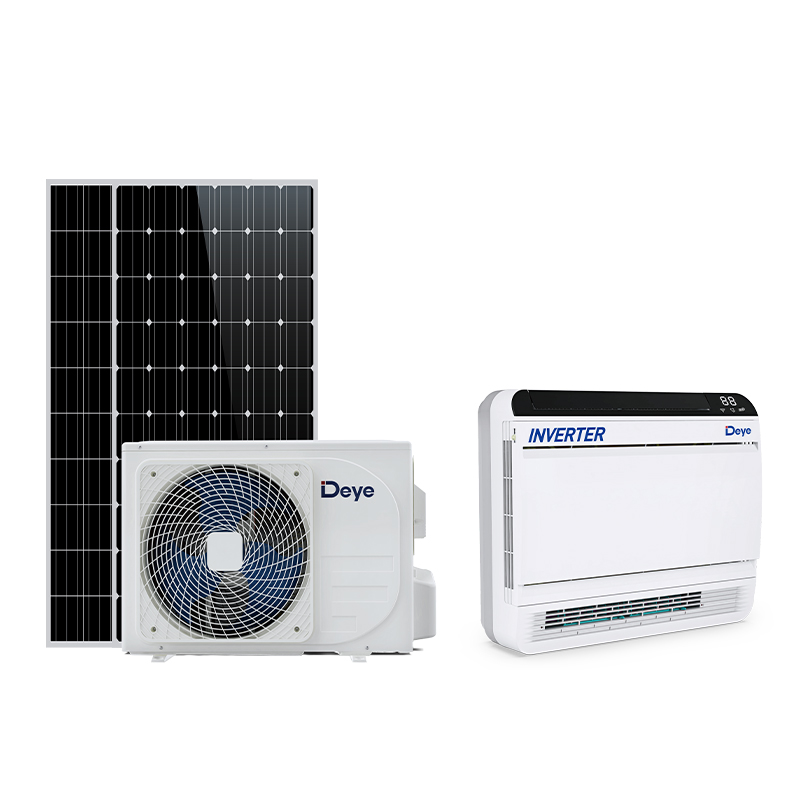
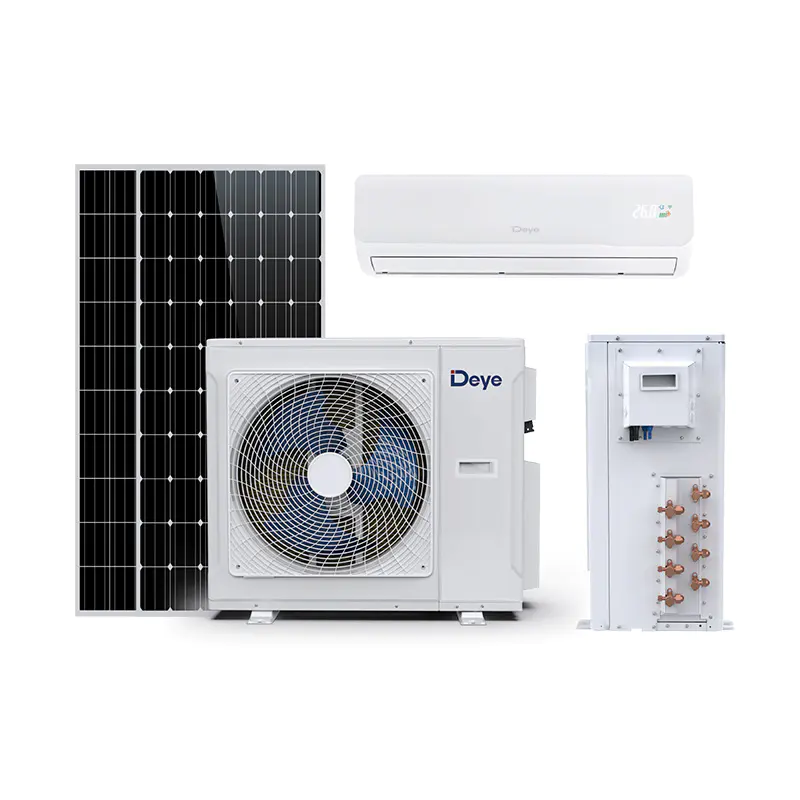
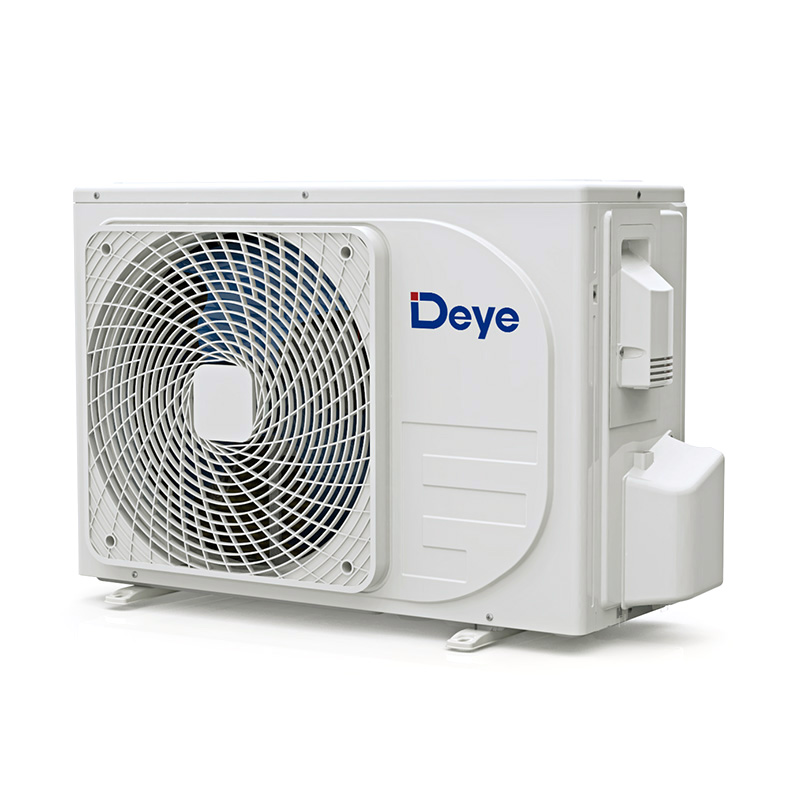 Deye Hybrid ACDC Solar Air Conditioner for Peak-Hour SavingsThis wall-mounted split unit uses solar power with built-in MPPT inverter, cutting grid reliance during peak tariffs, while its battery-free design demands robust internal protection.View Product →
Built-In Protection and Safety in Battery-Free Solar AC Systems
Removing batteries changes the safety architecture of a solar cooling system. In a conventional battery-backed system, the battery bank acts as a buffer that absorbs voltage spikes and smooths out power fluctuations. A battery-free system must handle those same fluctuations inside the air conditioner itself. This requires several protective mechanisms that standard air conditioners do not include.
- MPPT voltage clamping: The built-in charge controller limits the DC input voltage so that open-circuit panel voltage never exceeds the safe range for the compressor driver.
- Overcurrent shutdown: If a solar panel is short-circuited or partially damaged, the air conditioner detects the abnormal current and shuts off the solar input stage instead of drawing from the grid to compensate.
- Auto-restart after recovery: When solar radiation returns to a usable level, the controller resumes compressor operation with a soft start that prevents mechanical stress.
- Reverse polarity detection: DC solar wiring errors are common in field installations. Properly designed solar air conditioners detect reversed polarity and prevent damage to the controller board.
- Surge protection on the grid side: For hybrid units, a metal oxide varistor (MOV) on the AC input protects the power module from lightning-induced surges and grid switching transients.
These protections are standard in Deye solar air conditioners because factory-direct manufacturing allows us to integrate the power electronics and compressor protection into a single control board. Buyers should verify that any battery-free solar air conditioner they evaluate includes at least the first three protections listed above.
Installation Differences Compared with Conventional Air Conditioners
Installing a battery-free solar air conditioner is simpler than a battery-backed system but still differs from a standard mini-split installation. Understanding these differences helps avoid common field errors.
Mounting the Solar Panels
Panels must face the correct direction for your hemisphere and have an unobstructed view of the sun during peak cooling hours. A south-facing array in the northern hemisphere, or a north-facing array in the southern hemisphere, produces the most consistent daytime output.
Running DC Cables
Solar DC cables must be sized correctly to minimize voltage drop. For a 24 V or 48 V PV array located more than 20 meters from the air conditioner, thicker copper conductors are necessary. Undersized cables cause voltage drop that can trigger low-voltage shutdown on the MPPT controller.
Connecting Grid Power at the Indoor Unit
Hybrid ACDC units require a standard mains connection at the indoor or outdoor unit, depending on the model. The grid power serves as backup and powers the unit at night. This connection must be handled by a licensed electrician and must include proper earthing and circuit protection.
Programming the Operating Mode
Most hybrid solar air conditioners offer a solar-priority mode, a grid-priority mode, and an auto-balance mode. For maximum savings, solar-priority mode is the correct choice. The unit then uses grid power only when solar input is no longer sufficient to drive the compressor.
Charging the Refrigerant and Compressor Behavior Without Batteries
One technical aspect that surprises many installers is how a battery-free solar air conditioner handles the refrigeration cycle when solar intensity varies. In a standard AC unit, the compressor runs at a fixed speed or adjusts only according to indoor temperature. In a direct solar unit, the compressor also responds to available solar power.
When solar irradiance drops suddenly, the MPPT controller senses the reduced power availability and commands the compressor to slow down. This reduces the refrigerant flow rate, which lowers cooling capacity but keeps the system running. When irradiance rises again, the compressor speeds up. This behavior means the indoor temperature may fluctuate more than it would with a grid-fed unit on a partly cloudy day. The effect is minimal with hybrid units because grid power fills the gap instantly.
It is also important to use the correct refrigerant and charge amount. A solar air conditioner with a DC inverter compressor is more sensitive to overcharging than a fixed-speed unit. Factory-charged systems should not be modified in the field unless the technician follows the exact charge chart for the model. Our R410A and R32 based solar air conditioners ship with pre-charged sealed circuits for this reason.
How to Verify Environmental Suitability for Battery-Free Solar Operation
Not every building is a good candidate for a battery-free solar air conditioner. Evaluating your site conditions before purchase prevents disappointment and poor performance.
| Condition | Favorable for Battery-Free Solar AC | Unfavorable for Battery-Free Solar AC |
|---|---|---|
| Average peak sun hours | More than 4.5 hours per day | Less than 3.5 hours per day |
| Cooling load timing | Concentrated between 10:00 and 16:00 | Evening and nighttime dominance |
| Roof space | At least 15-25 m² available | Shaded or very limited roof area |
| Grid reliability | Stable grid, high tariffs | Frequent outages requiring backup |
| Budget for energy storage | Not available | Available and intended for resilience |
If your site matches the favorable column on at least three of these criteria, a battery-free solar air conditioner is a strong technical fit. If the unfavorable column dominates, consider either a battery-backed system or a hybrid unit that can still deliver value by reducing daytime grid consumption.
Frequently Asked Questions
Can a normal air conditioner run directly from solar panels without batteries?
A conventional air conditioner cannot run directly from solar panels because it requires a stable AC voltage and frequency. Without batteries, the solar array voltage fluctuates with irradiance, which causes the compressor to stall or the protection circuit to trip. A solar-specific DC air conditioner or a hybrid ACDC air conditioner is required for battery-free operation.
How many solar panels are needed to run a 1.5-ton solar air conditioner without batteries?
A 1.5-ton hybrid ACDC solar air conditioner typically consumes 1,200 to 1,400 watts under peak load. Using 550 W solar panels, you would need approximately 6 panels, which provides roughly a 3,300 W array. This covers the air conditioner demand with a 20 percent safety margin and still leaves some capacity for cloudy periods.
What happens when the sky is overcast and the solar air conditioner has no battery?
A pure DC unit will reduce cooling output or stop until sunlight strengthens. A hybrid ACDC unit automatically switches to grid power, so the room continues cooling without interruption. The hybrid configuration is strongly recommended for installations where comfort cannot be compromised.
Does a battery-free solar air conditioner need a separate solar inverter?
No. The MPPT controller and DC-to-DC conversion are built into the air conditioner's outdoor unit. You connect solar panels directly to the air conditioner using the DC input terminals. This eliminates the separate solar inverter and simplifies installation compared with conventional solar systems.
Can I add batteries later to a battery-free solar air conditioner system?
That depends on the model. Most hybrid ACDC units have a DC bus that can accept an external battery through a compatible charge controller, but this modification requires additional hardware and configuration. If you expect to add batteries later, choose a model that explicitly supports external battery connection or select a hybrid inverter-based system from the start.
Will a hybrid solar air conditioner without batteries still reduce my electricity bill at night?
At night, the unit operates as a standard grid-powered inverter air conditioner. It will not reduce your night-time electricity consumption because there is no stored solar energy. The bill reduction occurs during daylight hours, when the unit prioritizes solar power and minimizes grid draw. If your tariff is significantly higher during the day, this is still a valuable saving.
What cooling capacity should I choose for a battery-free solar air conditioner?
Choose the same capacity you would select for a conventional air conditioner based on room area and insulation. A 9,000 BTU unit covers rooms up to 20-25 m², a 12,000 BTU unit covers 25-35 m², and an 18,000 BTU unit covers 35-50 m², assuming normal ceiling height and reasonable insulation. Oversizing does not improve solar compatibility and increases the panel requirement.
