

 Español
 русский
 Français
 Português
 Deutsch
 عربى
 italiano


Content
- 1 DC inverter vs hybrid AC/DC solar air conditioners: the direct answer
- 2 Where the energy goes in a solar air conditioner
- 3 Architecture comparison: what changes in real operation
- 4 Solar offset depends on load match, not brochure numbers
- 5 Selection rules that change the energy answer
- 6 What to verify before you compare savings
- 7 Application scenarios: where each option makes sense
- 8 Installation details that decide measured savings
- 9 A simple payback model you can run before buying
- 10 FAQ: DC inverter and hybrid AC/DC solar air conditioners
- 10.1 Is a DC inverter AC the same as a hybrid AC/DC solar AC?
- 10.2 Which one saves more energy in a hot climate?
- 10.3 Can a hybrid solar air conditioner run at night?
- 10.4 Do I need a battery to use a hybrid AC/DC solar air conditioner?
- 10.5 What size solar array does a hybrid solar AC need?
- 10.6 Does a higher COP always mean lower annual energy use?
- 10.7 What is the biggest mistake when comparing these systems?
DC inverter vs hybrid AC/DC solar air conditioners: the direct answer
For a solar-ready home, shop, clinic, or small office with a daytime cooling load, a hybrid AC/DC solar air conditioner usually saves more grid energy than a DC inverter AC of the same cooling capacity. The hybrid unit can use DC power from PV before or alongside mains, while the DC inverter AC saves energy mainly by modulating the compressor instead of switching on and off.
The conclusion changes when there is no PV, no daytime load, or no plan to use solar DC. In that case, a DC inverter AC can be the lower-energy choice because the solar hardware is not doing useful work, and the hybrid premium may never be recovered. The comparison is therefore not a simple win for one architecture. It is a question of how much solar energy can be used at the moment cooling is needed.
Three product types are often mixed together in this discussion:
- DC inverter AC: an air conditioner with a variable-speed DC compressor and an AC mains input. Its efficiency advantage comes from part-load control, not from direct solar input.
- Hybrid AC/DC solar AC: an air conditioner that accepts both AC mains and DC solar input, with automatic switching or blending. It can reduce grid draw when PV is available.
- Off-grid DC solar AC: a direct DC unit designed for battery or solar-only systems. It is not the same as a hybrid unit and should be compared only when the site has no reliable grid.
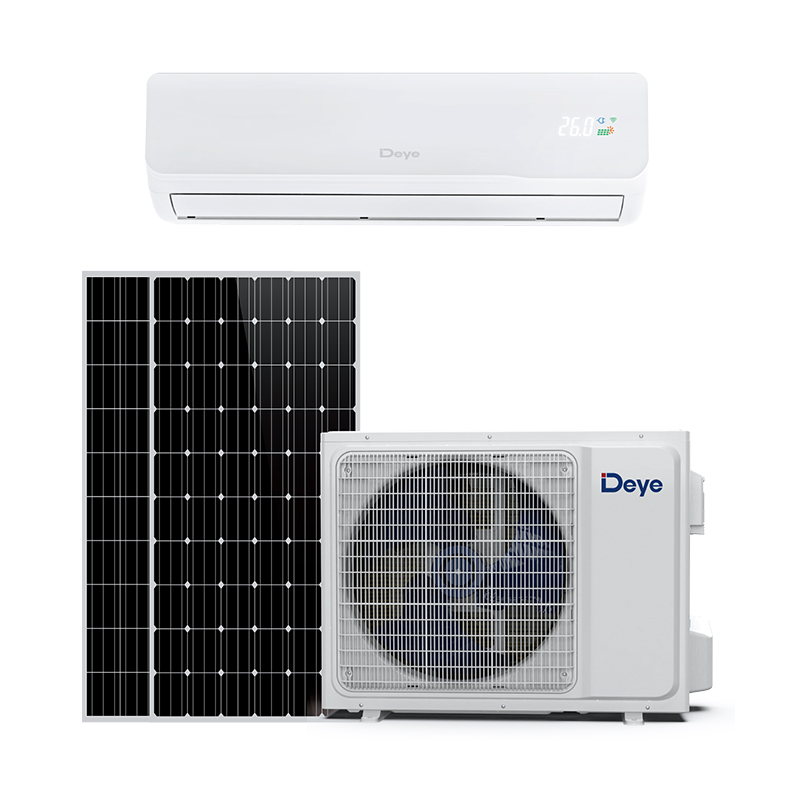
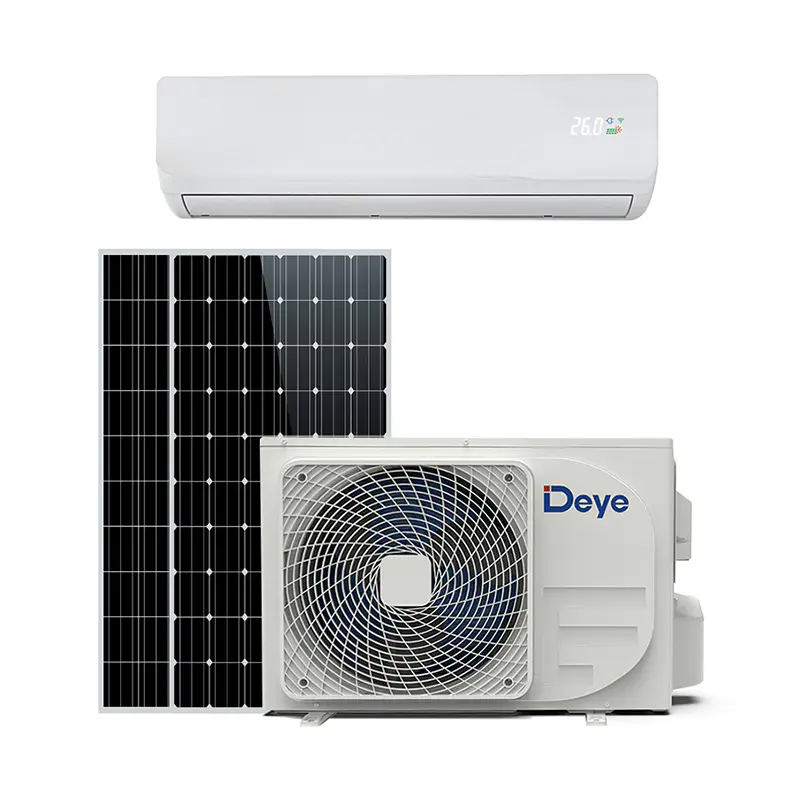
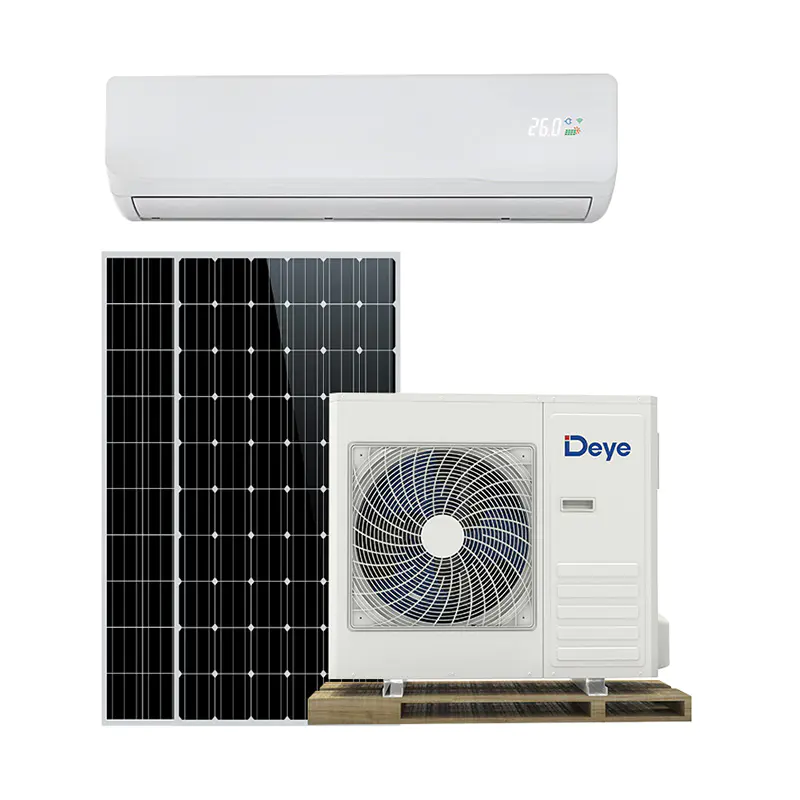
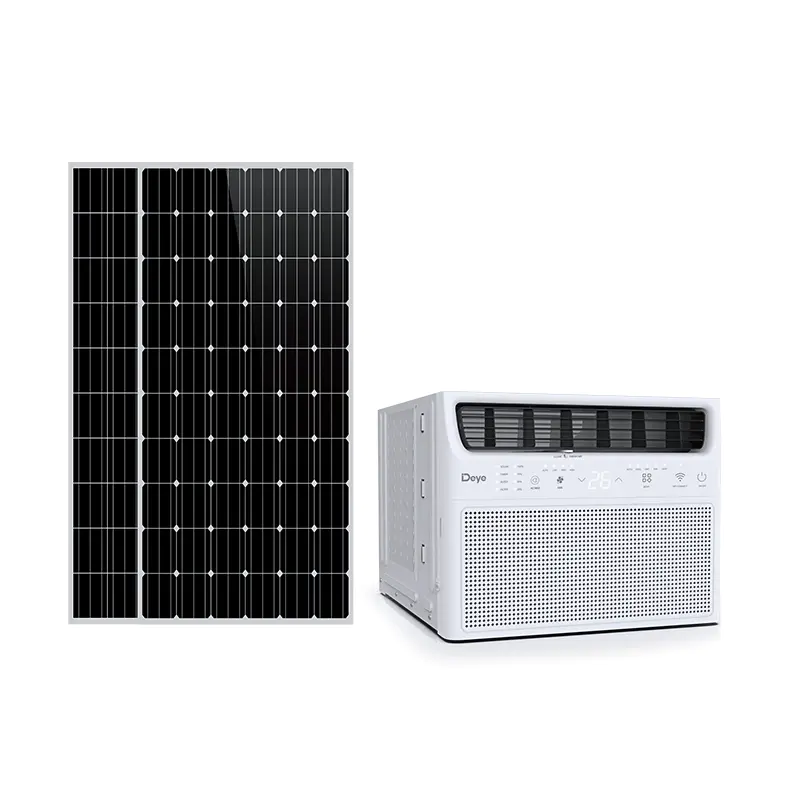
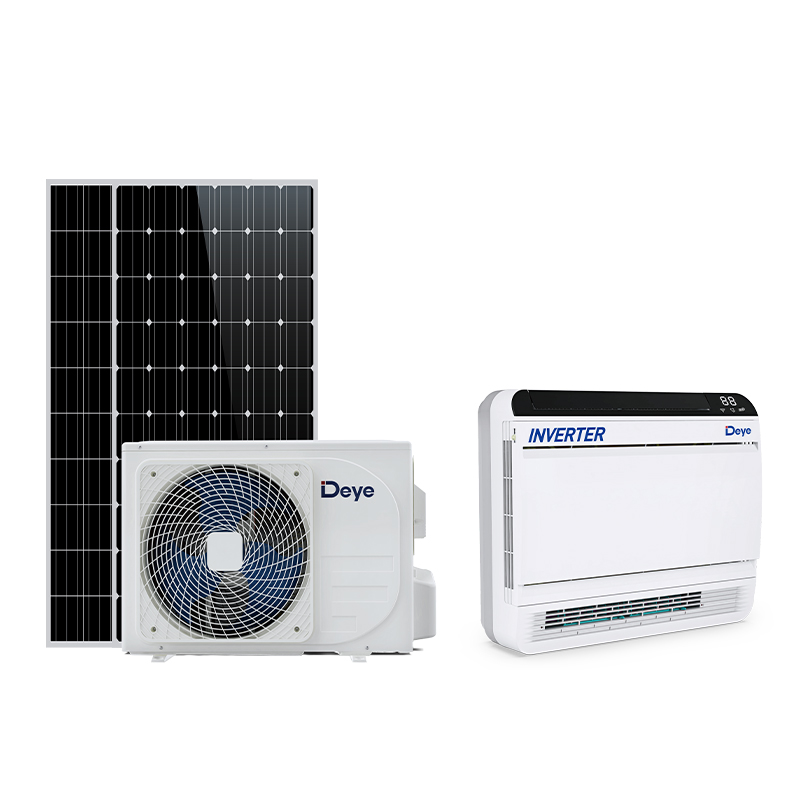
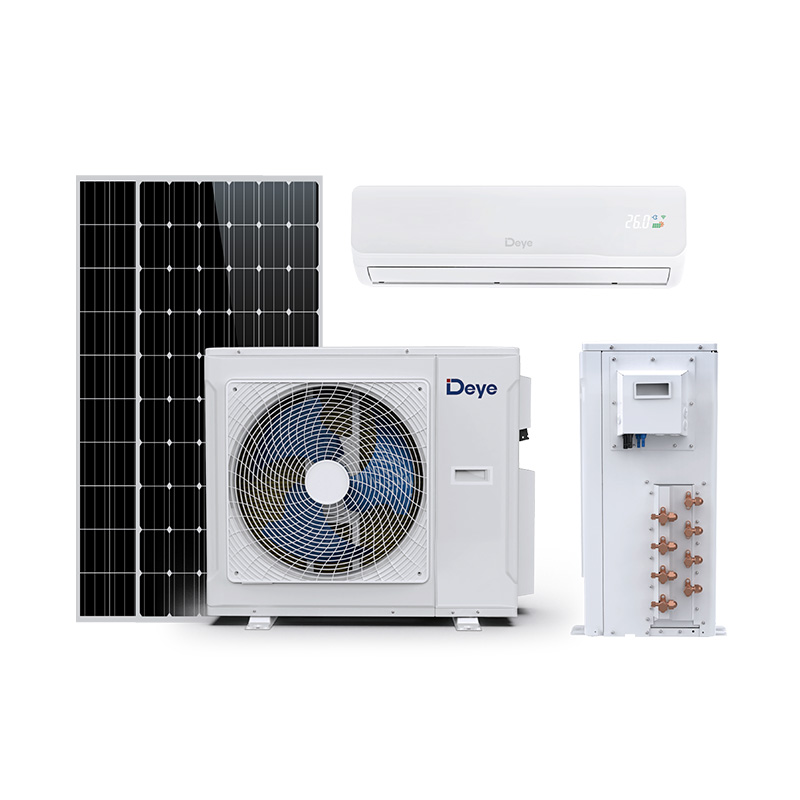
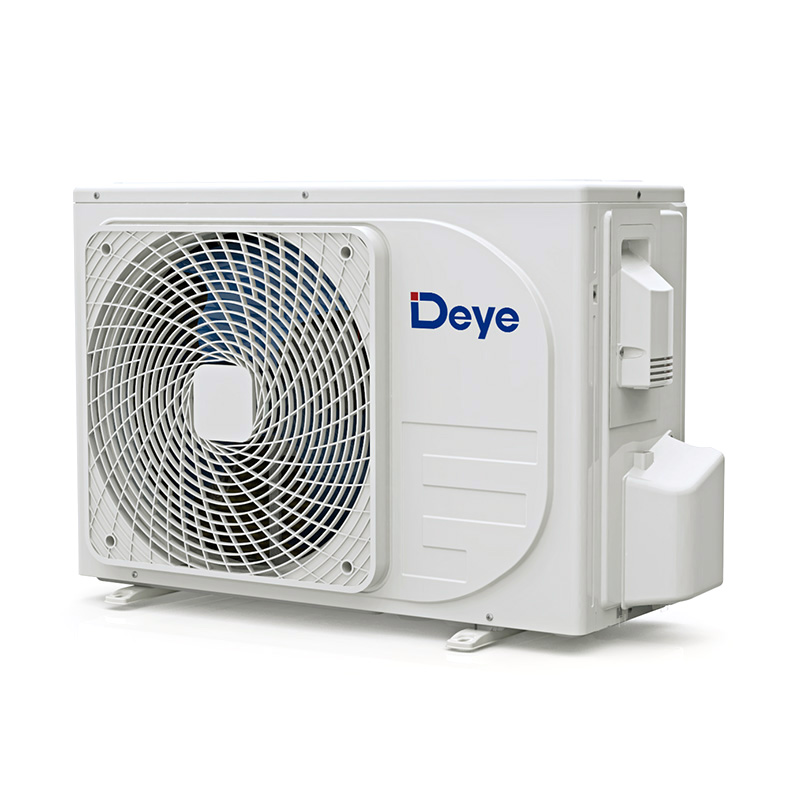 Hybrid AC/DC Wall-Mounted Solar Air ConditionerA wall-mounted split unit combining solar and grid power with built-in MPPT and inverter, relevant when comparing solar-hour efficiency against DC inverter AC.View Product →
The practical question is not “which label sounds more efficient?” It is “how many hours per day can the unit use solar DC, and what happens to efficiency when the sun drops?” A hybrid AC/DC unit with a good inverter and a well-matched PV array will usually beat a DC inverter AC on grid energy during solar hours. A DC inverter AC with a poor load match, long duct runs, or oversized capacity can lose much of its theoretical advantage.
Where DC inverter wins
Stable grid, no PV, moderate part-load operation, and a limited budget for solar hardware. The savings come from compressor modulation and better temperature control.
Where hybrid AC/DC wins
Daytime cooling demand, available roof or ground space for PV, and a load profile that overlaps with solar production. The savings come from direct solar DC use.
Where off-grid DC wins
Remote sites with no reliable grid, battery storage, and a design that accepts direct DC input. This is a different design problem from grid-tied hybrid cooling.
Where the energy goes in a solar air conditioner
Cooling energy is not decided by the compressor alone. The unit must move heat from the room, reject it outdoors, move air across the indoor coil, and control the entire process. The main losses sit in compressor part-load operation, fan power, refrigerant pressure drop, inverter conversion, standby power, and duct or pipe resistance. A hybrid AC/DC solar AC adds one more variable: how much solar DC is available and how cleanly it can be blended with mains.
The illustration below uses a 3.5 kW cooling class unit over an eight-hour daytime period. It is not a product rating and not a promise of savings. It shows why the comparison depends on solar availability, load profile, and control logic rather than a single efficiency label.
Illustrative grid-energy index for the same cooling output and weather. Actual results depend on PV size, solar irradiance, compressor control, refrigerant, fan settings, and building load.
A DC inverter AC earns its savings by running the compressor at partial speed for longer periods. That reduces on/off cycling, improves temperature stability, and often lowers average input power. A hybrid AC/DC solar AC can use the same inverter control, but it also has a second energy path. When PV output is high, the unit can draw less from the grid. When PV output falls, it can return to mains or blend both sources. The energy advantage therefore depends on the solar fraction during operating hours.
Off-grid DC solar air conditioners should not be judged by the same chart. They are designed around battery voltage, DC input range, and standalone operation. If the site has no grid, the comparison is not “hybrid versus inverter” but “DC solar with storage versus generator or no cooling.” That is a different purchase decision with different risks.
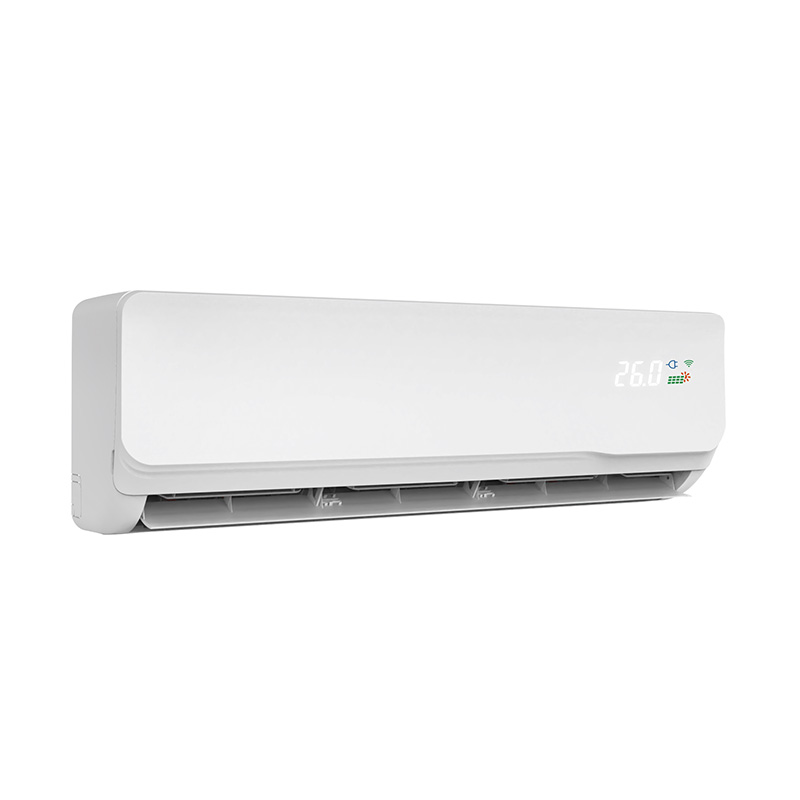 Off-Grid 48V DC Solar Air ConditionerA wall-mounted 48V DC off-grid unit using solar and battery storage for cooling and heating, relevant for remote sites where grid power is unavailable.View Product →
One detail matters in every architecture: standby power. A unit that draws 30 W when idle for 14 hours per day consumes about 0.42 kWh per day before it cools a single room. Over a long season, that is enough to change a payback estimate. Check standby consumption, fan-only power, and whether the control board can fully shut down the solar input path when the unit is off.
Architecture comparison: what changes in real operation
The table below compares a grid-tied DC inverter AC with a hybrid AC/DC solar air conditioner. It assumes both units have variable-speed compressors and are sized for the same room. The point is not to rank every model, but to show which design choices create energy savings and which create new risks.
| Feature | DC inverter AC | Hybrid AC/DC solar AC | What it means for energy use |
|---|---|---|---|
| Power input | AC mains only | AC mains plus DC solar input | The hybrid can reduce grid draw during solar hours. |
| Compressor control | Variable-speed DC inverter | Variable-speed DC inverter in most designs | Both can avoid fixed-speed cycling; the hybrid adds a solar source. |
| Solar contribution | None directly; PV must be converted to AC first | Direct DC solar input, often with automatic blending | Direct DC use can avoid one conversion step, but only when PV is available. |
| Grid dependence | Always dependent on mains | Can run on solar, mains, or a blend, depending on design | Hybrid is more resilient but not necessarily cheaper without solar. |
| Best fit | Stable grid, no PV, or a building with no daytime load | Solar-ready buildings with daytime cooling demand | Load match decides whether the hybrid premium is recovered. |
| Main risk | Paying for inverter efficiency but oversizing the unit | Oversizing PV or buying a hybrid without usable solar hours | Both risks erode savings more than the compressor label suggests. |
The key point is that a hybrid unit does not replace good inverter control. It adds a second energy source. If the compressor, fan, and control logic are poor, solar input only masks part of the loss. If the inverter is strong but the PV array is shaded or badly oriented, the hybrid cannot deliver its main advantage. The best result comes from matching three things: cooling capacity, solar availability, and operating hours.
For a more detailed explanation of how hybrid AC/DC switching works, the industry note on hybrid AC/DC operation for solar air conditioners is useful as background. The main takeaway is simple: automatic switching must be fast enough to avoid compressor interruption, and the control logic must protect the compressor when solar voltage fluctuates.
Solar offset depends on load match, not brochure numbers
A hybrid AC/DC solar air conditioner saves the most energy when the cooling load and solar production overlap. In a home, that often means midday and early afternoon. In a shop, it may mean the entire opening period. In an office, it may be strongest from late morning to late afternoon. In a bedroom used mainly at night, the solar fraction can be low unless battery storage is included.
Illustrative load-match chart. Dark bars represent cooling load; lighter bars represent relative solar production. Evening cooling usually relies on mains or storage.
This is why two buildings with the same air conditioner can report very different savings. A house that runs cooling from 9:00 to 17:00 may use a high solar fraction. A house that runs cooling mainly after sunset may see almost no direct solar benefit. A shop with a glass front and high afternoon load may use more solar energy than a well-insulated office, but it may also need a larger PV array to cover the load.
Use a simple solar-fraction estimate before comparing products. Start with the average daytime compressor input, not the rated cooling capacity. Multiply by operating hours to get daily grid energy without solar. Then estimate how much of that energy can be replaced by PV during the same hours. A conservative design usually assumes that only 30% to 60% of daytime cooling energy can be shifted without storage, depending on climate, schedule, and array size. Higher fractions are possible, but they need measured solar data and a load profile.
A hybrid AC/DC unit without a battery can still save energy at night if it uses mains efficiently, but the solar benefit after sunset is zero. That is not a fault; it is a design boundary. If evening cooling is the main load, compare the hybrid with a DC inverter AC plus a separate PV system, or include battery storage in the design. Do not assume that “hybrid” means “all-day solar.”
Selection rules that change the energy answer
Match capacity to the room, not to the label
An oversized inverter unit may short-cycle at low load, which reduces efficiency and humidity control. An undersized unit runs at high speed for long periods, which raises energy use and shortens compressor life. Use a room-by-room heat-load estimate that includes window area, insulation, occupancy, lighting, and local design temperature. For a quick check, compare the sensible and latent load, not only the floor area. Two rooms with the same square meters can differ by 30% or more when glazing and orientation change.
Check the solar input window and MPPT range
The solar input voltage range and maximum power point tracking window decide how many panels can be connected and how well the unit performs under partial shade. A wide input window gives more design freedom, but it does not guarantee high efficiency. Ask for the startup voltage, minimum operating voltage, maximum DC current, and behavior when solar voltage drops below the threshold. The changeover should be automatic and should not cause repeated compressor starts.
Look at part-load efficiency, not only rated COP
Rated COP at one condition does not describe a variable-speed unit over a season. Ask for part-load performance, inverter efficiency, fan power at low speed, and standby power. A unit with a high rated COP but poor low-load control can use more energy than a slightly lower-rated unit that modulates smoothly. If the manufacturer publishes only a single COP number, treat the comparison as incomplete.
Plan for low ambient and refrigerant choice
Low-ambient cooling and heating operation change compressor speed, defrost behavior, and control limits. R32, R410A, and R290 systems have different charge, pressure, and safety requirements. Refrigerant choice does not by itself decide energy use, but it affects system design, serviceability, and compliance in the destination market. For cold climates, confirm the operating range and defrost logic before comparing savings.
For shops, clinics, and small offices with ducted distribution, a light commercial solar AC duct type can use the same hybrid logic while serving multiple rooms. The design should account for static pressure, duct leakage, and zoning. A duct system with 10% leakage can waste more energy than the difference between two inverter control strategies.
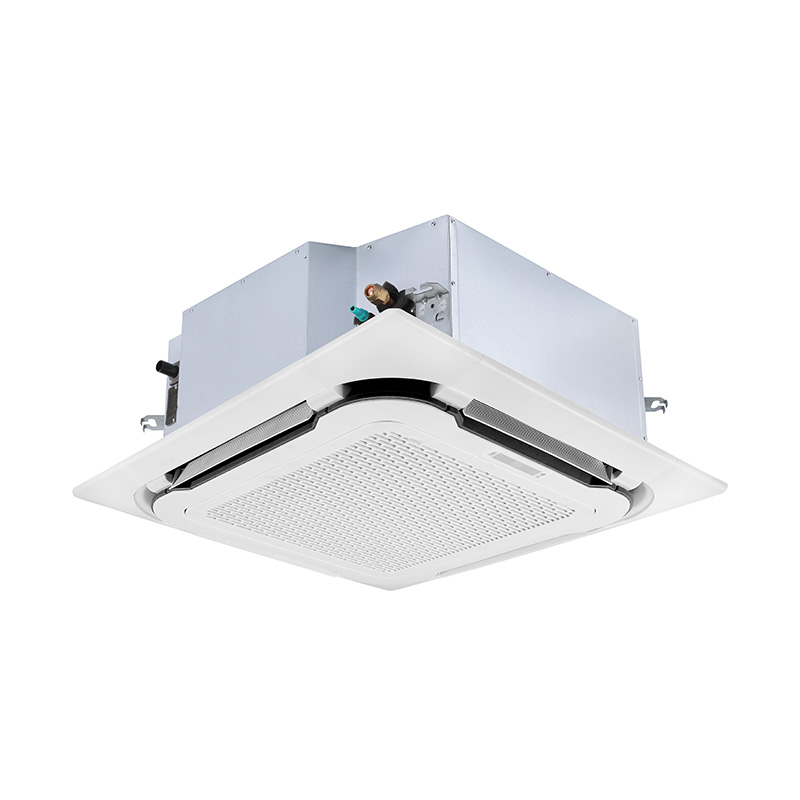
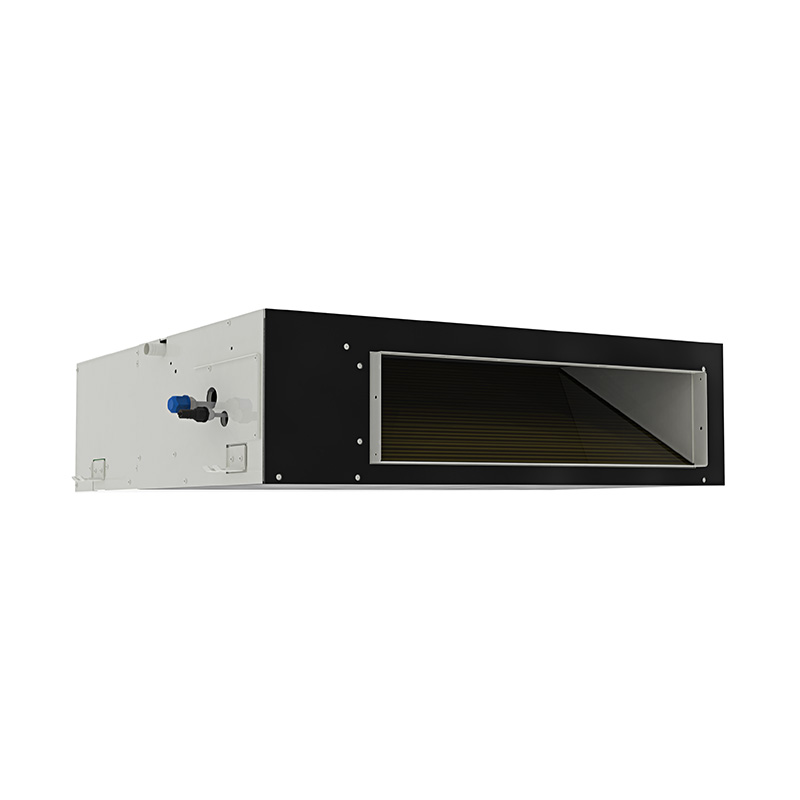 Light Commercial Ducted Hybrid Solar Air ConditionerA ducted hybrid solar/grid unit with DC inverter and MPPT, suited to concealed installation in shops and offices where duct distribution efficiency matters.View Product →
For any light commercial project, compare the full distribution efficiency, not only the outdoor unit. A cassette or ducted indoor unit with a poor air path may need a higher fan speed, which raises power use and can offset solar gains. The best hybrid design is the one that delivers the required cooling at the lowest fan and compressor power during the hours when solar is available.
What to verify before you compare savings
A fair comparison needs the same test boundary. Ask for the cooling capacity, input power, EER or COP, and operating conditions. Then check whether the numbers include fan power, standby power, and solar conversion losses. A hybrid unit that reports only compressor efficiency can look better than it is in real operation.
- Test conditions: confirm indoor and outdoor dry-bulb and wet-bulb temperatures. A COP quoted at a mild condition cannot be compared with one quoted at a hot design condition.
- Solar path efficiency: ask for DC input range, MPPT accuracy, and changeover behavior. A wide voltage window is useful only if the control logic is stable.
- Standby and fan power: check idle consumption and low-speed fan power. These small loads run for many hours and can change annual energy use.
- Compressor protection: confirm minimum run time, restart delay, and low-voltage protection. Frequent starts reduce reliability and efficiency.
- Refrigerant and service: verify the refrigerant, charge tolerance, and service access. A unit that is difficult to service may lose performance over time.
- Factory evidence: request test reports, calibration records, and production consistency data. The manufacturing background behind the inverter control matters as much as the product label. Deye’s solar HVAC manufacturing background is one example of how inverter and solar experience can be traced through the product line.
Use a simple risk matrix. If the site has a stable grid and no PV, the main risk is oversizing and poor part-load control. If the site has PV, the main risk is a solar array that does not match the cooling schedule. If the site is remote, the main risk is battery depth of discharge and low-voltage shutdown. Each risk changes the expected savings more than a small difference in rated efficiency.
Risk: solar array too small
The hybrid unit spends most of its time on mains, so the hybrid premium is slow to recover. Check the solar fraction during cooling hours, not annual PV production.
Risk: cooling load at night
Direct solar savings disappear after sunset. A battery or a different operating schedule may be needed to capture the benefit.
Risk: oversized capacity
The compressor cycles or runs at minimum speed with poor humidity control. The inverter advantage shrinks even if the product label is strong.
Application scenarios: where each option makes sense
Home with daytime cooling
A hybrid AC/DC wall-mounted unit is a natural fit when the family is home during the day or the house has a home office. The PV array can offset part of the cooling load without a battery, and the unit can fall back to mains at night.
Shop or small office
Daytime operation overlaps well with solar production. A hybrid cassette or ducted system can reduce grid draw during opening hours. The design should check ceiling space, duct leakage, and fresh-air load.
Remote clinic or site office
An off-grid DC 48V solar air conditioner may be more appropriate than a grid-tied hybrid when no reliable mains exists. Battery capacity, low-voltage protection, and service access become the primary design constraints.
Hot climate with long cooling season
The solar fraction can be high, but so can the load. Check derating at high ambient temperature and confirm that the inverter and compressor can maintain capacity without excessive current draw.
In a hotel or guesthouse, the load profile may be split between daytime common areas and nighttime rooms. A hybrid system can serve daytime communal spaces, while a high-efficiency DC inverter unit serves rooms with low daytime occupancy. This is often more cost-effective than forcing every room into the same solar design.
Installation details that decide measured savings
The best hardware can lose its advantage through installation. Solar DC cable length, connector quality, shading, and array orientation all affect the energy delivered to the air conditioner. AC cable voltage drop matters as well. A 5% voltage drop on a long AC run can raise current and losses, especially when the compressor is at high speed.
- Keep DC runs short and protected: use correct cable gauge, DC-rated isolators, and surge protection. Poor connections create heat and voltage loss.
- Check array orientation: a PV array that faces the wrong direction may still produce energy, but the cooling load may peak before the array reaches high output.
- Control solar shading: partial shade on one panel string can reduce the whole array. Use bypass diodes and a layout that limits shade.
- Verify airflow: restricted outdoor airflow raises condensing temperature and compressor power. Keep clearance around the unit and clean coils.
- Commission with measurements: record solar voltage, DC current, AC input power, and cooling output at least at one stable condition. This gives a baseline for future service.
Maintenance also changes the answer. Dirty filters reduce airflow and can cause the evaporator to ice. Low refrigerant charge reduces capacity and raises runtime. Shaded or dirty PV modules reduce solar input. A unit that saved energy in year one can lose that advantage in year three if the solar array and coil are not maintained.
For a long-season comparison, schedule maintenance before the cooling season and check both the AC and DC sides. Measure the solar input power at midday and compare it with the commissioning record. If the DC power has dropped, clean the array and check connectors before blaming the air conditioner.
A simple payback model you can run before buying
Use a three-step model. First, estimate annual grid energy for the cooling load. Second, estimate the solar fraction during operating hours. Third, multiply the avoided grid energy by the local tariff and compare it with the price premium for the hybrid unit and PV array.
- Annual cooling energy: average input power × cooling hours. For example, 1.1 kW average input × 1,200 hours = 1,320 kWh per year.
- Solar offset: annual cooling energy × solar fraction. At a 40% solar fraction, 1,320 kWh × 0.40 = 528 kWh avoided from the grid.
- Annual saving: avoided kWh × tariff. At $0.20 per kWh, 528 kWh × $0.20 = $105.60 per year. If the hybrid premium is $350, the simple payback is about 3.3 years before maintenance and tariff changes.
This model is deliberately simple. It does not include demand charges, time-of-use tariffs, battery degradation, or inflation. It does show why the solar fraction is the most important input. A hybrid unit with a 15% solar fraction may never recover its premium, while the same unit with a 55% solar fraction can look attractive even at a modest tariff.
Run the model twice: once with conservative solar hours and once with optimistic solar hours. If the payback is acceptable only in the optimistic case, treat the project as a solar design problem, not an air conditioner purchase. Add storage, change the array orientation, or reduce the cooling load before spending more on a hybrid unit.
FAQ: DC inverter and hybrid AC/DC solar air conditioners
Is a DC inverter AC the same as a hybrid AC/DC solar AC?
No. A DC inverter AC uses a variable-speed DC compressor but takes power from AC mains. A hybrid AC/DC solar AC can accept both AC mains and DC solar input, so it has a second energy path. The inverter control may be similar, but the energy source is different.
Which one saves more energy in a hot climate?
A hybrid AC/DC unit usually saves more grid energy when cooling runs during strong solar hours and the PV array is sized for that load. A DC inverter AC can be the better choice when there is no PV or when most cooling happens after sunset.
Can a hybrid solar air conditioner run at night?
Yes, it can run from mains or from a battery if the system includes storage. Without a battery, the solar benefit at night is zero, even though the unit can still cool efficiently from the grid.
Do I need a battery to use a hybrid AC/DC solar air conditioner?
Not always. Many hybrid units can blend solar DC and mains without a battery. A battery is useful when the main cooling load occurs after sunset or when grid reliability is poor. The cost and space for storage must be included in the payback calculation.
What size solar array does a hybrid solar AC need?
There is no universal size. Start with the daytime compressor input, local solar yield, and the desired solar fraction. Then check the unit’s DC input window and maximum current. A conservative design avoids claiming full solar coverage from a small array.
Does a higher COP always mean lower annual energy use?
No. Annual energy use also depends on part-load control, fan power, standby power, duct loss, solar availability, and maintenance. A unit with a slightly lower rated COP but better low-load modulation can use less energy over a season.
What is the biggest mistake when comparing these systems?
Comparing a hybrid unit’s best solar-hour performance with a DC inverter unit’s full-day performance. Use the same operating hours, weather, load profile, and tariff. If the comparison ignores when cooling is needed, the result is not reliable.
