

 Español
 русский
 Français
 Português
 Deutsch
 عربى
 italiano


Content
- 1 Can a Solar Air Conditioner Run Without Grid Power? The Practical Answer
- 2 Which Off-Grid Architecture Fits Your Cooling Load?
- 3 Sizing a Solar Air Conditioner for Real Off-Grid Runtime
- 4 Battery, Surge, and Night Operation: Where Most Off-Grid Systems Fail
- 5 Installation Details That Decide Whether the System Runs Cleanly
- 6 Where Off-Grid Solar Air Conditioning Delivers the Most Value
- 7 Common Buying Mistakes to Avoid
- 8 FAQ: Off-Grid Solar Air Conditioning
- 8.1 Can a solar air conditioner run at night without a battery?
- 8.2 How many solar panels does an off-grid air conditioner need?
- 8.3 Is a DC 48V solar air conditioner better than a hybrid ACDC unit?
- 8.4 Can I add solar to an existing air conditioner?
- 8.5 What maintenance does an off-grid solar AC need?
- 8.6 Can one system cool a whole house off grid?
- 9 Decision Checklist Before You Specify an Off-Grid Solar AC
Can a Solar Air Conditioner Run Without Grid Power? The Practical Answer
Yes, a solar air conditioner can run without grid power, but the air conditioner alone is not the whole system. The unit must be matched with a PV array, a DC or hybrid power path, and a battery or daytime-only operating strategy that can absorb compressor start-up surge. The practical question is not whether an off-grid solar air conditioner exists. It is whether the PV, battery, controller, and cooling load are sized as one system.
The most reliable off-grid projects usually start with one of two product paths: a dedicated DC 48V solar air conditioner, or a hybrid ACDC solar air conditioner that can accept PV and grid or generator input. The first path is simpler in remote locations. The second path gives more flexibility when the site has an unreliable grid or a backup generator. Both paths need realistic load calculations.
A common mistake is to compare only the air conditioner nameplate watts with the PV panel watts. That comparison misses inverter efficiency, cable loss, battery round-trip loss, compressor surge, and the fact that PV output falls when modules heat up. A system that looks adequate on paper can still trip on the first hot afternoon if the start-up current is not handled correctly.
Which Off-Grid Architecture Fits Your Cooling Load?
There are three workable architectures for off-grid solar cooling. The right choice depends on whether the site needs night cooling, whether a generator is available, and how much installation space the battery bank can occupy.
Pure DC 48V solar air conditioner
This is the cleanest architecture for a remote cabin, telecom shelter, container office, or small home with no grid connection. The solar array charges a 48V battery bank, and the DC air conditioner draws from that bank. The design avoids unnecessary AC conversion losses, but it requires correct DC cable sizing and a battery management strategy. It is not a direct PV-to-compressor system in most practical installations; the battery stabilizes the DC bus and carries the compressor through cloud transients.
Hybrid ACDC solar air conditioner with battery storage
A hybrid ACDC unit can use PV, battery, grid, or generator input depending on site conditions. This is useful where the grid is weak but not absent, or where a generator runs only during peak evening hours. The solar input reduces generator runtime, while the AC input provides a fallback. The control logic must prevent unwanted switching and must prioritize solar energy when it is available.
Hybrid ACDC daytime-only cooling
Some off-grid cooling loads do not need 24-hour operation. A workshop, farm office, storage room, or staff break area may only need cooling during sunlight hours. In that case, a hybrid ACDC solar air conditioner can run primarily from PV without a large battery bank. This reduces capital cost, but it is not a true night-capable off-grid system. The building must tolerate warmer temperatures after sunset.
| Architecture | Best fit | Night cooling | Main risk |
|---|---|---|---|
| DC 48V solar AC with battery | Remote homes, cabins, shelters, and sites with no grid | Yes, if battery autonomy is sized correctly | Undersized DC cables and poor battery depth-of-discharge control |
| Hybrid ACDC with battery | Weak-grid sites, backup generator sites, and mixed-energy buildings | Yes, with automatic source switching | Poor source priority settings and generator start-stop cycling |
| Hybrid ACDC daytime-only | Workshops, farm offices, storage rooms, and daytime occupancies | No, or limited without a battery | Overestimating PV output during clouds, dust, or high heat |
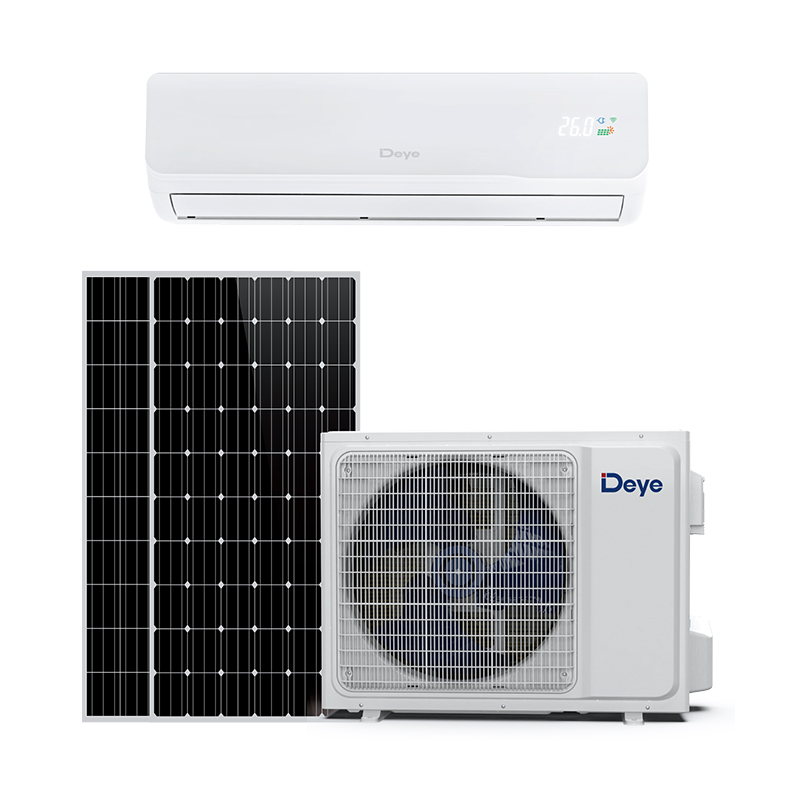
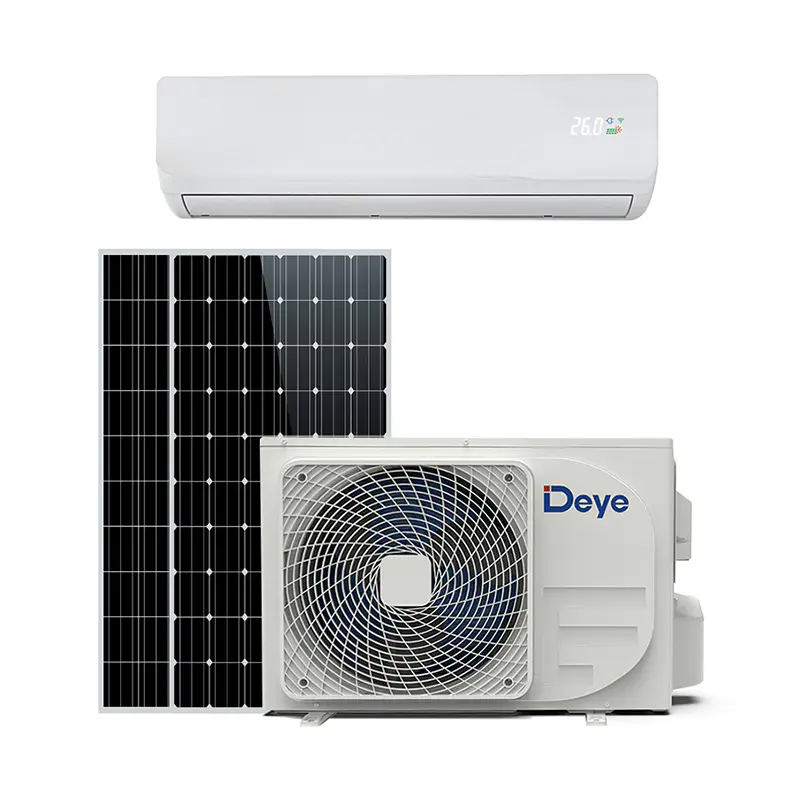
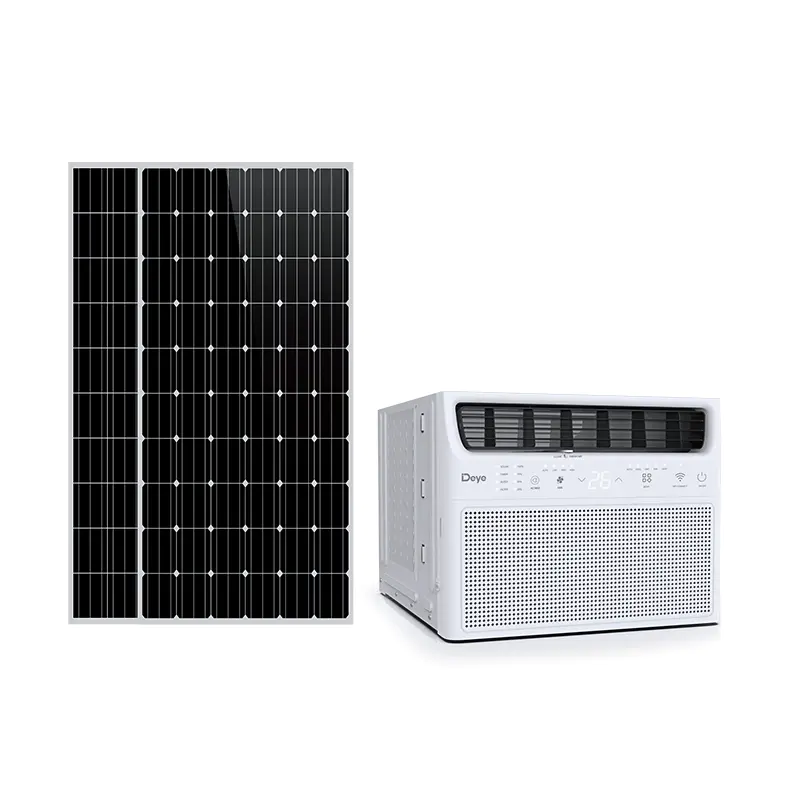
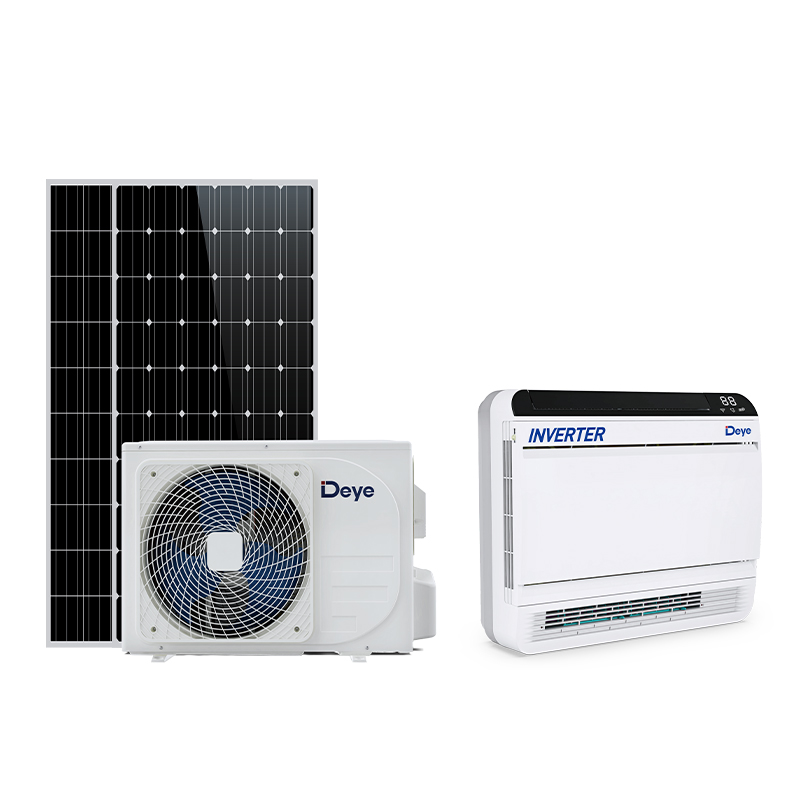
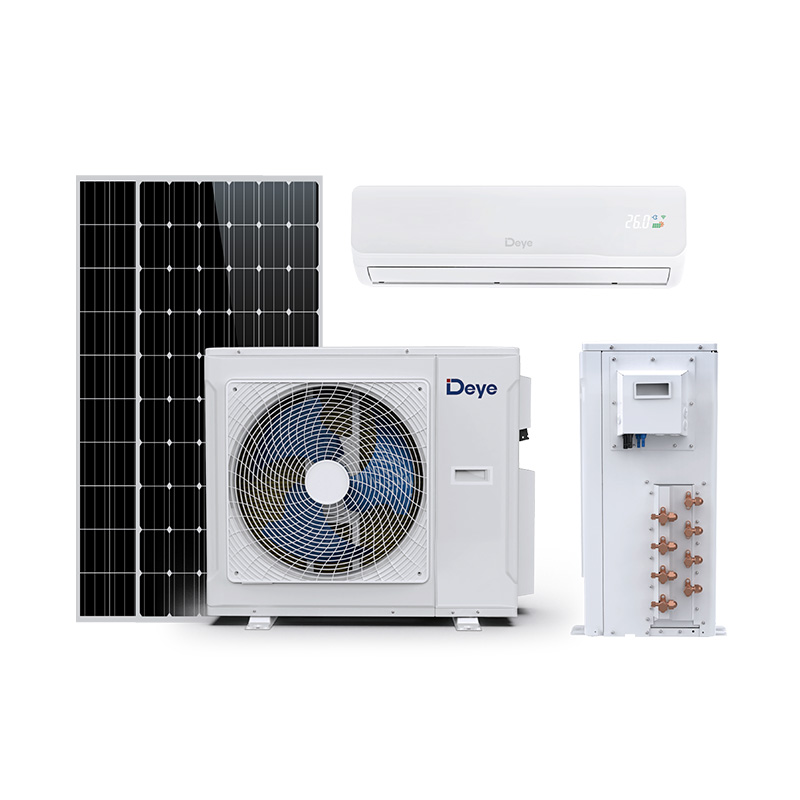
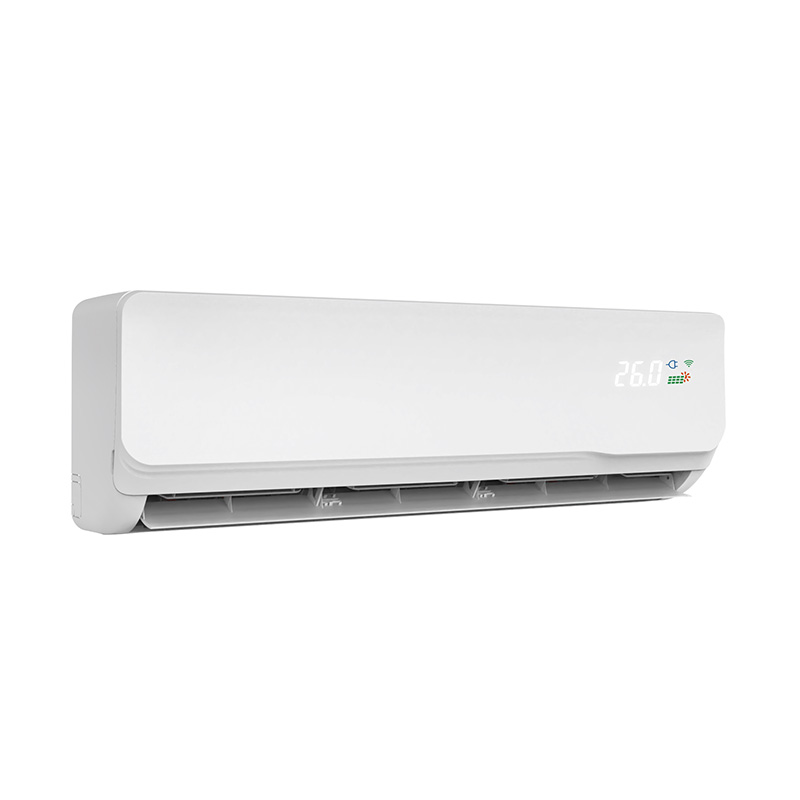 Off-Grid 48V DC Wall-Mounted Solar Air ConditionerFor remote off-grid spaces, this wall-mounted DC solar unit supports cooling and heating with battery integration; verify cooling load and surge headroom before sizing.View Product →
Sizing a Solar Air Conditioner for Real Off-Grid Runtime
Start with the cooling load, not the PV panel count. A 1.5-ton inverter air conditioner may draw roughly 1,200 to 1,800 watts while running, but the exact figure depends on ambient temperature, set point, insulation, refrigerant charge, and compressor modulation. A fixed-speed unit may draw a higher steady current and impose a harder start-up surge. Inverter-driven units usually modulate more smoothly, but the controller and battery still need surge headroom.
A practical sizing sequence looks like this:
- Estimate the continuous running watts of the air conditioner at the expected outdoor temperature.
- Add 20 to 30 percent headroom for inverter efficiency, cable loss, dust, and high-temperature derating.
- Confirm the compressor start-up surge and verify that the inverter or controller can supply it.
- Calculate battery energy for the required night runtime, then add a usable-depth-of-discharge margin.
- Size the PV array to recharge the battery and carry daytime cooling, not just to match the air conditioner nameplate.
For a simple example, assume a small off-grid room needs 1,500 watts of continuous cooling for six daytime hours and 700 watts average for eight night hours. Daytime energy is about 9 kWh, and night energy is about 5.6 kWh. After accounting for inverter and battery losses, the PV array and battery bank must be larger than the raw load figures. If the site has frequent clouds, the battery autonomy should cover at least one full night plus a partial backup day.
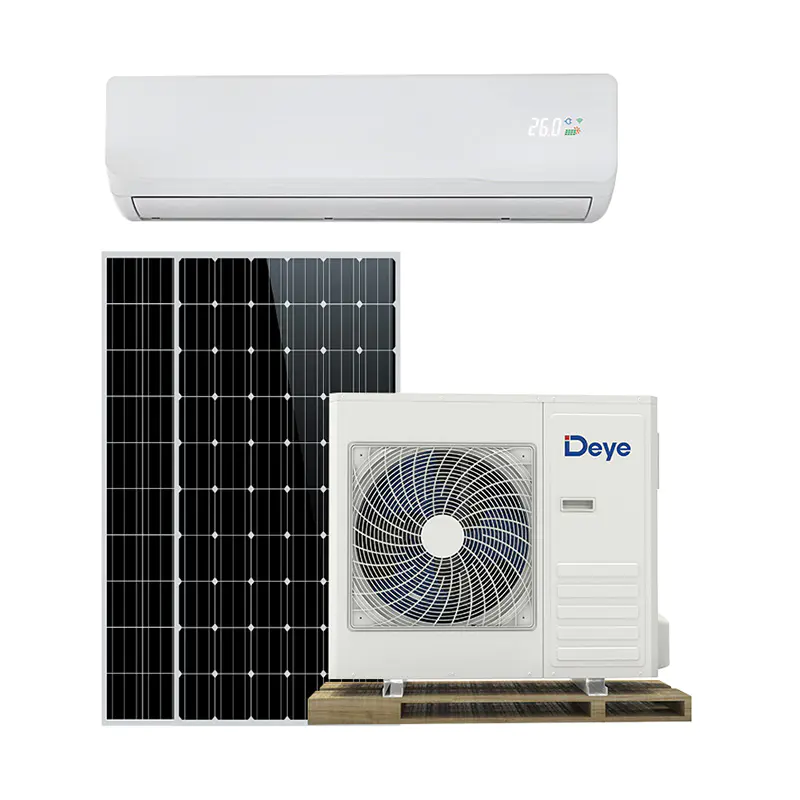
 Hybrid ACDC Wall-Mounted Solar Air ConditionerBattery-free hybrid ACDC wall-mounted system for solar-assisted cooling and heating; built-in MPPT and inverter suit daytime loads, with R410A/R32 options and Wi-Fi control.View Product →
Battery, Surge, and Night Operation: Where Most Off-Grid Systems Fail
Most off-grid solar air conditioner failures are not refrigerant failures. They are energy-management failures. A system may cool well at noon and then shut down at 9 p.m. because the battery reached its low-voltage limit. Another system may start the compressor repeatedly because the PV voltage collapses under cloud cover. A third system may work in spring and fail in summer because the PV array was sized without temperature derating.
Surge protection
The compressor, fan motor, and control board need coordinated protection. The inverter or DC controller must ride through start-up without dropping the control circuit.
Battery chemistry
Lithium batteries offer usable capacity and stable voltage, but they need correct charge limits. Lead-acid banks are cheaper upfront but require deeper derating and ventilation planning.
Low-voltage cutoff
Set the cutoff to protect the battery, not just to keep the room cold. A slightly warmer room is preferable to a damaged battery bank.
Source priority
Hybrid units should prioritize solar when PV is available, use battery when needed, and bring in grid or generator only as a controlled fallback.
Night operation also changes the comfort target. An off-grid bedroom may be预-cooled before sunset, then allowed to drift upward slightly overnight. That strategy reduces battery draw and keeps the system inside its design window. For medical stores, equipment rooms, or heat-sensitive products, the battery reserve must be calculated more conservatively.
Installation Details That Decide Whether the System Runs Cleanly
Off-grid solar air conditioning is an installation-sensitive product category. The same unit can perform well on one site and poorly on another because of cable voltage drop, refrigerant charge, airflow, and condensate handling. These details matter more than marketing labels.
DC cable voltage drop
Low-voltage DC systems are especially sensitive to cable length. A 48V system that uses undersized cable may lose several volts between the battery and the air conditioner. That loss appears as heat, reduced starting torque, and unstable control voltage. Keep DC runs short, use correct conductor sizing, and verify voltage at the unit terminals under load.
Refrigerant charge and line length
Split solar air conditioners must be charged according to the actual line length and manufacturer instructions. Too little charge reduces cooling capacity and can overheat the compressor. Too much charge raises pressure and current draw. Off-grid systems cannot afford either condition because every inefficiency is paid for by PV panels and batteries.
Airflow and heat rejection
The outdoor unit needs unrestricted airflow. In hot climates, a unit installed in a recessed wall, under a low roof, or beside a heat source will draw more current and deliver less cooling. Leave service access and avoid recirculation of hot discharge air.
Condensate and humidity
In humid off-grid locations, condensate volume can be significant. Drain lines need continuous slope and a safe discharge point. A clogged drain can damage ceilings, insulation, and control boards. For unattended sites, a secondary drain pan or alarm contact is a sensible addition.
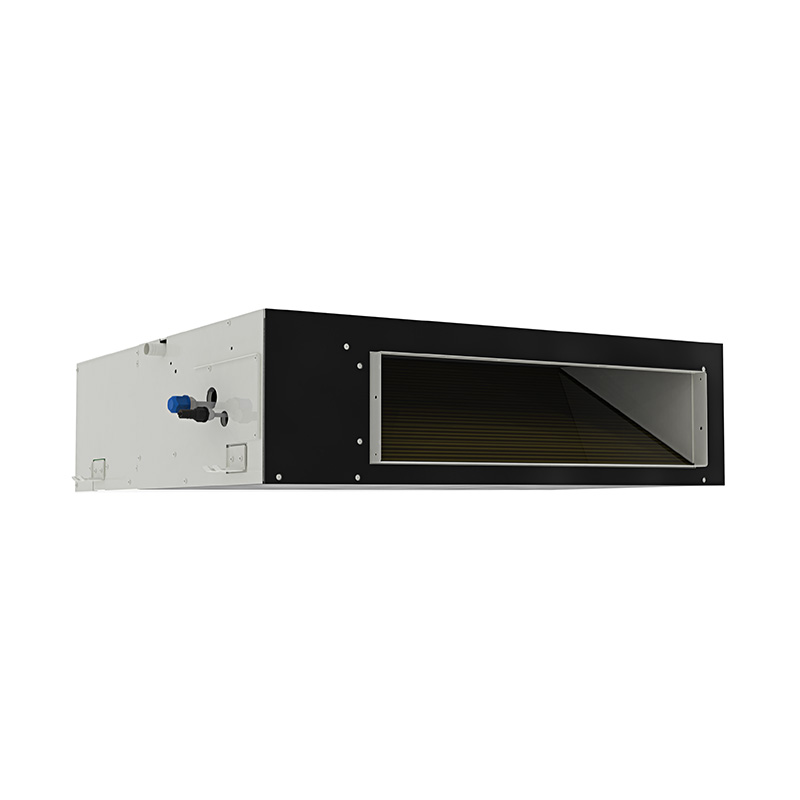
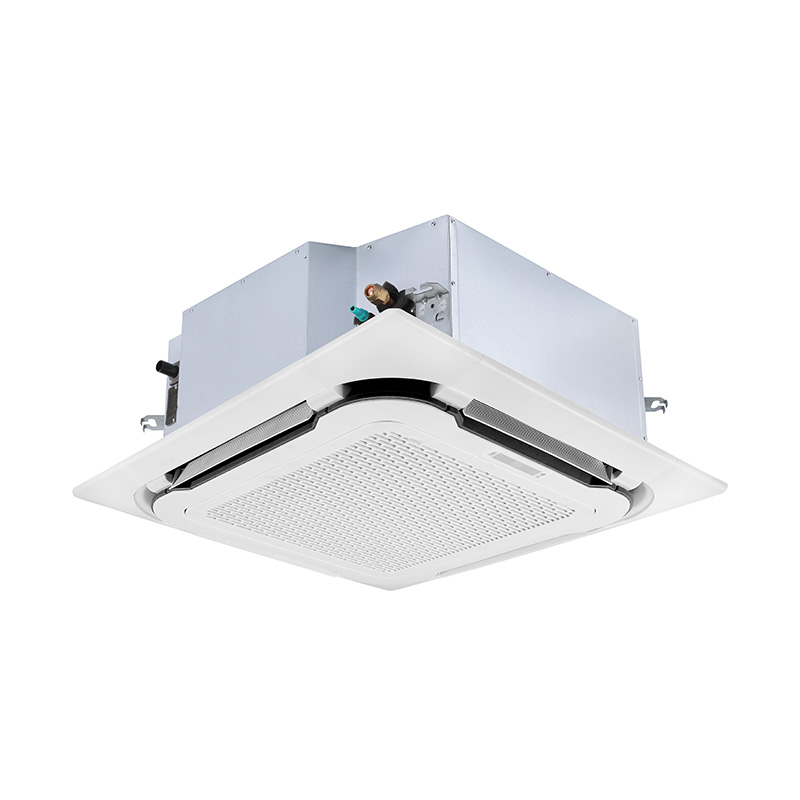 Light Commercial Solar Cassette Air ConditionerCeiling-mounted hybrid solar cassette for light commercial spaces, offering four-way airflow, DC compressor operation, and R410A/R32 options; plan condensate drainage for humid sites.View Product →
Where Off-Grid Solar Air Conditioning Delivers the Most Value
Off-grid solar cooling is most attractive when the cost of connecting to the grid is high, when diesel generator runtime is expensive, or when solar exposure is strong during the cooling season. It is less attractive when the building has a large continuous cooling load, poor insulation, or no space for a battery bank.
Remote residences
Cabins, farmhouses, and island homes can use a DC 48V system with a battery bank sized for evening cooling.
Container offices
Construction sites and temporary offices often need daytime cooling. A hybrid ACDC unit with a small battery can reduce generator hours.
Light commercial spaces
Shops, clinics, and workshops with ceiling or ducted systems can use hybrid solar cooling where the roof has adequate PV space.
Agricultural rooms
Storage and staff rooms in hot climates can benefit from daytime solar cooling, provided humidity and ventilation are controlled.
For projects with multiple rooms, a solar multi-zone system can centralize the outdoor equipment and reduce duplicated hardware. The trade-off is that the control strategy and piping layout become more complex. A multi-zone system should not be treated as a simple extension of a single-room kit; it needs a room-by-room load calculation and a clear priority plan for which zones run on limited battery energy.
Common Buying Mistakes to Avoid
Buyers often focus on the air conditioner headline capacity and overlook the balance of system. That is where budget overruns and performance complaints begin. The following checks prevent most of them.
- Do not size the PV array from the air conditioner nameplate alone. Use measured or calculated running watts, then add headroom.
- Do not ignore compressor start-up surge. A battery and inverter that carry the running load may still trip on start-up.
- Do not assume a hybrid unit will automatically manage every source correctly. Verify source priority, changeover logic, and generator compatibility.
- Do not install a DC system with long, thin cables. Voltage drop becomes a cooling and reliability problem.
- Do not plan night cooling without a realistic battery autonomy calculation and a low-voltage protection strategy.
- Do not overlook service access. Off-grid sites are often remote, so maintenance access should be designed in from the start.
It also helps to review the manufacturer’s solar HVAC experience and factory background before specifying a system. Deye’s solar HVAC manufacturing background is relevant because off-grid cooling depends on inverter control, refrigerant know-how, and product testing rather than on a single component. For project-specific sizing, contact the team with the room load, location, PV space, and night runtime target.
FAQ: Off-Grid Solar Air Conditioning
Can a solar air conditioner run at night without a battery?
No, not in a practical off-grid installation. A solar air conditioner can run during the day from PV, but night operation requires stored energy or another source such as a generator. A small battery may carry the control board and fan, but it will not run the compressor through the night.
How many solar panels does an off-grid air conditioner need?
The panel count depends on running watts, sun hours, derating, and battery recharge energy. A small high-efficiency DC unit may need a compact array, while a 1.5-ton system with night runtime needs a substantially larger array and battery bank. Size from energy demand, not from a generic panel count.
Is a DC 48V solar air conditioner better than a hybrid ACDC unit?
A DC 48V unit is simpler where there is no grid and the system is designed around a battery bank. A hybrid ACDC unit is more flexible where grid or generator backup exists. The better choice depends on the site, not on the product category alone.
Can I add solar to an existing air conditioner?
Usually not by simply connecting PV panels to a standard AC unit. Standard air conditioners expect stable AC power. A proper solar cooling system uses a solar-ready DC or hybrid air conditioner, a charge controller or hybrid inverter, and a battery or managed power source. Retrofitting a standard unit requires a larger inverter and battery system, which may not be economical.
What maintenance does an off-grid solar AC need?
Clean PV modules, check DC connections for torque and corrosion, inspect the outdoor coil, verify condensate drainage, and review battery voltage and charge settings. In dusty or coastal sites, cleaning and connection checks should be more frequent.
Can one system cool a whole house off grid?
It can, but whole-house cooling usually requires a multi-zone design, a large PV array, and a battery bank sized for evening load. A room-by-room approach often controls cost better because it lets the owner prioritize the bedroom, clinic, or workroom instead of cooling every space equally.
Decision Checklist Before You Specify an Off-Grid Solar AC
Use this checklist as a final cross-check before ordering equipment. It keeps the project focused on runtime and reliability rather than on a single product specification.
- Confirm the room-by-room cooling load and the desired indoor temperature at the hottest expected outdoor condition.
- Decide whether the system must run at night, or whether daytime-only cooling is acceptable.
- Calculate daily kWh for cooling, then add losses for inverter, battery, and wiring.
- Select DC 48V or hybrid ACDC based on grid availability, generator use, and battery space.
- Verify start-up surge, low-voltage cutoff, and source-change logic with the equipment supplier.
- Plan cable routes, outdoor unit clearance, condensate drainage, and service access before installation.
- Set a maintenance schedule for PV cleaning, battery checks, coil cleaning, and connection inspection.
An off-grid solar air conditioner is technically feasible, and it is already used in remote homes, clinics, shops, and workplaces. The difference between a successful installation and a disappointing one is almost always system engineering: realistic load data, correct surge capacity, adequate battery autonomy, and disciplined installation practice.
