

 Español
 русский
 Français
 Português
 Deutsch
 عربى
عربى italiano
-1.jpg)

Content
- 1 The Growing Need for Efficient Cooling
- 2 How Traditional Air Conditioning Works: The Grid-Dependent Cycle
- 3 How Solar Air Conditioning Works: Harnessing Renewable Energy
- 4 Key Technical and Operational Differences
- 5 Cost Analysis and Financial Implications
- 6 Environmental Impact and Sustainability
- 7 Pros and Cons of Solar Air Conditioning
- 8 Pros and Cons of Traditional Air Conditioning
- 9 Factors to Consider When Choosing Your Cooling Solution
- 9.1 Climate: Sunlight availability and cooling needs
- 9.2 Initial Investment vs. Long-Term Savings
- 9.3 Energy Consumption: Environmental concerns and energy efficiency goals
- 9.4 Home Size and Layout: Space for solar panels and AC unit
- 9.5 The Role of Entities: Photovoltaic, hybrid solar AC, solar thermal AC, compressor, condenser, evaporator, expansion valve
- 10 FAQ
The Growing Need for Efficient Cooling
Brief Overview of Air Conditioning and Its Importance: Discuss the essential role of AC in modern life, especially in hot climates, and its growing energy demand worldwide.
- The global context of rising temperatures and the necessity of effective cooling solutions.
Air conditioning (AC) has transformed from a luxury into an indispensable necessity in modern life, particularly against the backdrop of global climate change and the growing urban heat island effect. AC systems provide crucial thermal comfort and air quality assurance for residential, commercial, and industrial facilities, serving as a key factor in maintaining productivity, health, and quality of life.
The Importance of Air Conditioning in the Global Climate Context
Over the past few decades, global demand for cooling has grown explosively. As developing economies rise and global average temperatures continue to climb, the penetration rate of AC equipment is constantly increasing. However, this growth carries an enormous burden of energy consumption. According to data from the International Energy Agency (IEA), AC and fans currently consume nearly 20% of the total electricity used in buildings globally, and in some hot regions, this proportion is even higher during peak summer periods.
The peak electricity demand for traditional AC often coincides with peak supply periods for utility companies, placing immense strain on the power grid. This forces utilities to burn more fossil fuels to meet demand, thereby exacerbating greenhouse gas emissions and environmental pollution. Therefore, finding a solution that both satisfies cooling needs and reduces grid burden and environmental impact has become a top priority in the fields of energy and sustainable development.
Introduction to Solar Air Conditioning as an Alternative: Position Solar Air Conditioning as a sustainable and energy-efficient answer to the high energy consumption of traditional AC.
- Highlighting the appeal of using renewable energy for cooling.
It is in response to this pressing need for efficient and sustainable solutions that Solar Air Conditioning has emerged and gradually become a powerful alternative to traditional AC.
Solar Air Conditioning is an innovative cooling technology that utilizes solar energy—a clean, abundant, and renewable source—to drive the refrigeration process. The core appeal of this method is that it solves the fundamental conflict of traditional AC: when the cooling demand is highest (i.e., when sunlight is most intense and temperatures are hottest), the energy supply is also most abundant (i.e., solar power generation is maximal). By directly matching the cooling load with renewable energy generation, Solar Air Conditioning systems can significantly reduce reliance on the grid during peak demand times.
It is more than just an energy-saving technology; it is a sustainable, ecological system approach designed to:
- Reduce Energy Consumption: Through using "free" sunlight to replace high-cost grid electricity.
- Minimize Environmental Footprint: By significantly lowering carbon dioxide emissions resulting from thermal power generation.
- Enhance Energy Resilience: By increasing the independence and security of buildings during grid fluctuations or outages.
How Traditional Air Conditioning Works: The Grid-Dependent Cycle
Explanation of the Vapor-Compression Cycle: Detailed breakdown of the thermodynamic process that enables cooling.
- The science behind removing heat from an indoor space.
The essence of traditional air conditioning systems lies in utilizing thermodynamic principles to absorb heat from an indoor space and reject it outdoors, through a process known as the Vapor-Compression Cycle. This cycle is the foundation of all modern mechanical refrigeration systems, but its operation is entirely dependent on electricity supplied by the external power grid.
The Vapor-Compression Cycle is a continuous, closed physical process that uses the property of a refrigerant to change state at different pressures to achieve heat transfer. The cycle mainly includes four key steps:
- Compression: Low-pressure, low-temperature refrigerant vapor enters the compressor, where it is compressed into high-temperature, high-pressure vapor. This process requires a significant amount of energy input, making the compressor the largest energy-consuming component in traditional AC.
- Condensation: The high-temperature, high-pressure vapor flows through the outdoor unit (condenser), where it releases heat to the outside air via fins, cooling down and condensing into high-pressure liquid refrigerant.
- Expansion/Throttling: The high-pressure liquid refrigerant passes through an expansion valve or throttling device, where the pressure is rapidly reduced. This sudden pressure drop causes the refrigerant temperature to plummet, forming low-pressure, low-temperature liquid refrigerant.
- Evaporation: The low-pressure, low-temperature liquid refrigerant flows through the indoor unit (evaporator), absorbing heat from the indoor air, which cools the air. After absorbing heat, the refrigerant vaporizes into low-pressure vapor, completing one cycle, and returns to the compressor.
Components of a Traditional AC Unit: In-depth look at the function of the compressor, condenser, evaporator, and expansion valve.
- The role of the compressor as the primary energy consumer.
Traditional AC systems are mainly composed of the following four interconnected key components that work together to complete the vapor-compression cycle:
| Component Name | Functional Description | Core Role | Energy Consumption Characteristics |
| Compressor | Increases the pressure and temperature of the refrigerant, driving its flow through the system. | The "heart" of the cycle, and the system's largest energy consumer. | Consumes large amounts of electrical energy, causing peak demand on the grid for traditional AC. |
| Condenser | Located outdoors. The refrigerant releases heat here, condensing from a high-temperature, high-pressure gas to a liquid. | Heat rejection device. | Relies on a fan to expel heat, with the fan consuming a small amount of electricity. |
| Evaporator | Located indoors. The refrigerant absorbs heat from the indoor air here, vaporizing from a liquid into a low-pressure gas, thus cooling the indoor air. | Heat absorption device. | Relies on a fan to blow indoor air over the cold coil, with the fan consuming a small amount of electricity. |
| Expansion Valve | Reduces the pressure and temperature of the high-pressure liquid refrigerant, preparing it to enter the evaporator to absorb heat. | Pressure and flow control point. | No direct energy consumption, it is purely a mechanical or thermodynamic device. |
Energy Source: Electricity from the Grid: Emphasize the reliance on grid electricity, leading to energy bills and indirect emissions.
The operation of traditional AC is entirely dependent on grid electricity, with the main energy consumption concentrated on driving the compressor. When the user turns on the AC, the system draws the required power from the public grid.
This reliance on the grid causes two main issues:
- Operational Costs High: Electricity bills are the main expense for traditional AC users. Especially during peak summer cooling periods, electricity prices are often higher, increasing the user's energy bills accordingly.
- Indirect Environmental Footprint: The system's carbon emissions do not originate from the AC itself, but from power plants burning fossil fuels to meet its electricity demand. Therefore, the environmental friendliness of traditional AC is directly related to the "cleanliness" of the local power grid. The more the grid relies on high-carbon energy sources like coal, the larger the indirect carbon footprint caused by using traditional AC.
It is precisely to address the limitations of traditional AC systems in terms of energy consumption and environmental impact that Solar Air Conditioning has become so important, and the next section will delve into its operating principles.
How Solar Air Conditioning Works: Harnessing Renewable Energy
Explanation of Photovoltaic (PV) Solar Panels: Describe how PV technology converts sunlight into usable DC electricity.
- Focusing on the type of solar technology typically used to power Solar Air Conditioning units.
The core advantage of Solar Air Conditioning systems is that they shift the massive energy input required for the cooling process to a clean, renewable source—solar energy. These systems utilize light or thermal energy to replace the dependence of traditional AC on grid electricity, especially during the periods when solar radiation is strongest and cooling demand is highest.
Photovoltaic (PV) technology is the cornerstone of most modern Solar Air Conditioning systems. PV panels are composed of semiconductor materials (usually silicon) that convert sunlight directly into direct current (DC) electricity via the photovoltaic effect.
- Photons Excite Electrons: When photons in sunlight strike the solar cells, they transfer energy to the electrons in the semiconductor material.
- Current Generation: These excited electrons move directionally under the action of the electric field within the cell, forming a direct current.
This clean electricity can be immediately used to drive the compressor and fans in the Solar Air Conditioning unit, perfectly matching the time when cooling demand arises.
How Solar Energy Powers Air Conditioning Units: Detail the integration of PV systems with AC units, often via inverters.
- Illustrating the direct energy transfer from sun to cooling.
The integration methods of Solar Air Conditioning systems with solar PV arrays typically include the following:
- Direct DC Power: Specially designed Solar Air Conditioning units (usually DC inverter units) can directly receive the DC electricity generated by the solar panels. This eliminates the loss from converting DC to alternating current (AC), improving the overall efficiency of the system.
- Inverter Supply (Grid-Tied): The DC electricity generated by the solar panels is converted into standard AC electricity via an inverter. This AC can directly drive standard or inverter AC units and allows the system to send excess power back to the grid (if local policies permit).
Energy Matching Advantage: The key is that Solar Air Conditioning generates the most power when solar radiation intensity is highest, and this is exactly when the house receives the most heat and the cooling load is greatest. This perfect synchronization of time and energy makes solar power the ideal energy source for driving AC.
Types of Solar AC Systems:
| System Type | Energy Utilization Method | Cooling Mechanism | Reliance on the Grid | Typical Application Features |
| Direct Solar AC | Uses only solar PV electricity to drive a DC inverter compressor. | Vapor-compression cycle (DC driven). | No reliance during the day; requires battery or grid backup at night or on cloudy days. | Primarily for daytime use, pursuing maximum energy independence. |
| Hybrid Solar AC | PV electricity is the main energy source, seamlessly switching or supplementing with grid AC electricity when insufficient. | Vapor-compression cycle (AC/DC hybrid drive). | High operational reliability, with the grid as the main backup. | Generally applicable to residential and small commercial spaces, ensuring 24/7 operation. |
| Solar Thermal AC | Uses collectors to gather solar thermal energy to heat a liquid. | Absorption or Adsorption cycle. | Very low or no electricity demand (only for pumps and controls). | Large industrial or commercial applications requiring significant heat input. |
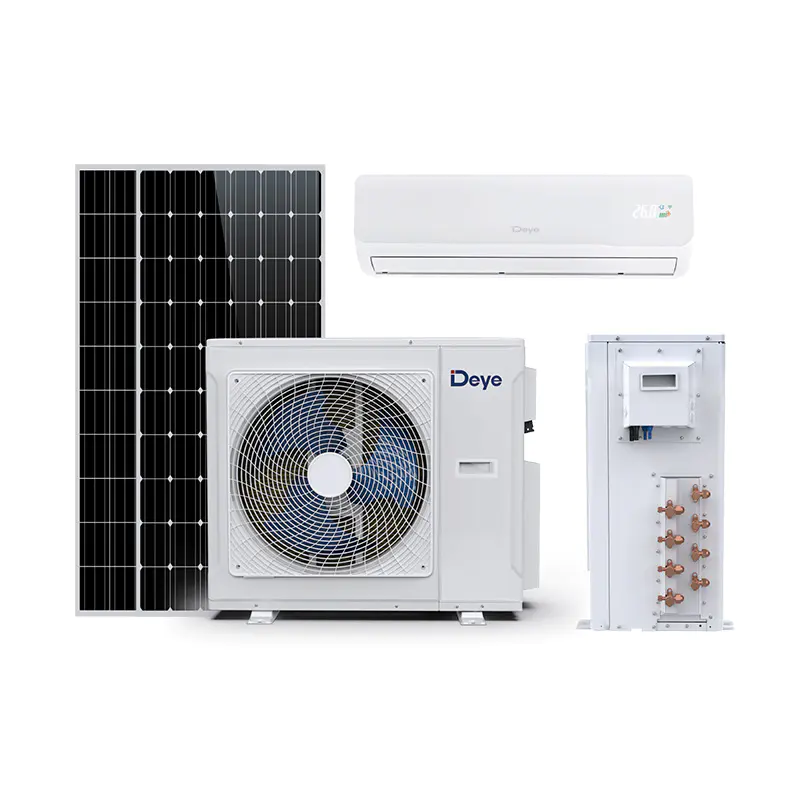
Hybrid Solar AC is the most widely applied type of Solar Air Conditioning in residential and light commercial use due to its reliability and practicality. It ensures that the system can continue to provide stable cooling service through grid power even at night or on extremely cloudy days, solving the intermittency problem of purely solar systems.
Key Technical and Operational Differences
Energy Source: Solar vs. Grid Electricity: A direct comparison of the input fuel and its cost implications.
- The concept of using "free" daytime energy for Solar Air Conditioning.
Solar Air Conditioning and traditional AC both aim to provide cooling, but they have fundamental differences in energy input, operational efficiency, and system integration. These differences determine their respective long-term economics and environmental impact.
This is the most critical difference between the two systems. Traditional AC relies entirely on centralized electricity provided by utilities, while Solar Air Conditioning relies mainly on decentralized, site-generated solar energy.
| Characteristic | Solar Air Conditioning | Traditional Air Conditioning |
| Primary Energy Source | On-site installed Photovoltaic (PV) array or solar collectors. | Public power grid (Grid Electricity). |
| Energy Cost | Operational cost tends toward zero during the day (free fuel). | Continuously generates electricity bills. |
| Grid Reliance | Hybrid systems can significantly reduce grid reliance during the day, achieving self-sufficiency. | Operation is completely dependent on the grid. |
| Peak Demand Impact | Generates maximum power during peak cooling demand (daytime), reducing strain on the grid. | Causes maximum load on the grid during peak cooling demand (daytime). |
The concept of using "free" daytime energy for Solar Air Conditioning is its biggest operational advantage. During the hours of abundant sunlight, the AC system consumes instantly generated clean energy, minimizing electricity expenses.
Efficiency:
- SEER/EER Ratings for Both Types: Define and compare Seasonal Energy Efficiency Ratio (SEER) and Energy Efficiency Ratio (EER).
- Discussing how the ratings apply differently to traditional AC and hybrid Solar Air Conditioning units.
The key parameters for measuring AC system energy efficiency are SEER and EER.
- SEER (Seasonal Energy Efficiency Ratio): Measures the AC's energy efficiency performance over an entire cooling season. A higher SEER value indicates better energy efficiency.
- EER (Energy Efficiency Ratio): Measures the instantaneous energy efficiency of the AC under specific rated operating conditions.
SEER/EER Ratings for Both Types:
In terms of the core refrigeration unit technology, the compressor section of a high-efficiency traditional AC (e.g., an inverter model) and a Solar Air Conditioning system may have similar baseline SEER/EER ratings.
However, the overall "efficiency" of a Solar Air Conditioning system must be evaluated from the perspective of energy utilization:
- Energy Source Efficiency: The solar energy used by the Solar Air Conditioning system bypasses the losses associated with power grid transmission and distribution, resulting in higher terminal energy utilization efficiency.
- DC Drive Efficiency: Many Solar Air Conditioning units use DC inverter technology, allowing them to utilize the DC power from PV panels directly, avoiding the energy loss from two AC/DC conversions, meaning the efficiency of obtaining energy from the sun is higher for the same cooling capacity.
Factors Affecting Efficiency: Ambient temperature, installation quality, unit size, and maintenance.
Regardless of the system, its ultimate operational efficiency is affected by various factors:
- Installation Quality: Incorrect refrigerant charge, kinked piping, or poor insulation can significantly reduce the EER of both systems.
- Ambient Temperature: The higher the outdoor temperature, the harder it is for the system (especially the condenser) to reject heat, leading to decreased energy efficiency.
- Unit Sizing: Oversized or undersized units will both lead to inefficiency and shortened lifespan.
- Maintenance: Dirty filters and coils obstruct heat exchange, reducing the efficiency of all systems.
Installation:
- Complexity and Requirements: Contrast the relatively straightforward installation of traditional AC with the added components (panels, mounting, wiring) for Solar Air Conditioning.
- Space requirements for solar panels vs. space for a conventional outdoor unit.
Solar Air Conditioning systems involve both energy generation and energy consumption components, making their installation complexity higher than that of traditional single-consumption units.
| Installation Characteristic | Solar Air Conditioning | Traditional Air Conditioning |
| System Complexity | High. Requires installation of indoor unit, outdoor unit, and an additional PV array (panels, mounting, wiring, inverter/controller). | Low. Requires only installation of indoor unit, outdoor unit, and connecting pipes. |
| Professional Requirements | Requires dual knowledge of HVAC and PV electrical systems. | Requires HVAC knowledge. |
| Space Requirements | Needs sufficient, unobstructed roof or ground space to install solar panels. | Requires only minimal space for the outdoor and indoor units (usually smaller footprint). |
| Grid Connection | Hybrid systems may require additional electrical work and utility approval. | Typically requires only standard electrical connection. |
The complexity of installation contributes to the higher initial cost of Solar Air Conditioning but provides long-term energy independence, laying the groundwork for the cost analysis in the next section.
Cost Analysis and Financial Implications
Cost: Initial Investment (Upfront Capital Expenditure): A detailed comparison of the upfront purchase and installation costs.
- The higher initial cost of Solar Air Conditioning due to the solar array.
Choosing a cooling system is a significant financial decision that must consider not only the initial procurement cost but also long-term operating and maintenance expenses. When conducting a financial analysis of these two technologies, the trade-off between initial investment and long-term savings is crucial.
The initial investment for a Solar Air Conditioning system is typically much higher than that of a traditional AC system, mainly due to the addition of energy generation equipment—the Photovoltaic (PV) array and its supporting components.
| Cost Element | Solar Air Conditioning | Traditional Air Conditioning |
| Equipment Cost | High (includes AC unit, PV panels, controller/inverter, specialized wiring). | Relatively low (includes only the AC unit and standard components). |
| Installation Cost | High (involves roofing work, electrical work, HVAC system integration, complex process). | Lower (standard HVAC installation). |
| Total Initial Investment | Significantly higher than traditional systems. | Industry standard. |
Despite the higher initial investment, the Solar Air Conditioning system is viewed as a long-term investment in the property's energy infrastructure, aiming to achieve payback through continuous reduction in operating costs.
Operational Costs: Analysis of ongoing electricity consumption costs.
- The near-zero daytime running costs of a well-utilized Solar Air Conditioning system.
Operational costs are the key factor that creates long-term financial differences between the two systems, mainly manifested in energy consumption.
| Operational Cost Characteristic | Solar Air Conditioning | Traditional Air Conditioning |
| Daytime Energy Cost | Tends toward zero (primarily uses on-site generated clean electricity). | Continuously incurs costs, often at peak electricity prices. |
| Nighttime/Cloudy Day Cost | Relies on grid power, costs are comparable to traditional AC. | Continuously incurs costs. |
| Total Electricity Bill Burden | Significantly lower, especially during peak cooling periods. | High, representing the user's largest operational expense. |
By utilizing "free" solar energy, Solar Air Conditioning can bring considerable energy savings to users over its entire lifespan, thereby shortening the payback period of the initial investment.
Maintenance Costs: Comparing standard AC maintenance (filter changes, coil cleaning) with the maintenance required for both the AC unit and the solar PV system.
| Maintenance Item | Solar Air Conditioning | Traditional Air Conditioning |
| AC Unit Maintenance | Same as traditional AC (filters, refrigerant, coil cleaning). | Standard HVAC maintenance. |
| PV System Maintenance | Requires periodic cleaning of solar panels, checking wiring and inverter (low maintenance requirement). | No such expense. |
| System Complexity | Maintenance requires higher technical expertise, needing checks on both electrical and HVAC systems. | Maintenance is simple and direct. |
Although Solar Air Conditioning adds maintenance requirements for the PV system, PV systems are known for their long lifespan (often over 25 years) and low maintenance needs.
Environmental Impact and Sustainability
Environmental Impact: Carbon Footprint Comparison: Quantifying the difference in CO2 emissions over the lifespan of both systems.
- Highlighting the significantly lower carbon footprint of Solar Air Conditioning.
Solar Air Conditioning shows distinct advantages in terms of energy utilization and sustainable development. The system's environmental footprint (Carbon Footprint) is primarily determined by the type of energy it uses.
| Environmental Metric | Solar Air Conditioning | Traditional Air Conditioning |
| Operational Carbon Emissions | Extremely low or zero (when running on solar energy). | Depends on the grid structure. High emissions if reliant on coal power. |
| Renewable Energy Share | Extremely high, primarily driven by solar energy. | Extremely low (only the share of renewable energy in the grid mix). |
| Life Cycle Emissions | Lower (after accounting for system manufacturing and disposal emissions). | Higher (continuous fossil fuel combustion emissions). |
The significantly lower carbon footprint of Solar Air Conditioning is its main environmental selling point. It directly reduces demand on centralized power plants reliant on fossil fuels, making it a key technology for achieving building net-zero emission goals.
Reduced Energy Bills: Case studies or estimations of potential savings with Solar Air Conditioning (focusing only on the energy savings driven by the technology).
- Solar Air Conditioning systems enhance the user's resistance to grid price fluctuations and supply instability through on-site power generation. During the day, users can achieve energy independence, hedge against continuously rising energy costs, and mitigate future electricity price uncertainty.
- Traditional AC systems are fully exposed to energy market fluctuations and cannot provide energy independence or hedging capabilities.
Potential for Energy Independence: Discussion on how Solar Air Conditioning lessens reliance on utility companies and helps hedge against fluctuating energy costs.
Government Incentives and Rebates: While this article does not discuss specific monetary amounts, it is worth noting that many governments and regions offer tax credits or rebate policies to support the adoption of clean technology, which effectively reduces the initial investment of Solar Air Conditioning and shortens its financial payback period.
Pros and Cons of Solar Air Conditioning
Solar Air Conditioning represents the future direction of cooling technology, but as a system integrating PV generation and HVAC technology, it has significant advantages and specific challenges.
Pros: Advantages of Solar Air Conditioning
| Advantage Category | Detailed Description | Core Value |
| Reduced Energy Bills | Daytime cooling is mainly solar-driven, significantly reducing the need for purchased electricity during peak hours, achieving substantial long-term energy savings. | Long-term financial returns. |
| Lower Carbon Footprint | Does not rely on fossil fuel generation during operation, directly reducing indirect greenhouse gas emissions, making it a highly environmentally friendly cooling solution. | Environmental sustainability. |
| Potential for Energy Independence | On-site power generation allows homes or businesses to hedge against electricity price hikes and reduces reliance on the public grid. | Energy security and resilience. |
| Government Incentives and Rebates | Many regions encourage renewable energy adoption, offering specific tax benefits and subsidies that help offset the higher initial investment. | Financial assistance. |
| Utilization Match | Peak cooling demand perfectly matches peak solar power generation, resulting in high energy utilization efficiency. | Technological synergy. |
Cons: Challenges of Solar Air Conditioning
| Disadvantage Category | Detailed Description | Practical Impact |
| High Initial Cost | Requires the purchase of additional PV panels, mounting, controllers, and other equipment, leading to higher upfront capital expenditure for installation and purchase. | Initial investment barrier. |
| Dependence on Sunlight | During nighttime, cloudy days, or adverse weather, solar energy output is insufficient, and the system must switch to grid power or battery backup (if available), preventing 24/7 pure solar operation. | Operational intermittency. |
| Space Requirements for Solar Panels | Requires sufficient, unobstructed roof or ground space to install the PV array, which is a limiting factor for small homes or shaded buildings. | Architectural applicability constraints. |
| Complexity of Installation | Installation involves electrical engineering and HVAC integration, making it more complex than traditional AC and requiring specialized, cross-disciplinary installation teams. | Installation difficulty and cost. |
Pros and Cons of Traditional Air Conditioning
Traditional AC systems are popular due to their mature technology, simple installation, and reliable cooling performance. However, their operating model and energy dependence present serious challenges in the era of sustainability.
Pros: Advantages of Traditional Air Conditioning
| Advantage Category | Detailed Description | Core Value |
| Lower Initial Capital Expenditure | Equipment and installation costs are much lower than a Solar Air Conditioning system that includes a PV array. | Ease of accessibility and affordability. |
| Easy Installation | Installation process is standardized, required time is short, space needed is minimal, and HVAC technicians are readily available. | Construction convenience. |
| Reliable Cooling Performance | As long as the grid supply is stable, the system can operate at full rated power, providing stable and continuous cooling, regardless of the weather. | Operational reliability. |
Cons: Challenges of Traditional Air Conditioning
| Disadvantage Category | Detailed Description | Practical Impact |
| High Energy Consumption | The compressor continuously consumes large amounts of grid electricity, especially in older models established before high-efficiency standards, energy consumption is particularly significant. | Continuous high operational costs. |
| Increased Carbon Footprint | Dependence on the grid indirectly emits significant amounts of greenhouse gases, particularly in grid areas reliant on fossil fuels. | Negative environmental impact. |
| Dependence on the Electricity Grid | Highly susceptible to grid failures, power outages, or electricity shortages; may face risks of power rationing during periods of peak grid load. | Energy vulnerability. |
| Fluctuating Energy Costs | User energy expenditures are directly exposed to fluctuations in the electricity market price, lacking cost-hedging capability. | Financial uncertainty. |
Factors to Consider When Choosing Your Cooling Solution
Choosing the most suitable cooling solution requires a comprehensive assessment of the local environment, financial capability, and long-term energy goals. The suitability of Solar Air Conditioning versus traditional AC depends on the following key factors:
Climate: Sunlight availability and cooling needs
Climate conditions are the core factor determining the value of Solar Air Conditioning.
| Climate Factor | Solar Air Conditioning Suitability | Traditional Air Conditioning Suitability |
| Sunlight Availability | Extremely High. Continuous, high-intensity sunlight is crucial for system power generation and economic returns. | Irrelevant. |
| Cooling Needs | Extremely High. Energy savings are maximized in hot and sunny regions (where cooling peaks match solar peaks). | Applicable to all regions requiring cooling. |
| Frequency of Cloudy/Rainy Days | Low. Prolonged cloudy weather can severely reduce system power generation, increasing grid reliance. | No impact. |
In regions with abundant solar resources and long, hot summers, Solar Air Conditioning can maximize its "free" energy advantage, achieving the highest return on investment and energy independence.
Initial Investment vs. Long-Term Savings
Despite not covering specific budget figures, decision-makers must weigh the upfront capital expenditure against future operational savings.
- Solar Air Conditioning: The initial investment is higher, but its value lies in achieving long-term cost recovery by drastically cutting electricity bills (especially during the day). Decisions should focus on the Payback Period—the time required to recover the system cost through saved electricity expenses.
- Traditional Air Conditioning: The initial investment is low, but long-term operational costs are high, and the total cost of ownership will continue to increase as electricity prices rise.
The evaluation should consider the system's lifespan (where Solar Air Conditioning PV components typically last over 25 years) to determine which solution has the lower total cost over the entire life cycle.
Energy Consumption: Environmental concerns and energy efficiency goals
For users with clear sustainability goals and energy efficiency requirements, Solar Air Conditioning is the more aligned choice.
- Solar Air Conditioning: Provides a direct path to achieving "net-zero emissions" or "green building" certification, with an extremely low carbon footprint that meets the highest environmental standards.
- Traditional Air Conditioning: While high-efficiency traditional inverter ACs can save energy, their environmental performance is constrained by the energy mix of the power grid, and they cannot directly utilize clean energy like Solar Air Conditioning.
Home Size and Layout: Space for solar panels and AC unit
Space constraints are a significant physical limitation when choosing Solar Air Conditioning.
- PV Array Space: Assess the roof area, load-bearing capacity, pitch, and orientation, and check for obstructions like trees or adjacent buildings. For properties with limited roof area or severe shading, installing the necessary solar panels may be difficult.
- Traditional AC Unit: Requires only minimal outdoor and indoor space, with minimal restrictions on building layout.
The Role of Entities: Photovoltaic, hybrid solar AC, solar thermal AC, compressor, condenser, evaporator, expansion valve
Understanding the role of key technical components is essential in selecting a cooling system:
- Photovoltaic (PV) Panels: Determine the energy input capacity of the Solar Air Conditioning system.
- Hybrid Solar AC: Provides flexibility, ensuring seamless switching to the grid when solar power is insufficient to guarantee cooling continuity.
- Solar Thermal AC: Though less common in residential settings, it retains value in industrial applications requiring large-scale cooling and ample thermal energy.
- Compressor, Condenser, Evaporator, Expansion Valve: These are the core elements of all vapor-compression systems, whether in traditional AC or Solar Air Conditioning, and their performance and efficiency directly impact the final cooling effect.
In summary, decision-makers need to customize the most suitable cooling strategy based on their climate conditions, long-term financial projections, and space limitations.
FAQ
Can a solar AC run completely off-grid?
- Answer: A purely DC Solar Air Conditioning unit can operate completely off-grid during the day. However, achieving 24/7 off-grid operation requires coupling with expensive battery storage systems. Hybrid Solar AC systems are generally the most practical and cost-effective choice, utilizing the grid as a reliable backup source for nighttime and cloudy days.
How long do solar AC panels last?
- Answer: Solar PV panels are known for their excellent durability, typically backed by performance warranties exceeding 25 years. This means the PV energy generation component usually outlasts the lifespan of the AC unit itself.
Is a solar AC system louder than a traditional AC?
- Answer: System noise primarily comes from the compressor and fans, which is related to the AC model and technology (e.g., whether it uses inverter technology), not the energy source (solar or grid). Many modern Solar Air Conditioning systems and high-efficiency traditional ACs use quiet inverter technology, resulting in comparable and often low noise levels.
What is the theoretical payback period for solar air conditioning?
- Answer: The theoretical payback period (based on energy savings) depends on the system's initial cost, local electricity prices, sunlight availability, and any available government incentives. In regions with high electricity costs and abundant sunlight, the payback period is typically shorter than in areas with lower electricity costs.
Does Solar Air Conditioning require special maintenance?
- Answer: Besides standard AC maintenance (like changing filters and cleaning coils), Solar Air Conditioning requires minimal maintenance for the PV array, mainly involving periodic cleaning of the panel surfaces to ensure maximum light absorption efficiency.
