

 Español
 русский
 Français
 Português
 Deutsch
 عربى
عربى italiano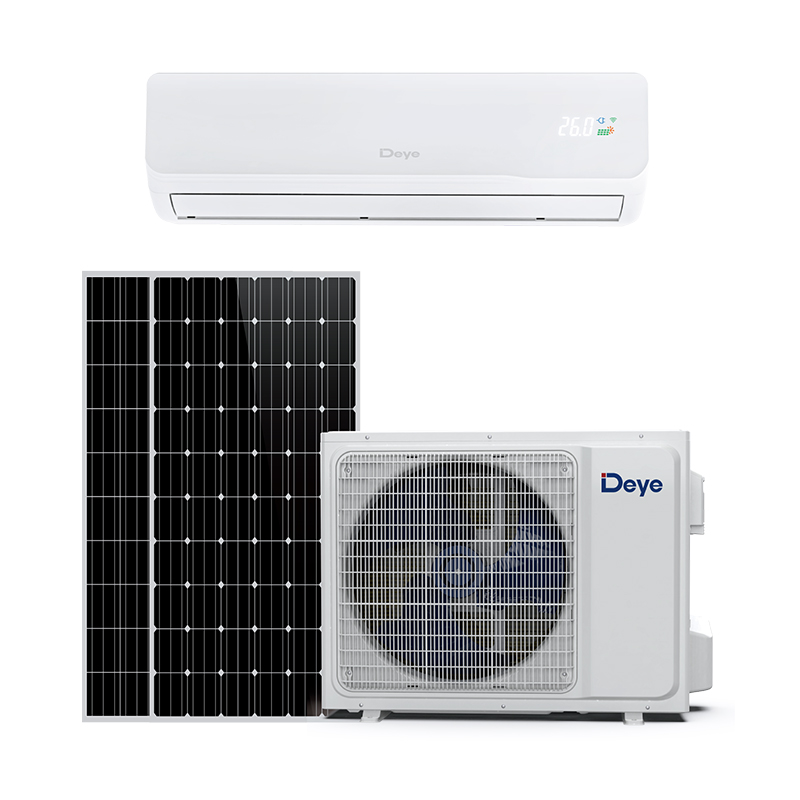
-1.jpg)

Content
- 1 Direct Answer: How Many Solar Panels for Your AC?
- 2 The Core Sizing Formula Used in Real Projects
- 3 Worked Examples: Sizing Different AC Units
- 4 Why SEER, EER, and Compressor Type Change the Result
- 5 Batteries: When They Are Necessary and How to Size Them
- 6 Hybrid AC/DC Solar Air Conditioners Reduce the Panel Count
- 7 Inverter Sizing: The Detail That Breaks Many Solar AC Projects
- 8 How to Reduce the Number of Solar Panels Needed
- 9 Installation Checklist for Solar-Powered AC
- 10 Common Sizing Mistakes and How to Avoid Them
- 11 Frequently Asked Questions
- 11.1 Can one 400W solar panel run an air conditioner?
- 11.2 What size solar system for a 12,000 BTU AC?
- 11.3 Can solar panels run AC at night?
- 11.4 How many batteries do I need to run AC off-grid?
- 11.5 Do I need an MPPT charge controller for a solar AC?
- 11.6 Can a hybrid AC/DC solar AC run from solar panels only?
- 12 Conclusion: The Fastest Way to Estimate Your Solar AC Setup
It was 3:40 p.m. in Karachi when an installer sent me a photo of a roof covered with clean yet unlabeled solar panels. He had already bought a 12,000 BTU air conditioner and was about to pair it with a 1,500W array. His question was simple: what size solar panel do I need to run AC without wasting money on too many panels or suffering from voltage drop when the compressor starts?
The short answer is that most homes need between three and eight modern 400W solar panels to run air conditioning during sunny hours. A 12,000 BTU mini-split with a SEER rating of 15 needs roughly five 400W panels for eight hours of daily operation in a location with five peak sun hours. A 24,000 BTU unit with a similar efficiency rating needs about eight 400W panels. If you replace a conventional AC with a purpose-built solar AC that accepts DC directly from the PV array, the number of panels can drop further because you avoid two energy conversions.
This guide explains the sizing method we use for residential and light commercial projects. It covers AC power consumption, solar panel calculations, batteries, inverter limits, and the places where a hybrid AC/DC solar air conditioner changes the math.
Direct Answer: How Many Solar Panels for Your AC?
For quick planning, use the table below. It assumes 400W solar panels, five peak sun hours, a practical system derate factor of 0.75, and eight hours of AC operation per day. These numbers represent a grid-tied setup where the utility or net metering can handle periods of low solar production.
| AC capacity | Typical running watts | Daily energy use | Required PV array | Number of 400W panels |
|---|---|---|---|---|
| 5,000 BTU window AC | 420W | 3.4 kWh | 900W | 3 |
| 8,000 BTU window AC | 620W | 5.0 kWh | 1,330W | 4 |
| 12,000 BTU mini-split | 800W | 6.4 kWh | 1,700W | 5 |
| 18,000 BTU mini-split | 1,130W | 9.0 kWh | 2,400W | 6 |
| 24,000 BTU mini-split | 1,330W | 10.7 kWh | 2,850W | 8 |
| 36,000 BTU light commercial | 2,000W | 16.0 kWh | 4,270W | 11 |
The table gives a useful starting point, but the real calculation must include your AC's actual SEER rating, your local sun hours, and whether you want battery backup. A 5,000 BTU window AC with a SEER of 10 will consume more energy than the table indicates, while a modern 36,000 BTU inverter unit with a SEER of 21 may need fewer panels than a smaller but older non-inverter AC.
The Core Sizing Formula Used in Real Projects
Use the three-step method below instead of guessing. It works for window units, mini-splits, and central air conditioners.
Step 1: Find the AC running wattage
If the nameplate only gives BTU and SEER, calculate running watts with this formula:
AC running watts = cooling capacity in BTU/h ÷ SEER
For example, a 12,000 BTU mini-split with SEER 15 draws about 800W while cooling steadily. An older 12,000 BTU unit with SEER 10 draws about 1,200W. The efficiency rating directly changes your required solar panel size.
Step 2: Estimate daily cooling energy
Multiply the running wattage by the number of hours you plan to cool. If the 800W mini-split runs for eight hours:
Daily energy = 800W × 8h = 6.4 kWh
This is the number that matters for solar sizing. A higher SEER AC reduces this number before you spend a single dollar on solar panels.
Step 3: Convert daily energy into a solar array size
Use this practical formula for a grid-tied system:
Required PV wattage = daily kWh ÷ (peak sun hours × derate factor)
The derate factor accounts for dust, heat, wiring loss, inverter loss, and the fact that a solar panel rarely produces its rated power at noon on a hot roof. We use 0.75 for grid-tied systems without batteries and 0.65 for systems that charge batteries.
The chart above shows the same information from the table in visual form. Every project still needs a location-specific adjustment because peak sun hours range from about 3.0 in cloudy regions to over 6.5 in desert climates.
Worked Examples: Sizing Different AC Units
Let us apply the formula to three realistic cases. These examples show why "one size fits all" advice fails in the real world.
Example 1: 5,000 BTU Window AC, SEER 12
Running watts = 5,000 ÷ 12 = 417W. If it runs six hours a day, daily energy is 2.5 kWh. With five peak sun hours and a 0.75 derate factor:
Required PV wattage = 2.5 ÷ (5 × 0.75) = 667W
No one makes a 667W panel, so you would use two 330W panels or two 400W panels. Three panels also work if you want to run a small load such as a fan or a phone charger during the same sunny hours.
Example 2: 12,000 BTU Mini-Split, SEER 15
Running watts = 800W. Running eight hours gives 6.4 kWh. With five sun hours and a 0.75 derate factor:
Required PV wattage = 6.4 ÷ (5 × 0.75) = 1,706W
Five 400W panels deliver 2,000W, which covers the derate with a small safety margin. If your location gets 5.5 peak sun hours, four 400W panels may be enough for daytime use only, but we recommend five panels when the roof is hot or the installation angle is not optimal.
Example 3: 24,000 BTU Central AC or Mini-Split, SEER 18
Running watts = 24,000 ÷ 18 = 1,333W. Running eight hours gives 10.7 kWh. With five sun hours:
Required PV wattage = 10.7 ÷ (5 × 0.75) = 2,853W
Eight 400W panels give 3,200W, which is enough for the AC plus normal daytime household loads. In a seven-sun-hour climate, six 400W panels would be enough for AC alone because the array can produce close to 2,400W in the middle of the day.
| AC unit | Running watts | Hours per day | Daily kWh | PV needed | Recommended panels |
|---|---|---|---|---|---|
| 5,000 BTU window AC | 417W | 6h | 2.5 kWh | 667W | 2 × 330W or 3 × 400W |
| 12,000 BTU mini-split | 800W | 8h | 6.4 kWh | 1,706W | 5 × 400W |
| 24,000 BTU mini-split | 1,333W | 8h | 10.7 kWh | 2,853W | 8 × 400W |
Why SEER, EER, and Compressor Type Change the Result
SEER is seasonal energy efficiency ratio. EER is the efficiency at a specific outdoor temperature. Two AC units with the same BTU rating can have completely different running wattage, and that difference changes your solar panel budget more than any other single factor.
A 12,000 BTU non-inverter AC with SEER 10 draws roughly 1,200W. The same capacity AC with a high-efficiency inverter compressor and SEER 20 draws only 600W. That means the first unit needs about ten 400W panels for eight hours of cooling, while the second unit needs only five. Replacing an old AC before adding solar is often cheaper than buying extra solar panels.
Inverter compressor technology also reduces the starting surge. A conventional fixed-speed AC may draw two to four times its running wattage for the first few seconds. An inverter-driven compressor ramps up slowly, so the solar array and battery do not need to handle a massive inrush current. For off-grid installations, this can mean the difference between a 5kW inverter and a 2kW inverter.
Cold-climate operation deserves special attention. When outdoor temperatures are high, the AC has to work harder. But in cooler climates, a standard AC may struggle to run at low ambient temperatures. If you need cooling in hot summers and heating in mild winters, a low-temperature solar heat pump or solar AC with a broad operating range is a more practical choice.
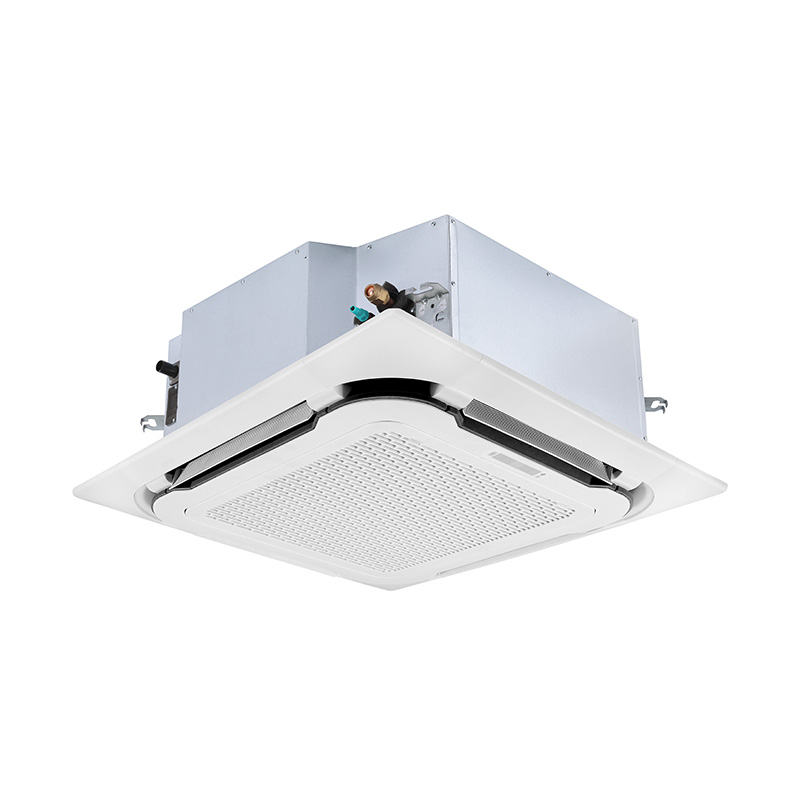
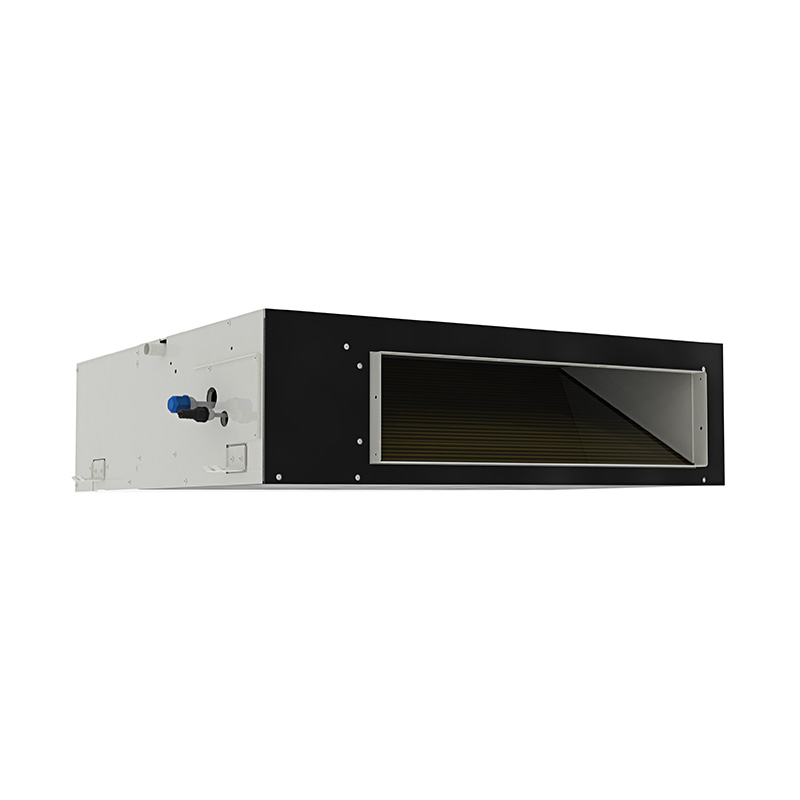
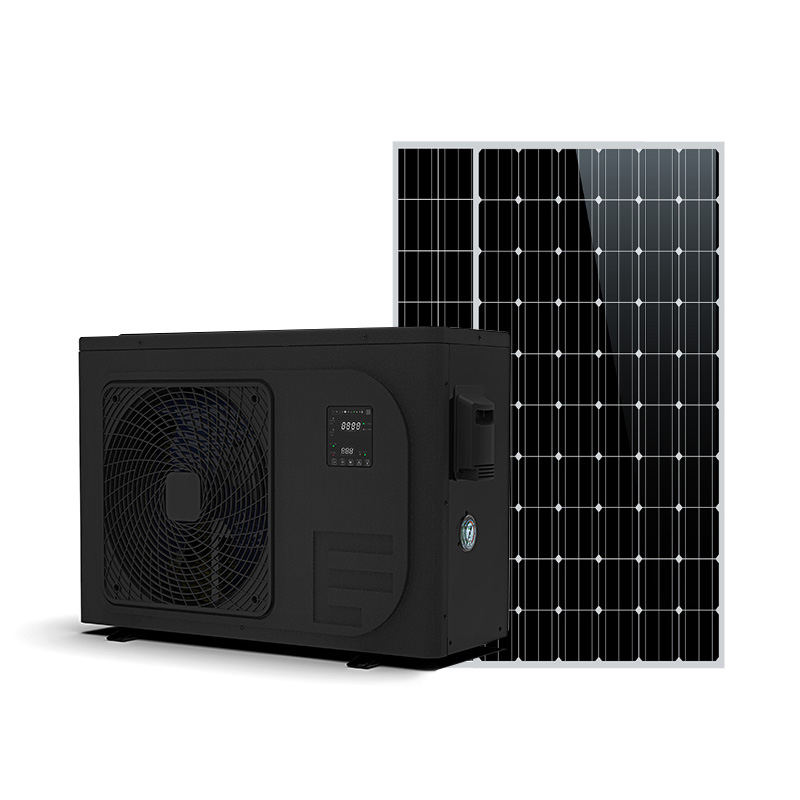
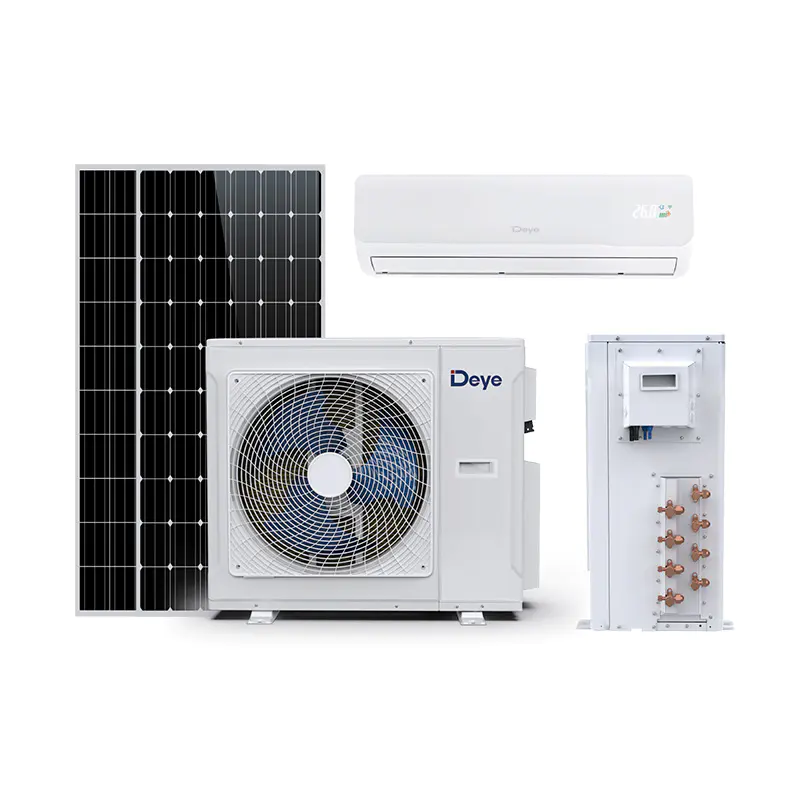
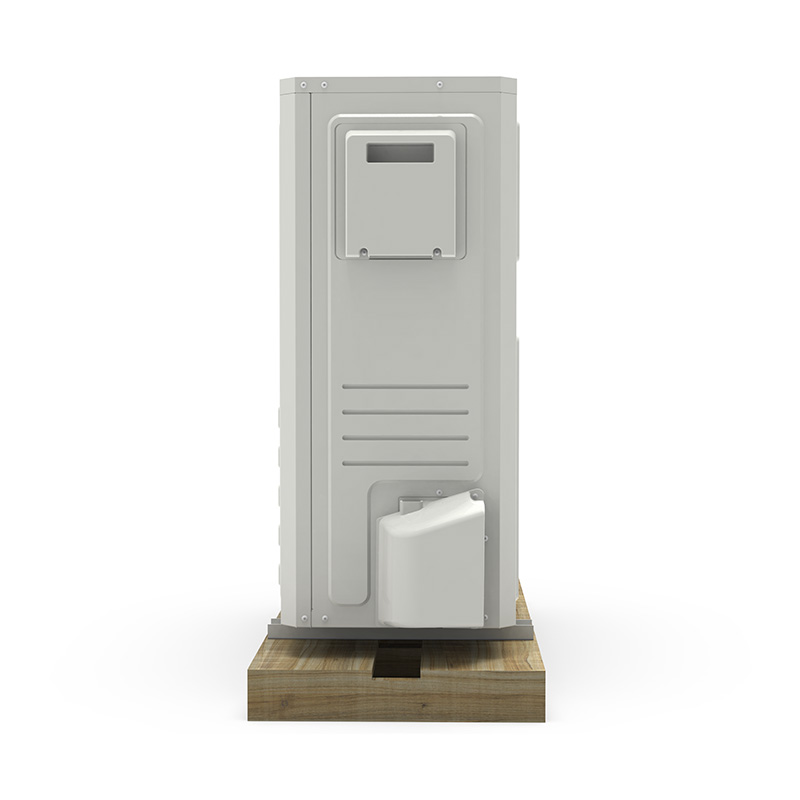 Low Temperature Hybrid AC/DC Solar Air Conditioner with EVIThis hybrid unit uses EVI technology to keep working efficiently in cold climates, combining solar DC with grid AC for reliable heating in cooler regions.View Product →
Batteries: When They Are Necessary and How to Size Them
Many buyers ask whether they can run AC directly from solar panels without a battery. The answer is yes for grid-tied systems and for hybrid solar AC units that mix DC from solar with AC from the grid or a generator. But if you are off-grid, or if the grid is unreliable, batteries become essential.
Grid-tied without battery
Your AC runs from solar during the day. When the sun drops, the AC pulls power from the grid. This minimizes system cost because you only need enough solar panels to offset daytime AC use, and you do not need a large battery bank. Use the 0.75 derate factor for this configuration.
Off-grid with battery
Battery sizing starts with daily AC energy. For the 12,000 BTU mini-split example, the AC uses 6.4 kWh per day. If you want one day of autonomy and you do not want to discharge the battery below 80% depth of discharge:
Battery capacity needed = 6.4 kWh ÷ 0.8 = 8.0 kWh
At a 48V battery voltage, this equals about 167Ah. If you add two days of autonomy for cloudy weather, the battery grows to 16 kWh. Solar panels must also charge the battery with some inefficiency. For the same daily energy with five sun hours and a 0.65 derate factor:
PV wattage = 6.4 ÷ (5 × 0.65) = 1,969W
Five 400W panels again provide the required array size, but with batteries you also need a charge controller and an inverter that can handle the AC starting surge.
For sites where the grid is completely absent or the voltage is too unstable, a dedicated off-grid DC 48V solar AC simplifies the system. This type of unit runs directly from a 48V battery bank and solar array without a separate high-voltage inverter. It is especially popular for remote cabins, mobile homes, and rural telecom shelters.
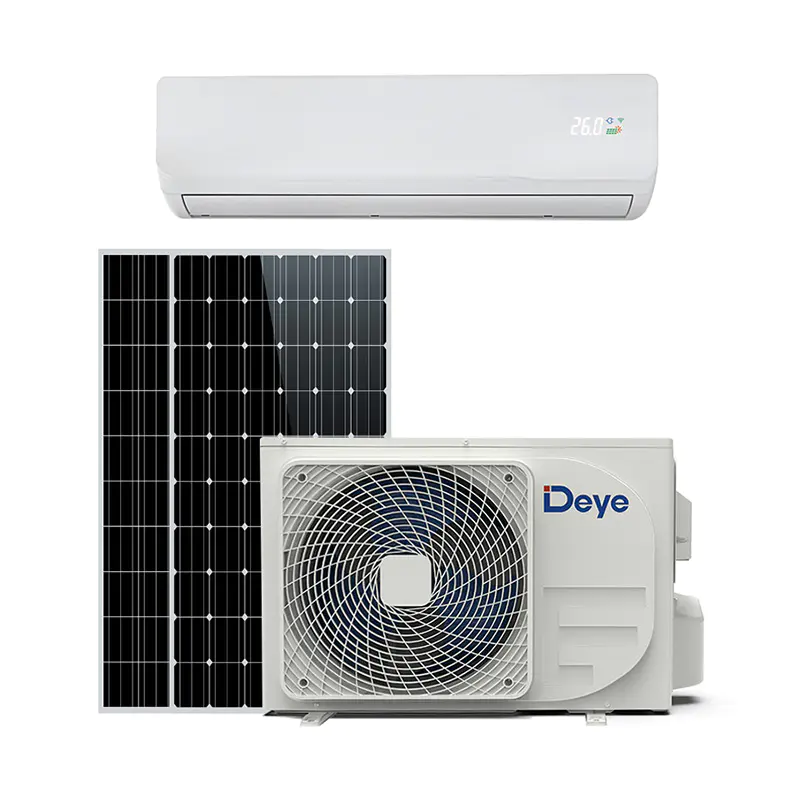
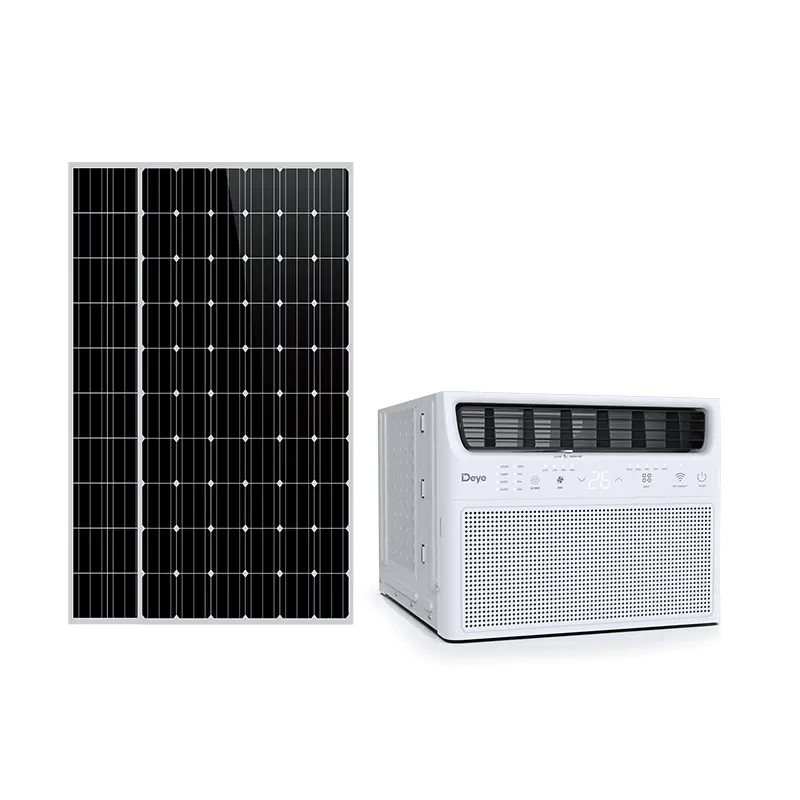
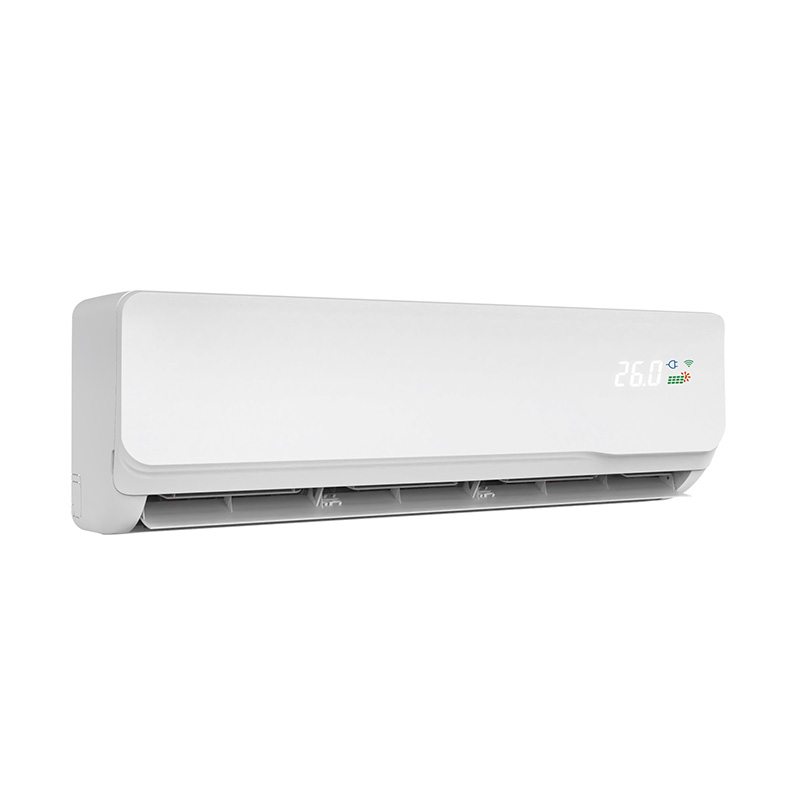 Off-Grid 48V DC Wall-Mounted Solar Air ConditionerDesigned for sites without a stable grid, this unit runs directly from a 48V battery and solar array, making it ideal for remote cabins and telecom shelters.View Product →
Hybrid AC/DC Solar Air Conditioners Reduce the Panel Count
A conventional solar AC system works like this: solar panels produce DC, a PV inverter changes that DC to AC for the AC unit, and the AC unit internally converts AC back to DC for its variable-speed compressor. Every step creates heat and loses energy. A hybrid AC/DC solar air conditioner changes the architecture by sending DC from the PV array directly to the compressor's DC bus, while still allowing AC power from the grid or a generator when solar power is too low.
What does this mean for solar panel sizing? In a standard mini-split with a PV inverter, you should budget for roughly 10% to 15% more solar panels than the AC running wattage formula suggests. In a hybrid AC/DC solar AC, the direct DC path reduces inverter loss during the sunniest hours. The compressor also modulates its speed to match the available solar power, so a 12,000 BTU hybrid AC can continue cooling at partial capacity on a partly cloudy day instead of shutting down completely.
Conventional mini-split
AC and PV are separate. The PV inverter must handle surge current. Power losses occur at the PV inverter and inside the AC power supply. Grid electricity is needed when solar is insufficient.
Hybrid AC/DC solar AC
DC from solar feeds the compressor directly. Grid AC supports the difference. One connection panel handles both sources. Efficiency increases in direct sun and partial load operation is smoother.
Off-grid DC 48V AC
Runs from a 48V battery and DC solar. No high-voltage PV inverter. Designed for isolated areas. Battery bank and solar array must cover peak starting load.
For a 12,000 BTU hybrid AC/DC unit, the practical array size in a sunny climate is often 1,400W to 1,800W, or four to five 400W panels. The same unit in a conventional grid-tied system would need around 2,000W to allow for ACLOSS and inverter efficiency. This is why we recommend thinking of the AC and the solar array as one integrated system rather than buying a random AC and adding panels afterward.
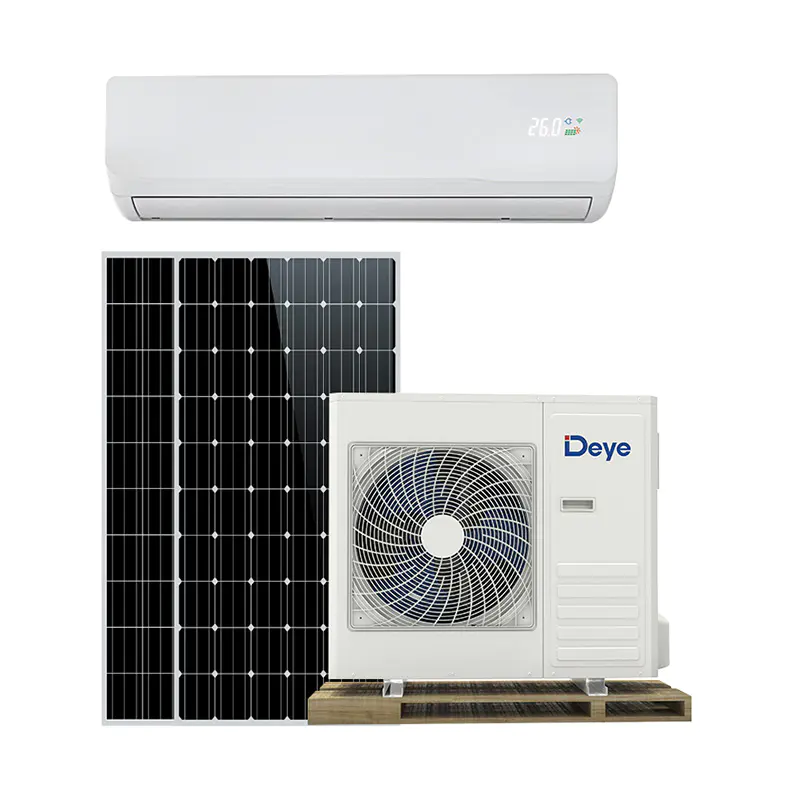
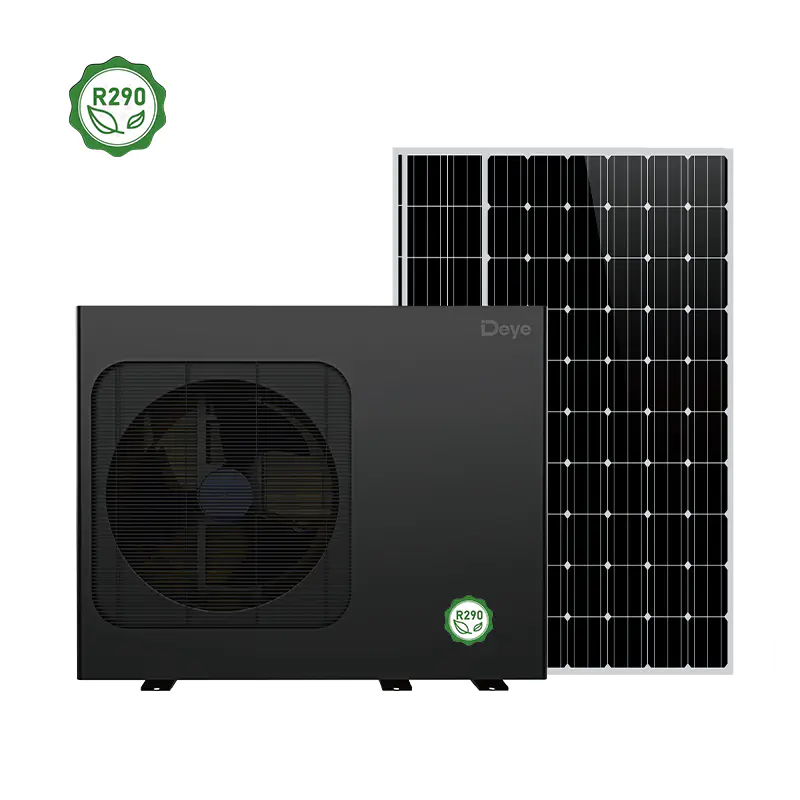
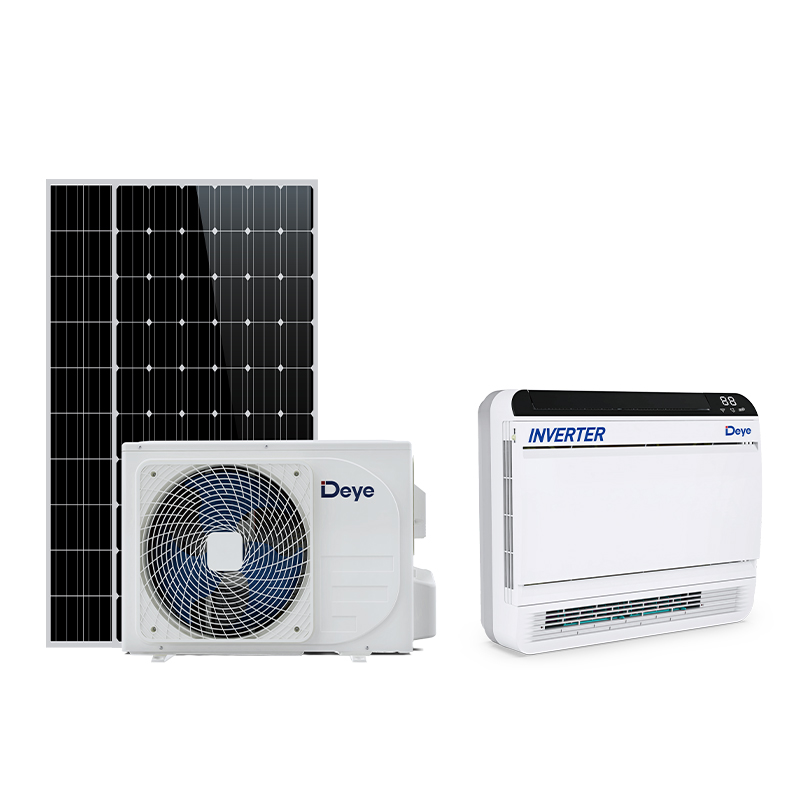
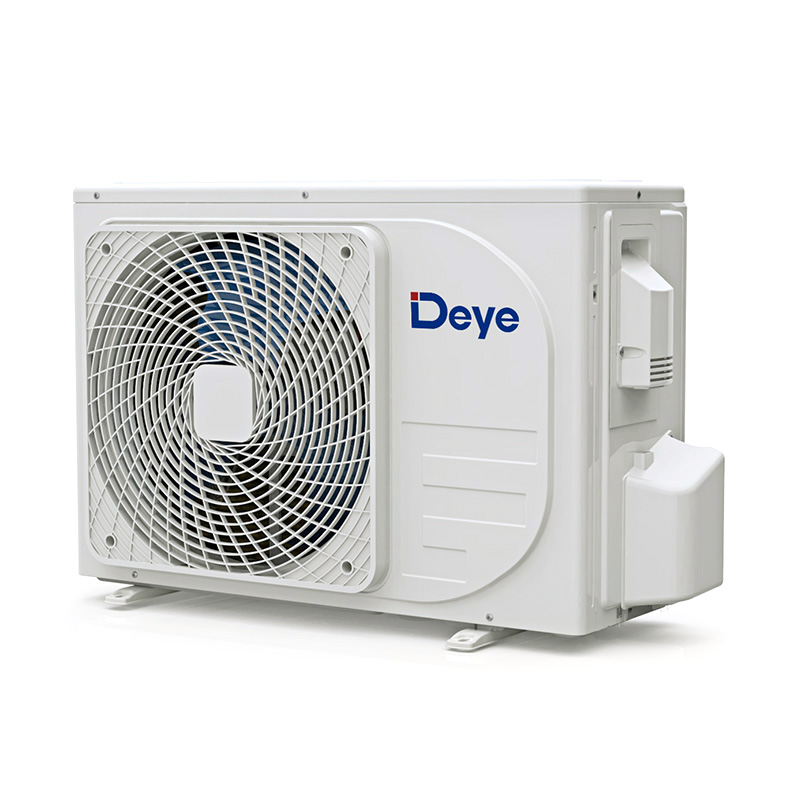 Wall-Mounted Hybrid AC/DC Solar Air Conditioner (R410A/R32)This battery-free hybrid model integrates a solar MPPT booster into the outdoor unit, pairing Deye inverter technology with direct DC solar input for efficient all-season use.View Product →
You can see how hybrid AC/DC operation works in more detail on our industry news page. The most useful takeaway is that panel sizing should always start with the actual control logic of the solar AC, not just the nameplate BTU.
Inverter Sizing: The Detail That Breaks Many Solar AC Projects
Solar panel wattage determines how much energy you can produce. Inverter and battery sizing determine whether that energy can actually start and run the AC compressor. A 5,000W solar array is useless if the inverter trips every time the condenser kicks in.
Standard inverter AC with soft start
Modern inverter compressors have a low starting surge. An 800W running load may surge to 1,400W for a few seconds. A 2,000W pure sine wave inverter is usually enough for a 12,000 BTU inverter mini-split.
Fixed-speed AC with high surge
Older fixed-speed AC units can draw 3,000W to 5,000W for compressor startup even if the running wattage is only 1,200W. In that case, you need at least a 5,000W inverter and a battery that can supply high current without voltage collapse.
- Choose an inverter with at least 1.25 times the running wattage for inverter AC units.
- Use an inverter with at least 2.5 times the running wattage for fixed-speed AC units.
- Check the inverter's peak surge duration; some units only sustain peak for 20 seconds.
- Use a 48V battery bank instead of 12V or 24V for long cable runs.
- Keep the inverter close to the battery and use AWG wire that matches the surge current.
How to Reduce the Number of Solar Panels Needed
Before you spend money on more PV modules, look at all the ways to reduce the horsepower required by the AC and the amount of time it runs. These changes are usually far cheaper than adding another panel.
- Replace an old AC with a high-SEER inverter AC. Going from SEER 10 to SEER 18 can cut AC energy demand by nearly half.
- Use a hybrid AC/DC solar AC instead of a conventional AC. The direct DC path lowers conversion loss and lets the compressor follow solar production.
- Insulate and shade the space. A sealed room with ceiling insulation and window shading needs less cooling energy.
- Set the thermostat to 24°C or 25°C instead of 18°C. Every degree of cooling adds about 3% to 5% to energy use.
- Use ceiling fans or standing fans. Fans improve airflow so you can raise the AC setpoint without losing comfort.
- Clean the air filter and condenser coil regularly. A dirty coil can increase energy use by 15% to 20%.
- Schedule cooling only when the room is occupied. A WiFi controller or timer prevents unnecessary operation.
These steps matter for both grid-tied and off-grid systems. In an off-grid home, reducing daily AC energy by 1 kWh saves roughly 2,000W of solar panel investment and about 1.25 kWh of battery capacity after derate factors are considered.
Installation Checklist for Solar-Powered AC
PV sizing is only part of a reliable system. The physical installation must support the DC current, handle heat, and follow local codes. Use this checklist when you plan the wiring and mounting.
- Orient the solar panels to the true south in the northern hemisphere and true north in the southern hemisphere, with a tilt angle between 15° and 30° for most regions.
- Keep the AC outdoor unit in a shaded area with free airflow. Direct sunlight on the condenser raises operating pressure and increases wattage draw.
- Use PV cable sized for voltage drop below 3% between the array and the inverter or AC connection box.
- Install a DC disconnect switch for easy maintenance and emergency shutdown.
- Use surge protection on both DC and AC sides. Lightning in tropical countries is a leading cause of controller failure.
- Confirm that the AC earth connection is continuous and bonded to the solar inverter or battery frame.
- Test the system under full sun with a clamp meter to verify that the AC input current is not higher than the nameplate value.
Many installers we work with prefer a manufacturer that can supply the full solar AC unit and control box together. This reduces compatibility problems and shortens commissioning time on site.
Common Sizing Mistakes and How to Avoid Them
Mistake 1: Sizing only from BTU
BTU tells you how much heat the AC can remove, not how much electricity it consumes. A 12,000 BTU AC from one brand may draw 700W, while another brand draws 1,100W. Always check the nameplate amps and calculate running watts.
Mistake 2: Ignoring peak sun hours
Two sites with the same latitude can have different solar resources because of fog, rainy seasons, and array tilt. Use historical solar radiation data for the actual city rather than a national average.
Mistake 3: Forgetting the compressor surge
Many off-grid failures are caused by the inverter shutting down when the compressor starts, not by insufficient solar panels. Include surge capacity in the inverter and battery sizing.
Mistake 4: Underestimating cloudy days
If you expect to run AC every evening after a cloudy day, the battery will be drained. Either reduce the daily runtime, add a generator, or increase the panel area to charge the battery faster.
Mistake 5: Choosing a huge local battery instead of a solar AC
A high-efficiency AC is usually less expensive than a battery expansion. For the same daily cooling load, a hybrid AC/DC solar AC can cut the required battery capacity by 20% to 40% because it uses solar power directly during daylight hours.
Frequently Asked Questions
Can one 400W solar panel run an air conditioner?
No, not a typical room AC for more than a short test. A 400W panel produces around 1.6 to 2.4 kWh per day in good sun, but a 5,000 BTU AC needs at least 2.5 kWh per day for six hours of cooling. One panel may run a very small 12V DC fan cooler, but not a standard compressor AC.
What size solar system for a 12,000 BTU AC?
For daytime use, a 1,700W to 2,000W solar array is a practical starting point. With five hours of sun, five 400W panels cover the daily energy of a SEER 15 mini-split running eight hours. With a hybrid AC/DC solar AC, 1,400W to 1,800W may be enough.
Can solar panels run AC at night?
No. Solar panels produce no electricity at night. Unless you have a battery system, the AC must rely on grid power or another backup source. A hybrid AC/DC unit can switch to grid power at night, but the solar panel itself will not supply energy.
How many batteries do I need to run AC off-grid?
Start with daily AC energy and multiply by the number of autonomy days, then divide by depth of discharge. A 12,000 BTU AC using 6.4 kWh per day needs about 8 kWh of usable battery capacity for one day. At 48V, this is roughly 167Ah.
Do I need an MPPT charge controller for a solar AC?
If your solar AC has a separate DC input from solar panels, the unit usually includes or requires an MPPT controller. If you are using a conventional AC with a battery and inverter, an MPPT charge controller is essential to harvest maximum power from the PV array.
Can a hybrid AC/DC solar AC run from solar panels only?
Yes. When solar power is available, the unit uses DC power directly. When solar output is insufficient, it automatically draws AC power from the grid or a generator. This makes it more flexible than a pure off-grid DC AC unit.
Conclusion: The Fastest Way to Estimate Your Solar AC Setup
Start with the AC's running watts, not its BTU rating. Calculate daily energy by multiplying running watts by cooling hours. Then divide by local sun hours and a derate factor of 0.75 for grid-tied systems or 0.65 for battery systems. Choose standard high-quality panels in the 330W to 450W range because they offer the best cost per watt.
If the project is off-grid, account for compressor surge, battery voltage, and days of autonomy. If the project is on-grid and the main aim is lowering daytime electricity bills, a hybrid AC/DC solar AC can provide more usable cooling per installed watt because it avoids unnecessary conversions and continues running at partial power in changing sunlight.
As a manufacturer of solar air conditioners, we have seen projects fail from oversizing as often as undersizing. The correct answer always comes from measuring actual conditions rather than copying a neighbor's system. Use this guide as the starting point, then confirm the final array size with your local installer or with our engineering team through the contact page. If you want to understand the technology behind the calculation, our company background explains how the Deye engineering team moved from DC inverter controller development to complete solar AC systems.
