

 Español
 русский
 Français
 Português
 Deutsch
 عربى
 italiano


Content
- 1 What Actually Happens When the Sun Hits the Panel
- 2 The Four-Stage Power Path, Stage by Stage
- 3 DC, AC and Hybrid: Three Architectures Compared
- 4 Why the Compressor Is the Whole Story
- 5 Sizing: How Much PV Does a Solar Air Conditioner Really Need
- 6 Reading the Efficiency Numbers Without Getting Fooled
- 7 Four Installation Profiles and What Each One Demands
- 8 Failure Modes, Maintenance and the Mistakes That Cost Money
- 9 Specification Checklist Before You Place an Order
- 10 Frequently Asked Questions
- 10.1 Does a solar air conditioner work at night?
- 10.2 Can I run a solar air conditioner without any battery?
- 10.3 How many solar panels do I need for a 1.5-ton unit?
- 10.4 Does the air conditioner still work during a grid outage?
- 10.5 What maintenance does the solar side need?
- 10.6 Is a solar air conditioner worth it compared with a high-efficiency conventional unit?
- 10.7 Which refrigerant should I specify?
- 10.8 How does a solar air conditioner compare with a solar thermal cooling system?
- 10.9 What happens on a partly cloudy day?
- 10.10 Can a solar air conditioner also provide heating?
What Actually Happens When the Sun Hits the Panel
A solar air conditioner does not use sunlight to chill refrigerant directly, and it does not need a battery bank to start running. It takes direct current from a photovoltaic array, converts it into controlled rotary motion inside a variable-speed compressor, and adjusts that motion many times per second so the cooling output tracks the sunlight available at that moment. The controller, the inverter bridge, the electronic expansion valve and the outdoor fan all exist to support that one energy transfer.
Three facts explain most of the behaviour you will observe in the field. First, photovoltaic modules produce DC, and a DC inverter compressor is a DC load, so the intermediate conversion step that a conventional mains-powered unit performs is partly removed. Second, the compressor is the only component that consumes the majority of the power; fans and control boards together typically draw less than 10 percent of rated input, which is why the compressor architecture decides the whole system's behaviour. Third, sunlight is intermittent, so every practical design has either a second power source, a storage buffer, or a thermal mass strategy to bridge clouds and evening hours.
When a cloud covers the array, PV output can fall by 60 percent or more within seconds. A unit that was running at 2.8 kW of cooling capacity may find itself with only 40 percent of its rated DC input. What happens next separates a mature design from a laboratory prototype: a well-matched controller reduces compressor frequency smoothly, keeping the evaporator above freezing and the room comfortable, rather than tripping on undervoltage and restarting.
| Component | Function in the cooling cycle | Response when PV output changes |
|---|---|---|
| PV array | Generates DC power proportional to irradiance and module temperature | Output falls with shading, dust, high module temperature and low sun angle |
| MPPT boost controller | Tracks the maximum power point of the array and raises or lowers voltage to the DC bus | Re-tracks within milliseconds; keeps the bus stable while input collapses |
| Inverter module | Converts DC bus voltage into three-phase variable-frequency AC or direct DC modulation for the compressor | Adjusts switching pattern and frequency limit to match available power |
| Inverter compressor | Raises refrigerant pressure and drives the vapour-compression cycle | Slows down instead of stopping; frequency floor prevents lubrication starvation |
| Electronic expansion valve | Meters refrigerant flow into the evaporator | Opens or closes to hold superheat as mass flow drops |
| Outdoor fan and control board | Reject heat at the condenser; manage logic, protection and communication | Fan speed reduces with load; protection thresholds guard against low DC voltage |
The practical consequence is that a solar air conditioner behaves more like a dimmable lamp than an on-off switch. Output scales with available energy rather than snapping between full power and nothing, which is exactly why the technology became viable once inverter control became cheap enough to embed in a residential outdoor unit.
The Four-Stage Power Path, Stage by Stage
Follow the energy from a 6 kW rooftop array through to a 12,000 BTU indoor unit and you pass four distinct stages. Each stage has its own efficiency loss and its own failure signature, which is why service technicians should be able to identify which stage is underperforming from the symptoms alone.
Stage 1: Harvest
Modules wired in series produce a string voltage that rises in cold weather and sags in heat. A 550 W module at 25 °C might sit near 41 V open circuit, but at 65 °C cell temperature the same module loses roughly 8 to 12 percent of its power. Cable sizing matters here more than most installers expect: a 4 mm² run of 30 metres carrying 15 A loses enough voltage to cost a measurable share of daily cooling.
Stage 2: Condition
The MPPT controller holds the array at its maximum power point while presenting a regulated DC bus to the inverter. This is the stage that absorbs the mismatch between a string that wants to swing between 180 V and 340 V and a compressor drive that needs a stable rail. Boost ratio, switching frequency and thermal design determine whether the controller survives a 45 °C ambient afternoon.
Stage 3: Convert
The inverter bridge turns the DC rail into a three-phase waveform with adjustable voltage and frequency, or in a direct-DC design, modulates the effective voltage applied to the compressor windings. A 180-degree sine wave control scheme produces a smooth rotating field rather than the stepped approximation used by older 120-degree commutation, cutting torque ripple and audible noise at low speed.
Stage 4: Modulate
Compressor speed is chosen to hold suction pressure, discharge temperature and room setpoint simultaneously. A typical residential hybrid unit sweeps from roughly 15 Hz to 120 Hz. At 20 Hz the cooling output may be only 25 percent of nominal, which is precisely the range where solar production and building load most often overlap.
Note where the battery would sit if one were used: after stage 2, on the DC bus. Removing the battery does not remove the need to manage that bus, which is why the controller in a battery-less hybrid unit carries more responsibility than a charge controller in an off-grid power system.
DC, AC and Hybrid: Three Architectures Compared
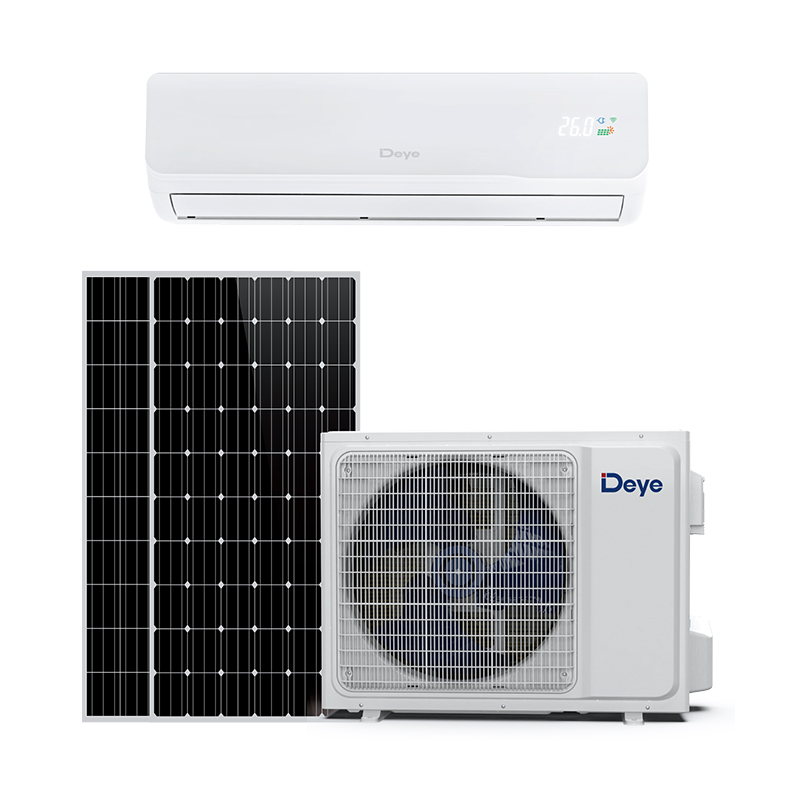
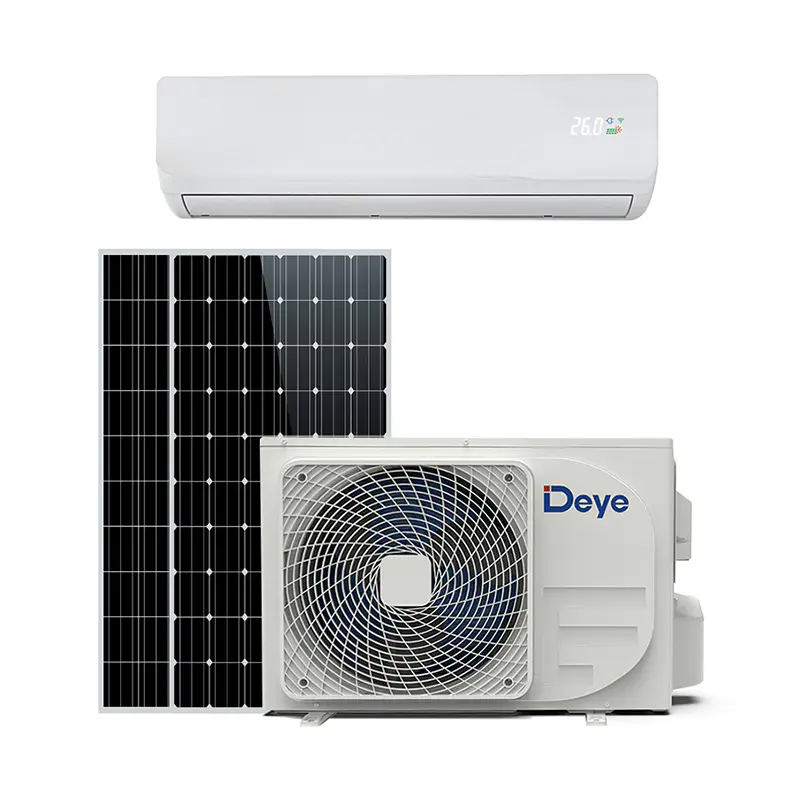
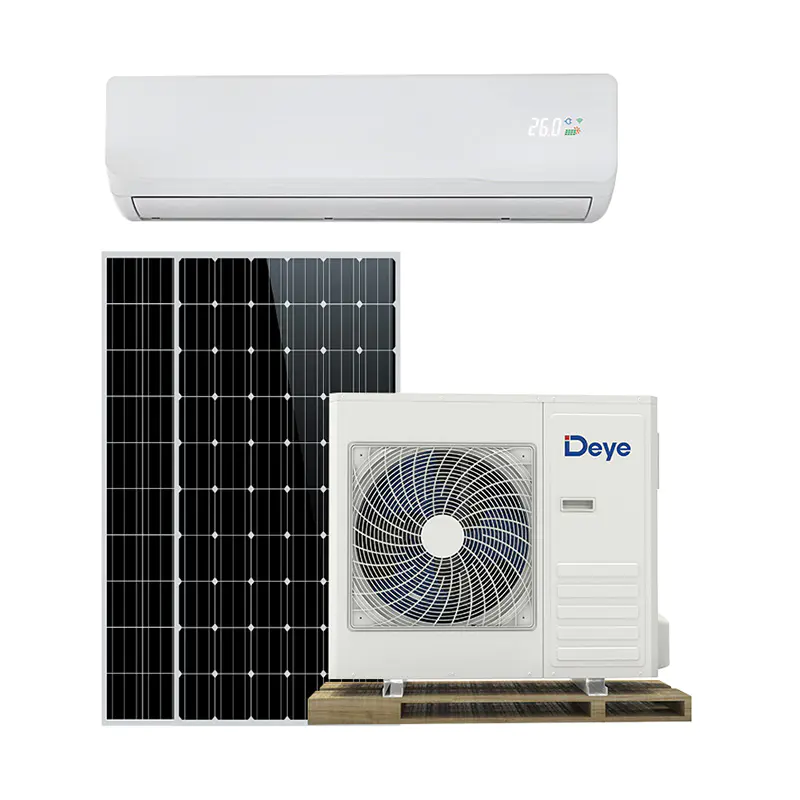
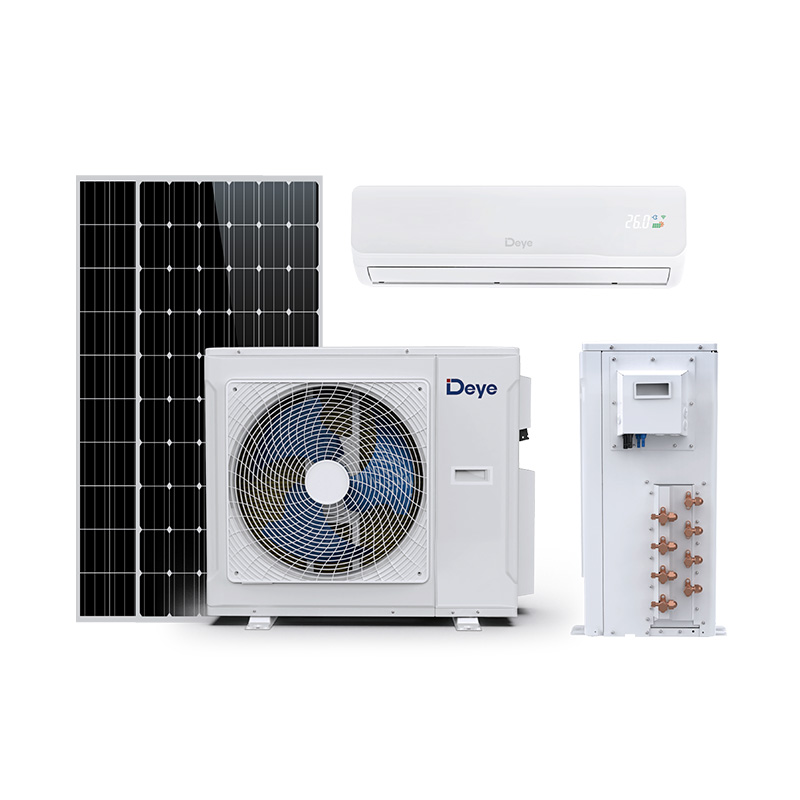
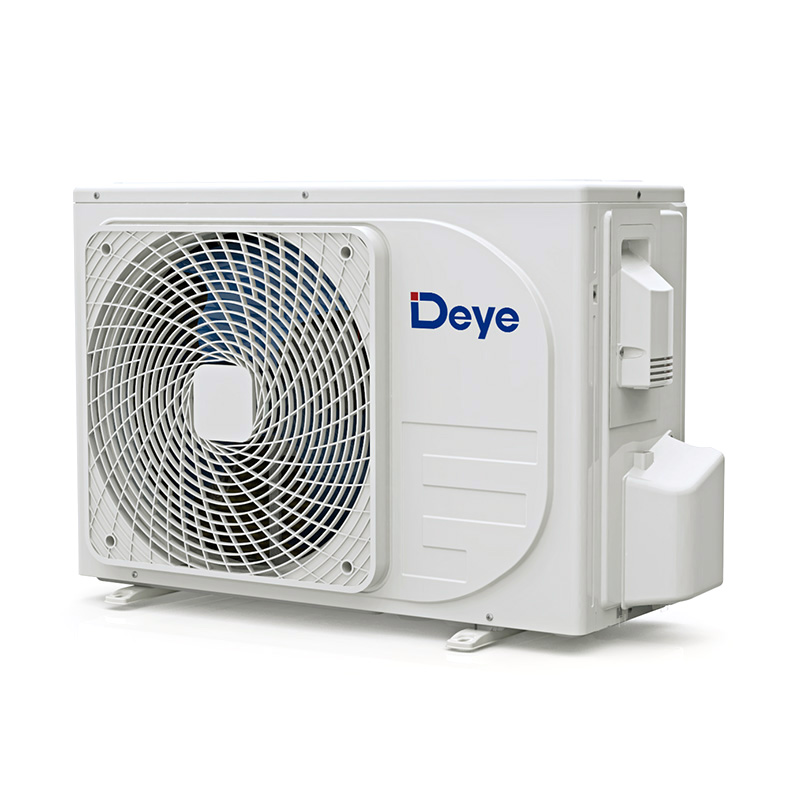 Wall-Mounted Battery-Free Solar Hybrid Air ConditionerBattery-free wall-mounted split system with built-in MPPT booster and inverter, blending solar and grid power for DC inverter cooling and heating.View Product →
Buyers frequently conflate three different products under one name. They are not interchangeable, and specifying the wrong one is the most expensive mistake in this category.
| Architecture | Input sources | Typical use case | Constraint to plan for |
|---|---|---|---|
| Off-grid DC | PV array and battery bank at 48 V DC | Sites with no reliable grid, telecom shelters, remote cabins | Battery bank sizing dominates cost; night operation limited by stored energy |
| Hybrid ACDC | PV array plus mains AC, switched automatically | Homes and shops with an intermittent or expensive grid connection | Requires a properly sized AC circuit as a fallback path, not as the primary source |
| Solar-ready AC | Mains AC only, with a dedicated PV input on some models | Grid-tied buildings offsetting consumption through net metering | Depends on utility tariff rules; no independence during an outage |
The hybrid ACDC category is where most residential demand now sits, because it answers a question buyers actually ask: what happens at night, or during a week of monsoon cloud? The answer is that the unit runs on mains power with the same efficiency as a conventional inverter air conditioner, then returns to solar priority the moment array voltage recovers. There is no manual changeover and no intervention from the occupant.
The switching logic deserves scrutiny during specification. A robust design monitors DC bus voltage, array current and compressor demand together, then decides whether to blend sources or transition fully. Units that simply drop to AC whenever DC falls below a fixed threshold will oscillate between sources on partly cloudy days, and each transition stresses the contactors and the inverter bridge. Ask for the hysteresis band and the minimum dwell time before a source change, because those two numbers predict long-term reliability more accurately than any brochure claim.
Sizing the AC fallback circuit is straightforward but often neglected. If the unit draws 1.6 kW at rated cooling on mains, the circuit must be sized for that continuous load plus startup tolerance, not for the lower average consumption that solar input makes possible during the day. Undersizing the AC feed because "the sun does most of the work" produces nuisance trips in the rainy season.
Why the Compressor Is the Whole Story
Two compressors with identical displacement can behave completely differently on a solar bus. The difference lies in how the motor is driven.
A conventional fixed-speed compressor starts across the line, drawing five to seven times its running current for a fraction of a second. On a PV array with limited short-circuit current, that inrush collapses the bus voltage and the drive trips. A DC inverter compressor ramps instead, starting near 15 Hz and climbing only as fast as available power allows. This is not a refinement; it is the enabling condition for battery-less solar cooling.
The control scheme matters at the low end of the speed range. With 180-degree sine wave commutation, current in each phase follows a smooth sinusoid, so the air gap flux rotates evenly and torque stays nearly constant through each electrical cycle. Older 120-degree schemes leave the unenergised phase floating for 60 degrees, producing torque dips that show up as vibration at 20 to 30 Hz, exactly where a solar unit spends much of its operating life. Vibration accelerates bearing wear and loosens tubing joints, so the control detail has a direct maintenance consequence.
Field measurements from low-load operation illustrate the point. A 12,000 BTU hybrid unit running at 22 Hz on 900 W of array output delivered roughly 1.1 kW of cooling with a condensing temperature only 6 °C above ambient. The same unit stepping to 60 Hz on mains power delivered 3.4 kW cooling with a condensing temperature 14 °C above ambient. Lower lift at low speed is not a trick of the measurement; it is the thermodynamic reward for matching capacity to load.
Protection behaviour completes the picture. Three limits dominate: a minimum DC bus voltage below which the drive stops modulating, a maximum discharge temperature that forces frequency reduction, and a minimum oil return frequency that prevents the compressor from running too slowly for too long. Well-designed firmware balances all three, which is why the same hardware can feel either smooth or erratic depending on who wrote the control logic.
Sizing: How Much PV Does a Solar Air Conditioner Really Need
Start with rated input power, not rated cooling capacity. A 12,000 BTU hybrid unit typically draws between 1.0 and 1.4 kW at rated conditions. Divide that by a realistic module yield, and then add margin for the two losses nobody wants to discuss: high module temperature and non-ideal tilt.
A workable planning figure for most latitudes is 75 to 80 percent of nameplate array capacity as real midday output. So a 1.2 kW load needs roughly 1.5 to 1.6 kWp of array to run continuously at full speed around solar noon. Because the unit modulates, a smaller array still produces useful cooling for more hours of the day.
| Cooling capacity | Rated compressor input | Array for full-speed noon operation | Array for 70 percent average output |
|---|---|---|---|
| 9,000 BTU | 0.85 kW | 1.1 kWp | 0.8 kWp |
| 12,000 BTU | 1.15 kW | 1.5 kWp | 1.05 kWp |
| 18,000 BTU | 1.70 kW | 2.2 kWp | 1.55 kWp |
| 24,000 BTU | 2.30 kW | 3.0 kWp | 2.1 kWp |
| 36,000 BTU cassette | 3.40 kW | 4.4 kWp | 3.1 kWp |
Values represent the proportion of instantaneous compressor input supplied by the array. The shortfall is drawn from the AC feed without any manual switching.
Three site variables shift these numbers more than any specification sheet. Tilt and azimuth are the largest: a roof facing 40 degrees away from the ideal azimuth can lose 10 to 15 percent of daily yield. Dust and soiling cost 3 to 8 percent in dry climates and considerably more near construction activity. Cable and connector losses add another 2 to 3 percent if string runs exceed 25 metres.
Do not forget the indoor unit's fan, which continues to run on mains power in most hybrid designs and consumes 30 to 60 W. It is a small number, but it is the reason a system can appear to "use grid power even at noon" on a monitoring dashboard.
Reading the Efficiency Numbers Without Getting Fooled
Adsorption and desiccant systems are a genuinely different technology, using solar heat rather than electricity, and they belong to a separate conversation. The overwhelming majority of products sold today are photovoltaic vapour-compression units, judged on the same metrics as any air conditioner.
Capacity holds near nominal up to about 15 C, then declines as condensing temperature rises. The shape explains why oversizing an outdoor coil helps hot-climate performance more than increasing compressor displacement.
Seasonal efficiency ratings compress an entire year of weather into one number, and they mislead in exactly the conditions solar units operate. A high seasonal rating earned in mild climate bins tells you little about 46 C afternoons, when capacity loss and compressor current both peak.
- Check the rated capacity at 43 C or 46 C, not only at the standard 35 C test point. A 5 to 10 percent derate is normal; a 25 percent derate signals an undersized condenser.
- Compare coefficient of performance at part load. Most solar hours are spent between 30 and 70 percent capacity, so that is the operating region worth optimising.
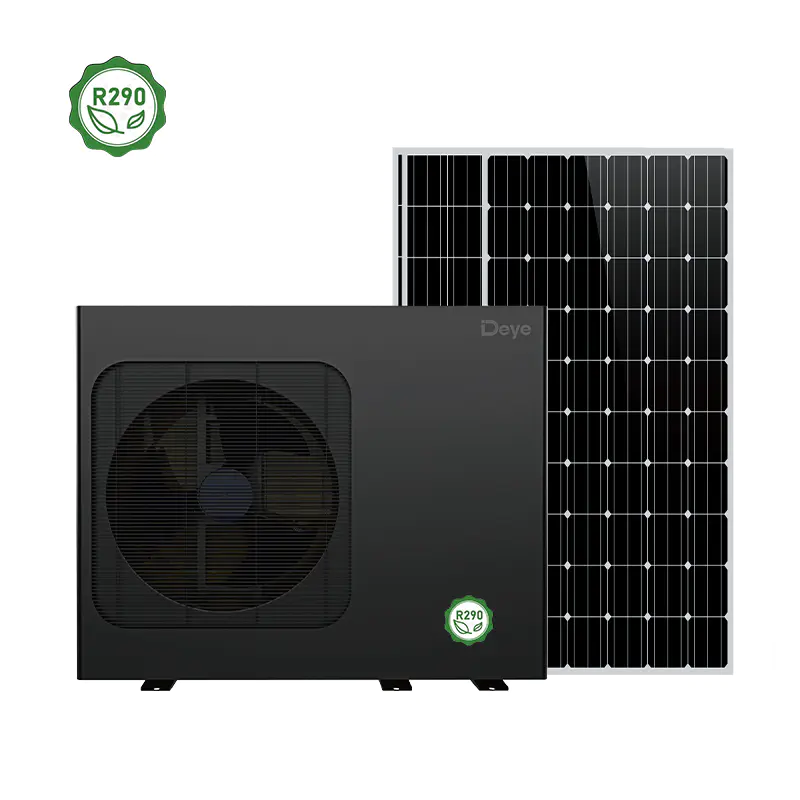
- Confirm the refrigerant. R32 and R410A dominate wall-mounted hybrid products, while R290 appears in monoblock heat pumps with strict charge limits. Refrigerant choice affects service logistics and future availability, not just efficiency.
- Ask for the compressor frequency range and the minimum cooling output. A unit that cannot go below 30 percent of nominal will cycle on a lightly loaded afternoon, wasting the solar advantage.
Four Installation Profiles and What Each One Demands
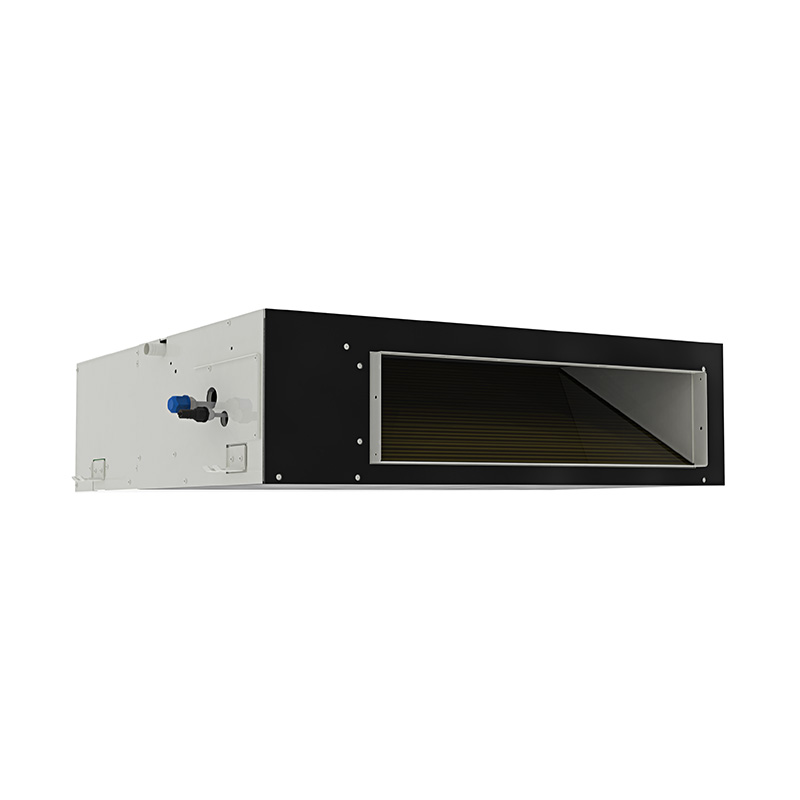
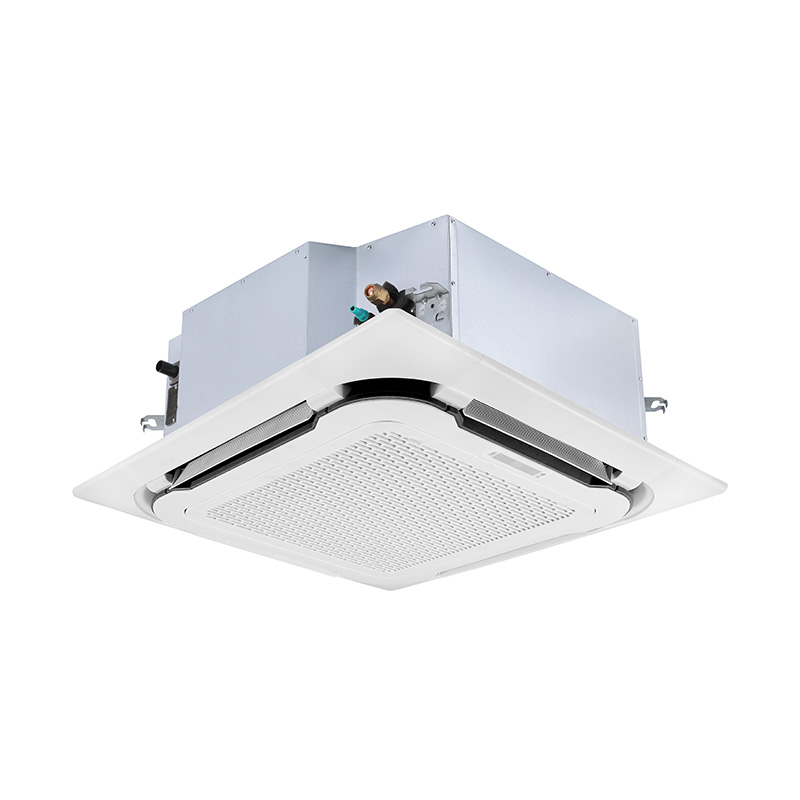 Light Commercial Solar Cassette Air ConditionerCeiling-mounted cassette unit for light commercial spaces, using solar and grid power with DC compressor, four-way airflow, and Wi-Fi monitoring.View Product →
The same product family behaves differently depending on where it is installed. These four profiles cover most of the enquiries that reach a manufacturer's technical desk.
Coastal residence with a weak grid
Voltage sags to 190 V for two hours each evening. A hybrid wall-mounted unit with a wide AC input tolerance keeps running while neighbours' fixed-speed units trip. Priority: input voltage range and protection behaviour, not peak efficiency.
Light commercial shop with a flat roof
Cassette units serve a 90 m² retail floor with a 6 kWp array above. Duct and cassette formats need a condensate route and service access planned before the ceiling closes. Priority: static pressure, drain slope and access panel clearance.
Remote site with no grid at all
A 48 V DC off-grid unit with a modest battery bank. The compressor's slow ramp and low starting current let a smaller battery survive the evening. Priority: minimum DC voltage threshold and low-voltage cut-off behaviour.
Cold-climate workshop
Winter temperatures reach -15 C and summer cooling is still required. A low-temperature hybrid model with refrigerant injection handles both seasons. Priority: heating capacity retention at low ambient and defrost logic quality.
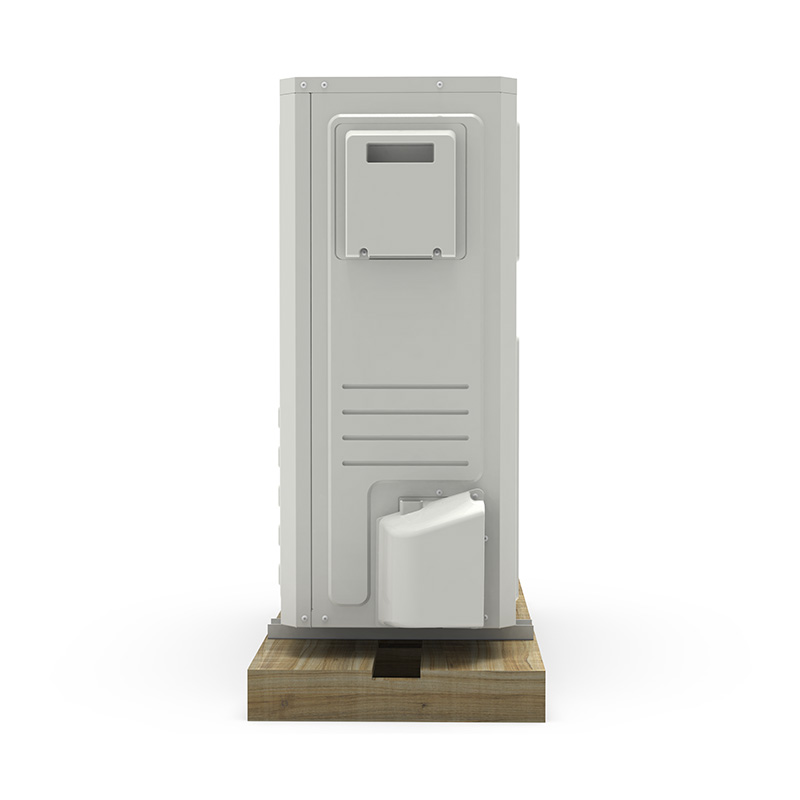 Low-Temperature Solar Hybrid AC/DC Air ConditionerHybrid R32 solar air conditioner with enhanced vapor injection and automatic AC/DC switching, intended for reliable heating and cooling in cold climates.View Product →
In our own production history, the transition from third to fourth-generation solar units came down to control firmware rather than hardware. The 2007 development of a 180-degree sine wave DC inverter controller gave the engineering team the algorithmic base that later allowed solar input to be blended with mains supply without a battery buffer. Units built on that platform have been shipped to more than 20 countries since 2020, including markets in South Asia, the Middle East and Australia where ambient temperatures routinely exceed 45 C.
Manufacturing tolerance becomes visible at this stage. A 2 percent variance in inverter module calibration between units translates into noticeably different low-light behaviour in the field, which is why end-of-line testing under simulated partial shading matters more than a catalogue tolerance figure. Details of the production and test process are documented on our company profile page.
Failure Modes, Maintenance and the Mistakes That Cost Money
Solar air conditioners do not fail in novel ways. They fail in the ordinary ways, accelerated by two factors: unstable DC input and installers who treat the PV side as an afterthought.
- Undervoltage tripping during cloud transients. Usually caused by an array that is too small for the configured minimum bus voltage, or by undersized DC cable adding voltage drop. Remedy: recalculate string voltage at 70 C cell temperature, not at standard test conditions.
- Frequent source switching on partly cloudy days. Symptom is contactor chatter and short compressor restarts. Remedy: increase the hysteresis band and enforce a minimum dwell time in the controller parameters.
- Reduced cooling with a clean filter and normal refrigerant charge. Often a dirty condenser combined with high ambient, pushing discharge temperature past the derate threshold so the drive limits frequency. Remedy: coil cleaning schedule and a check of fan blade pitch.
- Noise at low compressor speed. Frequently traced to tubing vibration excited by residual torque ripple, or to a mounting bracket that lost its isolation grommets. Remedy: verify control scheme and inspect pipe clamps.
- Premature connector failure on the roof. Caused by dissimilar metals and thermal cycling at a junction that was never crimped to the correct torque.
Preventive maintenance for a solar unit adds two tasks to a conventional schedule. Array cleaning should follow local soiling conditions, typically every two to four months in dusty regions and less often in temperate ones. DC isolation and connector torque checks belong on an annual visit, ideally before the cooling season rather than during it.
Refrigerant-side maintenance is unchanged: verify superheat and subcooling, confirm the expansion valve responds to load changes, and check that the compressor crankcase heater is functioning before cold-weather startup. The one solar-specific addition is a review of logged frequency data. A compressor that never exceeds 45 Hz across a full summer suggests the array is undersized or a string is underperforming, and that pattern is invisible on a single service visit.
Specification Checklist Before You Place an Order
Sixteen data points separate a workable specification from a hopeful one. Request them in writing, because verbal assurances about "working with solar" carry no engineering content.
| Category | Data point | Why it matters |
|---|---|---|
| Electrical | DC input voltage window | Determines usable string length and behaviour at high module temperature |
| Electrical | AC input voltage tolerance | Predicts performance on weak or fluctuating grids |
| Electrical | Source transfer logic and hysteresis | Governs switching frequency and contactor life |
| Performance | Capacity at 43 C ambient | Real hot-climate output rather than laboratory rating |
| Performance | Compressor frequency range | Defines minimum output and part-load capability |
| Performance | COP at 50 percent load | Reflects the region where solar hours are actually spent |
| Mechanical | Refrigerant type and charge | Affects service availability and regulatory compliance |
| Mechanical | Condenser coil face area and rows | Strong predictor of high-ambient capacity retention |
| Mechanical | Sound pressure at low speed | Matters for bedroom and retail applications |
| Installation | Maximum pipe run and elevation | Constrains where the outdoor unit can sit relative to the array |
| Installation | Drain route requirements | Cassette and duct formats need gravity fall planned early |
| Control | Communication protocol and monitoring access | Enables fault diagnosis without a site visit |
| Protection | Low-voltage cut-off and recovery thresholds | Prevents oscillation and nuisance lockouts |
| Protection | Compressor restart delay | Protects against short cycling after a source change |
| Documentation | Wiring diagram with PV and AC feeds | Required for inspection and future service |
| Documentation | Warranty terms separated by component | Compressor, inverter module and controller often differ |
Two commercial questions belong on the same list. Ask how spare inverter modules and control boards are stocked for your region, and ask what the firmware update path looks like. A solar air conditioner is a power electronics product as much as a refrigeration product, and the support model should reflect that.
Frequently Asked Questions
Does a solar air conditioner work at night?
Yes, if it is a hybrid or grid-connected model. After sunset the unit draws from the mains supply and operates exactly like a conventional inverter air conditioner, with the same efficiency rating. Off-grid DC models continue only while the battery bank holds charge, so night operation is a function of battery capacity rather than of the air conditioner itself.
Can I run a solar air conditioner without any battery?
Yes. Battery-free operation is the standard configuration for hybrid ACDC units. The compressor modulates its speed to match available array power, and mains supply covers any shortfall instantly. The trade-off is that cooling output follows sunlight rather than remaining constant, which is acceptable for most residential daytime loads but must be planned for in commercial settings.
How many solar panels do I need for a 1.5-ton unit?
For a 12,000 BTU hybrid unit drawing roughly 1.15 kW at rated conditions, plan 1.5 kWp of array for full-speed operation at solar noon, or about 1.0 kWp if you accept reduced output during the hottest hours. Four 400 W modules typically cover the first case, allowing for tilt, soiling and cable losses.
Does the air conditioner still work during a grid outage?
Only if the unit is an off-grid DC model, or if the hybrid design includes a dedicated islanding mode with an independent AC output. Standard hybrid units synchronise with the mains and will stop when the grid disappears, because their AC fallback path has no source. Buyers who need outage resilience should specify that requirement explicitly rather than assume it.
What maintenance does the solar side need?
Module cleaning according to local soiling, typically every two to four months in dusty climates, plus an annual check of DC connectors, cable gland sealing and string voltage under load. The refrigeration side follows a conventional schedule: coil cleaning, refrigerant charge verification and electrical connection torque checks.
Is a solar air conditioner worth it compared with a high-efficiency conventional unit?
The comparison depends on daytime load profile and tariff structure. A solar unit earns its premium when cooling demand coincides with strong irradiance, which is precisely when conventional units impose the highest grid draw. In markets with high daytime tariffs and long cooling seasons, the payback period is typically shorter than for a battery storage system of equivalent capital cost, and it avoids battery replacement cycles entirely.
Which refrigerant should I specify?
R32 is now the common choice for wall-mounted hybrid units because of its lower global warming potential and favourable charge efficiency. R410A remains widely available and well understood by service networks. R290 appears in monoblock heat pump products where charge limits can be respected. The practical criterion is local service capability, because a refrigerant nobody nearby can handle becomes a liability.
How does a solar air conditioner compare with a solar thermal cooling system?
They are different technologies. Solar thermal cooling uses heat-driven absorption or desiccant processes and is generally suited to large commercial installations with substantial collector areas. Photovoltaic vapour-compression units use standard refrigeration components, are available in residential capacities, and can fall back to mains power seamlessly. For most buildings under 500 m², the photovoltaic route is simpler to install and maintain.
What happens on a partly cloudy day?
Array output fluctuates rapidly, and the compressor responds by adjusting frequency rather than stopping. A well-tuned controller applies hysteresis so the unit does not switch power sources every few seconds. The observable effect is a gentle variation in cooling output, not a series of shutdowns, provided the array is sized correctly and the DC cable is not undersized.
Can a solar air conditioner also provide heating?
Yes. Hybrid models operate as reverse-cycle heat pumps, drawing solar power for heating in shoulder seasons and using mains power in winter. Low-temperature variants extend the operating range to roughly -15 C with refrigerant injection and improved defrost control, which makes the same unit useful across a full year rather than a single season.
For readers comparing product families in more depth, the technical library covers how different solar air conditioner types work, including window, cassette and multi-split configurations.
