

 Español
 русский
 Français
 Português
 Deutsch
 عربى
عربى italiano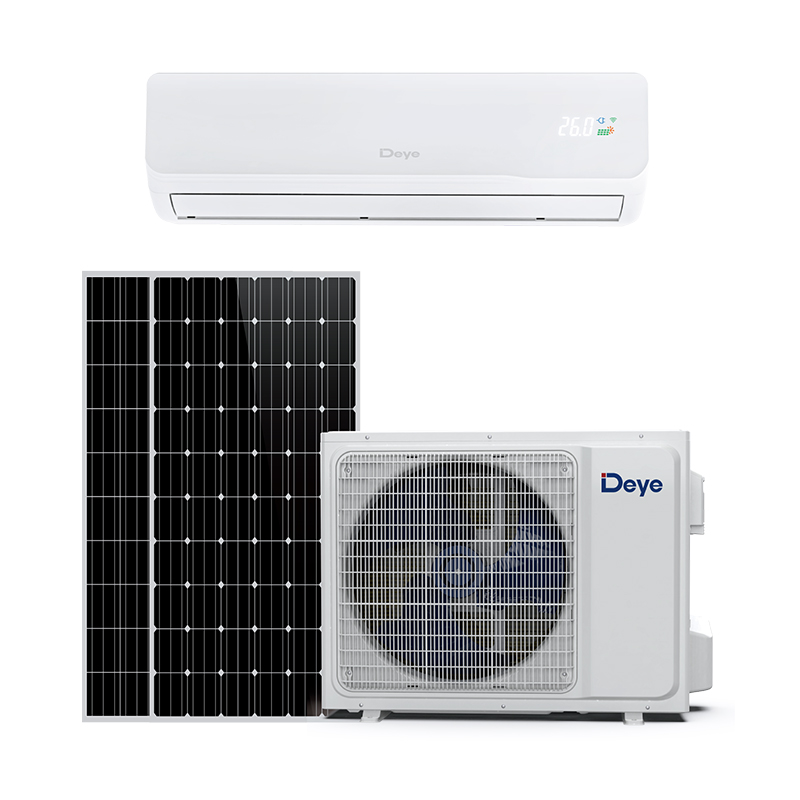
-1.jpg)

Content
- 1 What a 1.5-Ton AC Really Consumes: Watts, Tonnage, and Efficiency
- 2 Daily Energy Use: kWh per Day, Not Just Watts
- 3 How Many Solar Panels Do You Need? A Calculation You Can Use
- 4 Why the Exact Panel Count Changes: Location, Weather, and Setup
- 5 Inverter and Battery Sizing: What Else Do You Need?
- 6 Dedicated Solar Air Conditioners: Built for This Application
- 7 Sample Solar Designs for a 1.5-Ton AC
- 8 Cost, Payback, and Long-Term Value
- 9 Frequently Asked Questions
- 9.1 Can a 1 kW solar panel run a 1.5-ton AC?
- 9.2 Do I need a battery for solar AC?
- 9.3 How many 550 W panels do I need for a 1.5-ton AC?
- 9.4 What happens on cloudy days?
- 9.5 Can I run the AC at night with solar panels?
- 9.6 Is a dedicated solar air conditioner more efficient than a regular AC with solar panels?
- 10 Build Your Solar Solution Around the Actual Cooling Load
Homeowners, shop owners, and facility managers often ask the same practical question: How much solar panel is required for 1.5 ton AC? The direct answer is: most 1.5-ton air conditioners need a roughly 2.5 kW to 3.5 kW solar panel array, or about 5 to 7 modern 550 W panels, depending on how many hours you run the AC, the unit’s efficiency, local peak sun hours, and whether you also need battery backup. This guide explains exactly how to reach that number, what variables change the result, and when a dedicated solar air conditioner can simplify the whole system.
Quick answer: A typical 1.5-ton inverter AC running 8 hours per day uses around 9.6 kWh. With 5 peak sun hours and a system efficiency of 80%, you need about 2.4 kW of solar panels. That translates to 5 panels of 550 W, or 8 panels of 330 W. If you run the AC longer, live in a region with fewer sun hours, or add battery storage, increase the array to 3 kW or more.
What a 1.5-Ton AC Really Consumes: Watts, Tonnage, and Efficiency
The term “1.5 ton” does not describe electrical power consumption. It refers to the cooling capacity of the unit. One ton of air conditioning equals 12,000 British Thermal Units per hour. A 1.5-ton AC therefore delivers about 18,000 BTU/h, which is approximately 5.28 kW of cooling output.
The electrical input needed to produce that cooling varies widely. Older fixed-speed models draw a lot of power whenever the compressor runs, while modern inverter models modulate the compressor speed and consume less energy over time. Startup current is also important because a compressor can briefly draw 2 to 3 times its running wattage when it turns on. That startup surge affects both inverter sizing and the initial load on a solar system.
| AC Type | Typical Running Input | Typical Startup Surge | Best Solar Design Assumption |
|---|---|---|---|
| Older fixed-speed AC | 1.8 – 2.2 kW | 3.0 – 4.0 kW | Allow 2.0 kW average in daily energy planning |
| Standard inverter AC | 1.2 – 1.8 kW | 2.5 – 3.0 kW | Use 1.5 kW average for most running hours |
| High-efficiency inverter AC | 0.8 – 1.2 kW | 2.0 – 2.5 kW | Use 1.0 kW average when compressor is well sized |
When we see advice that says “a 1.5-ton AC needs 2 kW of panels,” it usually refers to running wattage, not daily energy. Daily energy is the number that determines your solar array size, so the next step is converting these wattage numbers into kilowatt-hours.
Daily Energy Use: kWh per Day, Not Just Watts
Solar panel sizing is based on energy, not power. Your electricity bill is measured in kWh, and your solar array must generate enough kilowatt-hours over a full day to match what the AC consumes. The basic formula is simple:
Daily AC energy = average running power (kW) × running hours per day
For example, a 1.5-ton inverter AC that averages 1.2 kW while running and operates for 8 hours consumes 9.6 kWh per day. A more power-hungry fixed-speed unit averaging 1.9 kW for the same 8 hours would consume 15.2 kWh per day. That difference changes the number of solar panels by 30% to 40%.
- Use the AC nameplate to check the rated input current and calculate approximate running wattage.
- Check the seasonal energy efficiency ratio or ISEER if available; higher efficiency directly reduces daily kWh.
- Count actual compressor running hours, not just thermostat hours. A compressor cycles on and off, and inverter units do not always run at maximum speed.
- Add other loads that share the same solar system, such as lights, fans, TVs, and refrigerators. The solar array must cover the combined daily load.
If you only need cooling during the hottest part of the day, say 5 hours in the afternoon, the daily energy is much lower. The solar array may be smaller than what would be needed for all-night cooling. Always size for the actual cooling schedule, not a theoretical maximum.
| Running Hours per Day | 1.0 kW Average | 1.2 kW Average | 1.5 kW Average |
|---|---|---|---|
| 4 hours | 4.0 kWh | 4.8 kWh | 6.0 kWh |
| 6 hours | 6.0 kWh | 7.2 kWh | 9.0 kWh |
| 8 hours | 8.0 kWh | 9.6 kWh | 12.0 kWh |
| 10 hours | 10.0 kWh | 12.0 kWh | 15.0 kWh |
Using a 1.2 kW average is a conservative and practical assumption for a modern inverter AC. For a high-efficiency unit in a warmer room, 1.0 kW may be realistic. For an old non-inverter model, 1.5 to 2.0 kW is safer.
How Many Solar Panels Do You Need? A Calculation You Can Use
Once you know the daily kWh consumption of the AC, you can calculate the required solar array size with this formula:
Required solar array (kW) = Daily AC energy (kWh) ÷ (Peak sun hours in your location × System efficiency)
Peak sun hours are not the same as daylight hours. They represent the number of hours in a day when sunlight intensity equals 1,000 W per square meter. A location with 8 hours of daylight might still only receive 5 peak sun hours. Most sunny regions receive 4 to 6 peak sun hours per day, while tropical areas can reach 5 to 7 hours.
System efficiency is included because solar panels, wires, inverters, charge controllers, and batteries all have losses. A well-designed system might have an efficiency of 80% to 85%; off-grid systems with batteries are often closer to 75% to 80%. The formula protects you from undersizing due to these losses.
Let us use the 9.6 kWh daily figure from earlier. With 5 peak sun hours and 80% system efficiency, the array needs to be:
9.6 ÷ (5 × 0.80) = 2.4 kW
That is 2,400 watts of solar modules. If you choose 550 W panels, you need 4.36 panels, so you must install 5. With 330 W panels, you need 7.27 panels, so you install 8. If your area only gets 4 peak sun hours, the same AC schedule requires 3.0 kW of panels, which is 6 panels of 550 W or 10 panels of 330 W.
| Peak Sun Hours | Required Array Size | Number of 550 W Panels | Number of 330 W Panels |
|---|---|---|---|
| 4 hours | 3.0 kW | 6 | 10 |
| 5 hours | 2.4 kW | 5 | 8 |
| 6 hours | 2.0 kW | 4 | 7 |
The same calculation works for other consumption levels. If the AC averages 1.5 kW and runs 8 hours, daily energy is 12 kWh. With 5 peak sun hours and 80% efficiency, the array must be 3.0 kW. If the AC averages 1.0 kW and runs only 6 hours, daily energy is 6 kWh, so the array is only 1.5 kW under the same sun and efficiency assumptions.
These numbers assume the solar array is dedicated to the AC. If the same panels also power lights, pumps, refrigerators, or other appliances, add their daily kWh to the numerator before dividing.
Why the Exact Panel Count Changes: Location, Weather, and Setup
The basic calculation gives a sensible starting point, but real-world projects rarely match a perfect formula. Several factors can push the final panel count up or down by one or two modules. Understanding these factors helps you avoid buying a system that is too small on hot afternoons or too large for your actual budget.
Peak sun hours
A coastal city with frequent afternoon clouds may receive only 3.5 usable peak sun hours, while a desert location receives 6. Use local solar radiation maps or monitoring data rather than relying on national averages.
Panel orientation and tilt
South-facing panels at the correct tilt angle produce more energy. East or west-facing roofs lower output by 10% to 20%, which increases the required number of panels.
Temperature coefficient
Solar panels lose efficiency on very hot days. A typical panel may drop by 0.35% to 0.45% per degree Celsius above 25°C. On a 40°C roof, output can drop by 5% or more.
Inverter and battery losses
Off-grid systems with batteries lose 10% to 20% of solar energy during charging, storage, and discharge. Grid-tied systems lose less, but every component contributes to the overall system efficiency factor.
Compressor startup surge
A fixed-speed compressor can draw 3 to 4 kW for a few seconds. The solar system must be able to handle that surge, either through a large inverter, a grid-tied connection, or a battery that can deliver high current.
Cooling demand variations
Extreme heat increases compressor running time and power. A system sized for average summer conditions may struggle during the hottest week of the year. If reliability matters, add a 10% to 20% safety margin.
When in doubt, model the system for the worst-case summer month, not the annual average. That approach prevents the AC from cutting out during heatwaves. If the budget is tight, consider allowing occasional grid backup rather than building a massive array.
Inverter and Battery Sizing: What Else Do You Need?
Solar panels alone do not run an AC. The energy produced by the panels must be converted from DC to AC if you are using a conventional air conditioner. If you want cooling at night, you also need battery storage. The size of the inverter and battery is just as important as the panel count.
Inverter capacity
The inverter must handle both the running load and the starting surge of the AC. A 1.5-ton non-inverter AC can briefly draw 3.0 to 4.0 kW, so a 3 kVA inverter is usually the minimum. A 5 kVA inverter gives more startup margin and allows other loads to run at the same time. For an inverter AC with lower starting current, a 3 kVA unit may be acceptable, but always check the manufacturer’s locked rotor amp specification.
Battery capacity
Battery size is calculated from the daily energy stored and the usable depth of discharge. If you need to run the AC for 8 hours at night, those 9.6 kWh must come from the battery. Because batteries should not be fully discharged, you must install more capacity than the AC consumes.
Required battery capacity = daily AC energy ÷ depth of discharge
For a 9.6 kWh daily load with lithium batteries at 80% depth of discharge, the battery bank should be 12 kWh. With lead-acid batteries at 50% depth of discharge, the bank grows to 19.2 kWh. At 48 V nominal, a 12 kWh lithium bank is roughly 240 Ah; a 19.2 kWh lead-acid bank is roughly 400 Ah.
| Battery Type | Usable Depth of Discharge | Required Installed Capacity | Approx. Amp-Hours at 48 V |
|---|---|---|---|
| Lead-acid | 50% | 19.2 kWh | 400 Ah |
| Lithium LiFePO4 | 80% – 90% | 10.7 – 12 kWh | 225 – 250 Ah |
Battery capacity also depends on how many cloudy days you want to cover. If you need two nights of backup with lithium batteries, double the bank to about 24 kWh. This is one reason why fully off-grid solar AC systems become expensive; the panels are only half of the total cost.
Dedicated Solar Air Conditioners: Built for This Application
Instead of designing a standard AC plus solar inverter system, many buyers choose a dedicated solar air conditioner. These units combine a DC inverter compressor with a built-in maximum power point tracking controller, allowing the AC to accept DC power directly from solar panels. This approach can eliminate the need for a separate solar inverter and reduce battery losses when the AC runs during sunlight hours.
Dedicated solar ACs are especially useful in regions with high electricity tariffs, weak grid supply, or frequent blackouts. They also simplify system design because the air conditioner itself manages the solar input. Let us look at three common configurations.
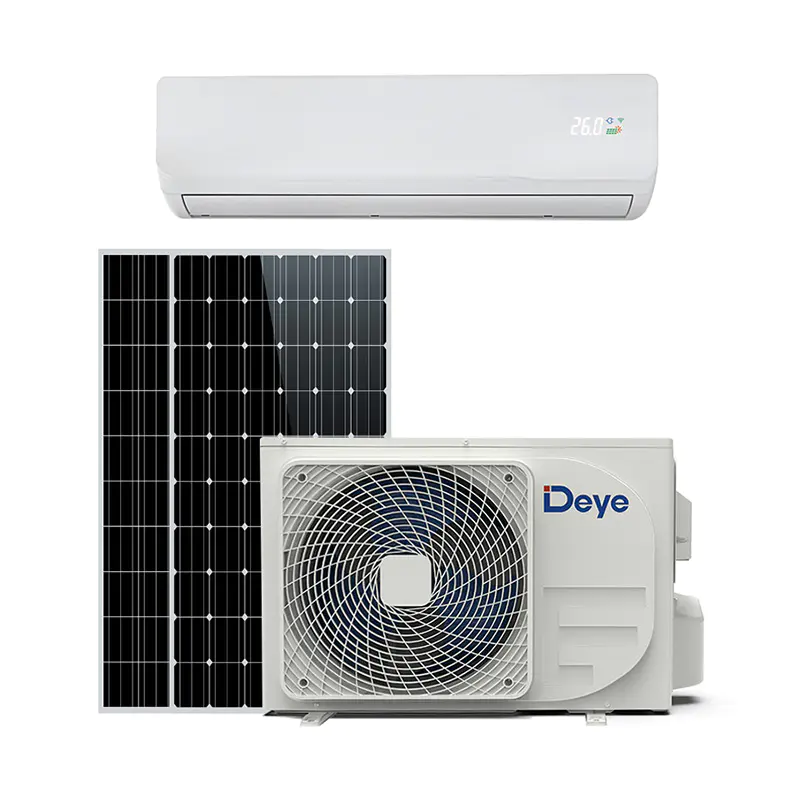
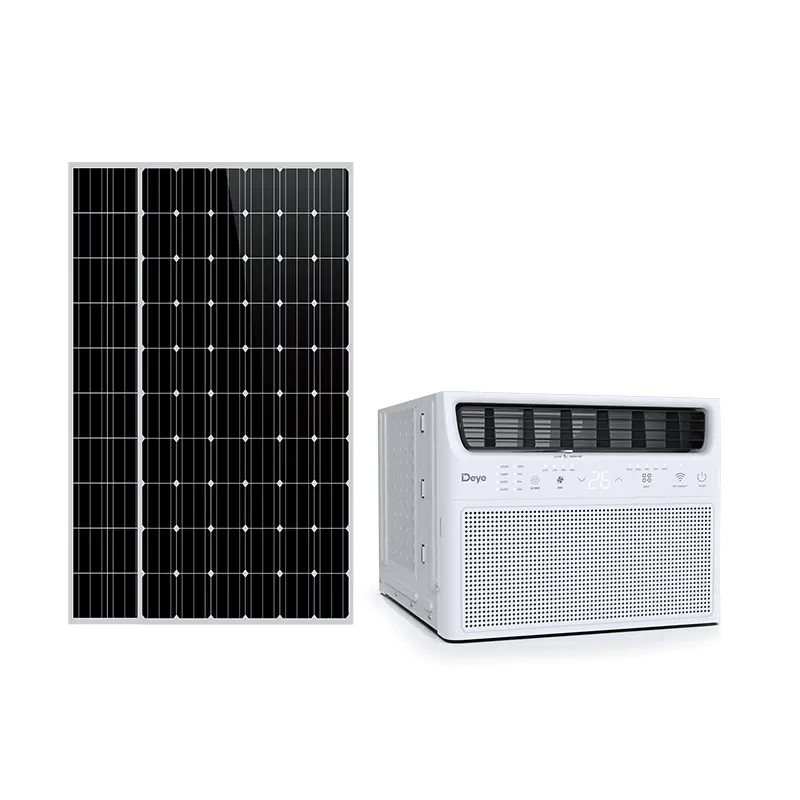
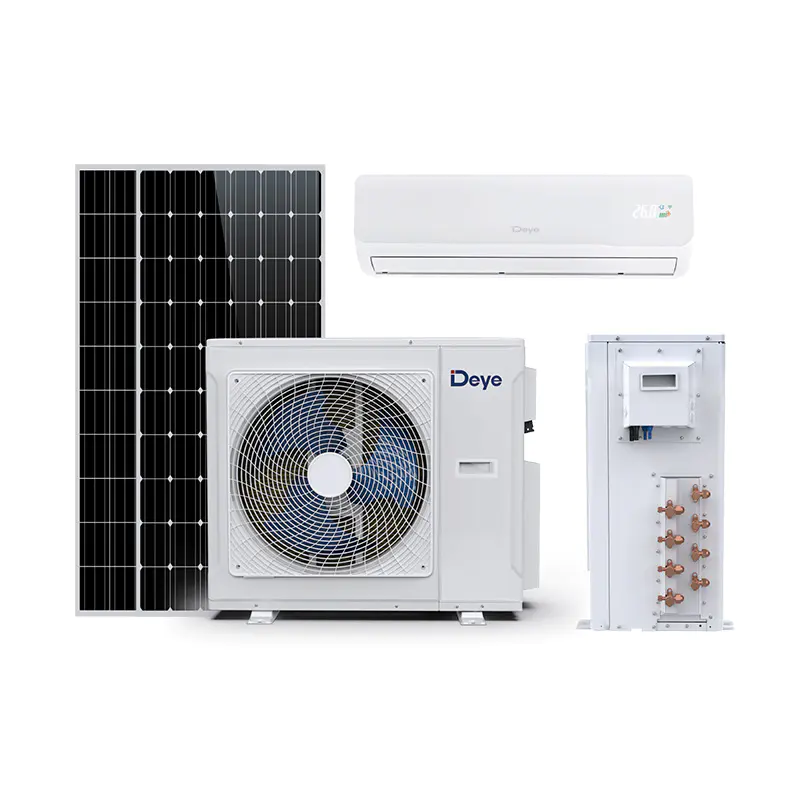
Wall-Mounted Hybrid AC/DC Solar Air Conditioner
Hybrid AC/DC units can run from solar panels and grid electricity at the same time. During the day, the controller gives priority to solar power. If the sun is strong enough, the AC runs almost entirely from the solar array. If clouds pass over or the AC needs more power, the grid automatically fills the gap. This is the most user-friendly option for homeowners who want lower electricity bills without buying a battery bank.
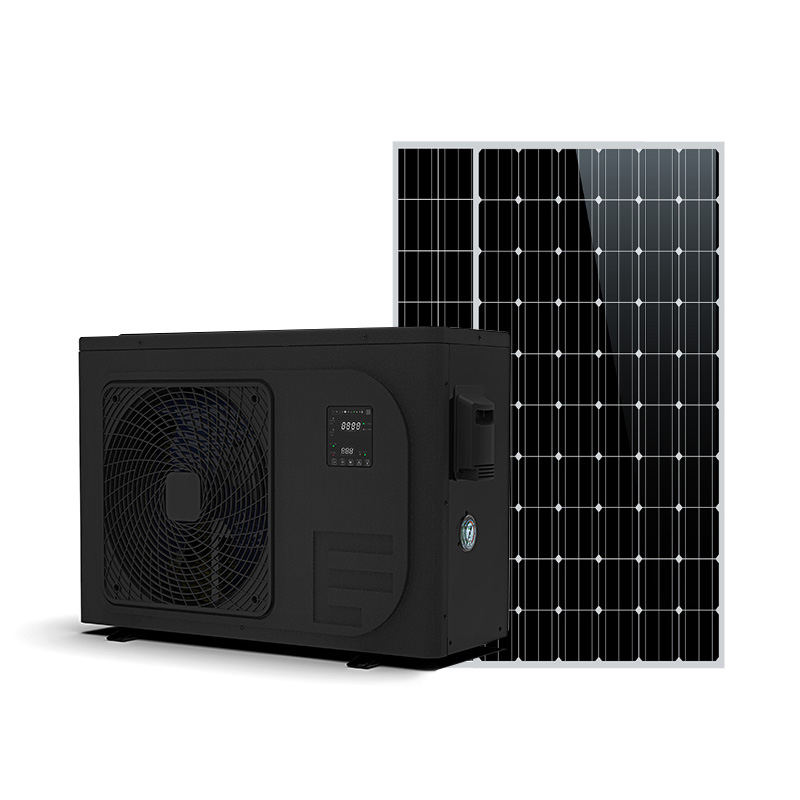
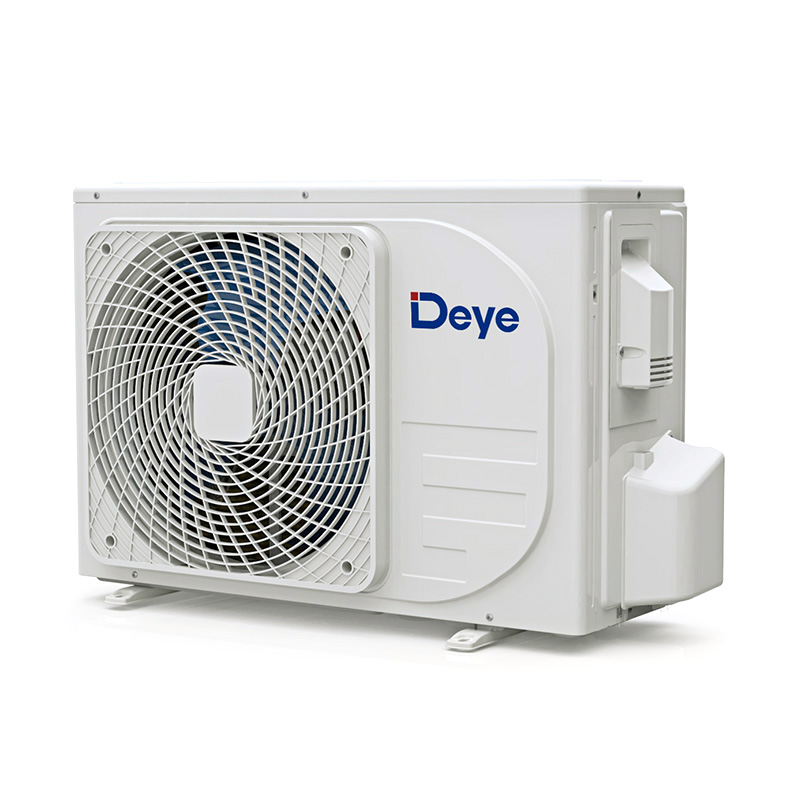 Wall-Mounted Hybrid AC/DC Solar Air Conditioner with R410A/R32This hybrid unit prioritizes solar power while the grid fills gaps, so homeowners can cut electricity bills without batteries. Its built-in MPPT booster and inverter technology suit the described day-and-night operation.View Product →
Because the hybrid AC directly couples the solar panels to the compressor, the required panel array is often smaller than a conventional AC system. There is no separate DC-to-AC conversion loss on the solar path, and the compressor can run at different speeds to match the available solar power.
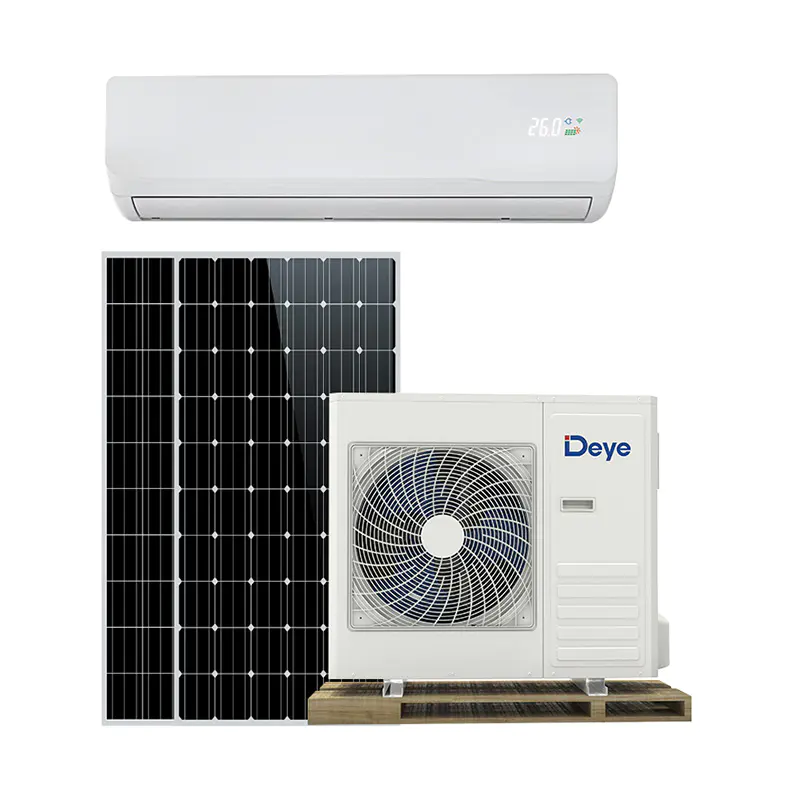
Off-Grid DC48V Wall-Mounted Solar Air Conditioner
For remote buildings, farmhouses, or sites with an unreliable grid, a DC48V off-grid solar AC is purpose-built to run from a solar battery bank. This unit uses 48V DC power natively, so it does not require a separate inverter between the battery and the air conditioner. The system stores solar energy in the battery and draws from the battery whenever cooling is needed.
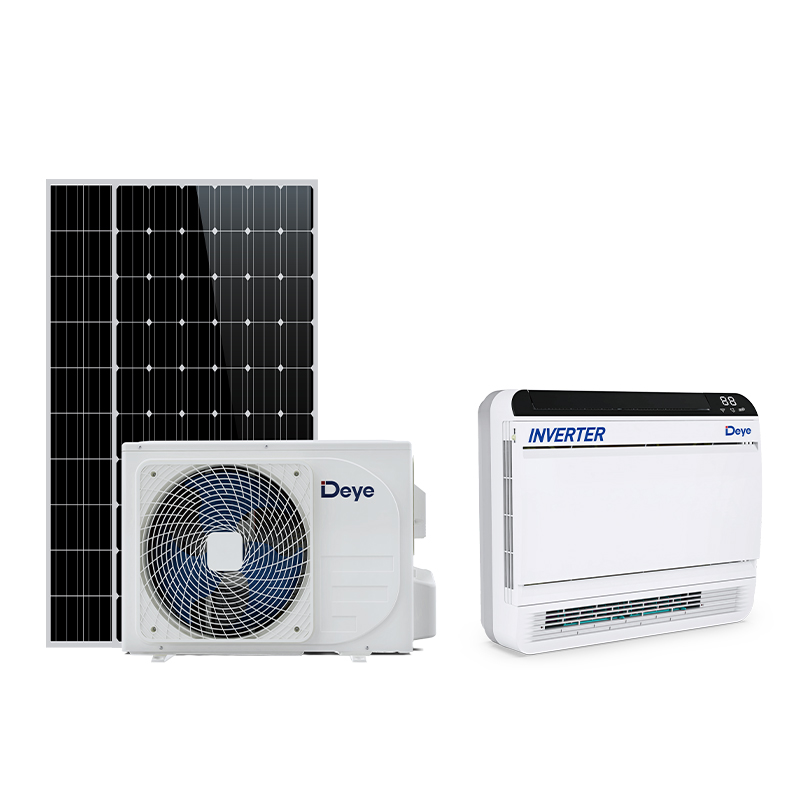
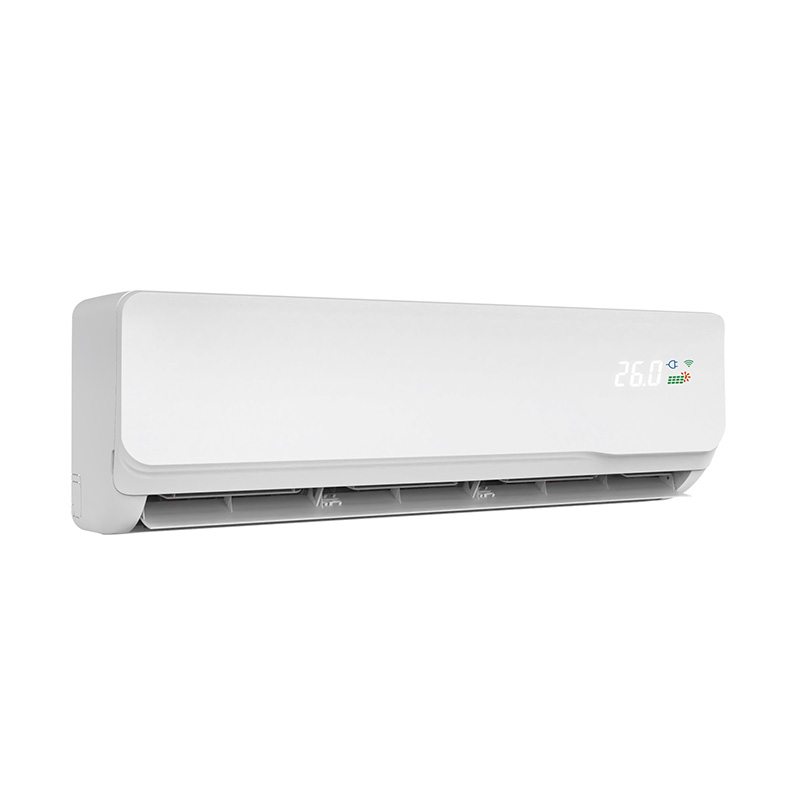 Off-Grid DC 48V Wall-Mounted Solar Air Conditioner with R410ADesigned for remote sites with unreliable grids, this unit runs natively on 48V DC from a battery bank, avoiding a separate inverter. Its DC compressor and Wi-Fi control support the described off-grid setup.View Product →
This architecture reduces conversion losses and lowers the overall component count. A 48V battery bank—usually lithium phosphate—can supply enough current for the compressor. Still, the solar array must be large enough to recharge the battery for the next evening’s cooling load.
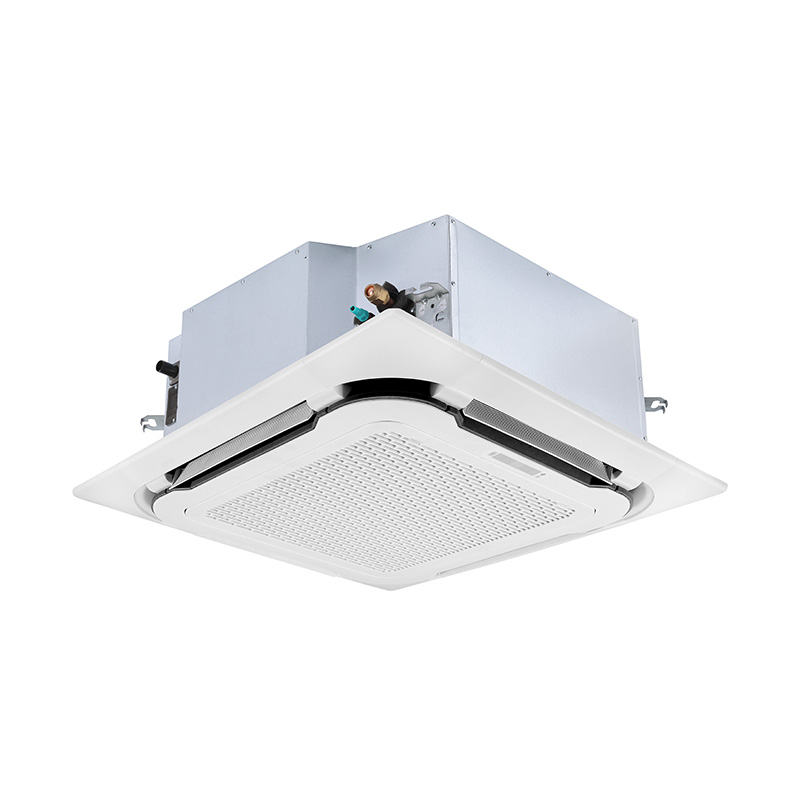
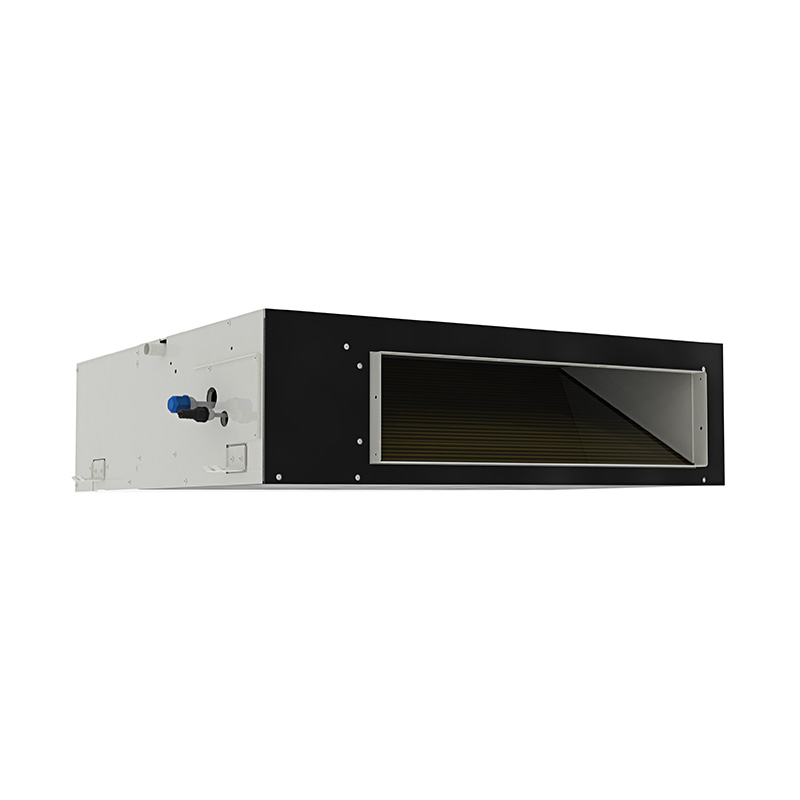
Light Commercial Cassette Solar Air Conditioner
Small offices, retail stores, guesthouses, and restaurants often use cassette-type indoor units because they mount in the ceiling and distribute air evenly. A light commercial solar AC cassette type combines the same hybrid solar controller with a higher air delivery capacity. This is a practical option when the cooling load is above what typical wall-mounted residential units can handle.
 Light Commercial Ceiling Cassette Solar Air Conditioner with R410A/R32This ceiling-mounted cassette delivers even four-direction airflow for offices and shops, combining hybrid solar operation without batteries. Its DC compressor and inverter technology suit the higher cooling loads mentioned in the surrounding text.View Product →
These units are available with R410A or R32 refrigerant, and many models can operate in low ambient temperatures for cold-room or year-round use. The solar panel calculator remains the same: determine the unit’s daily energy use, divide by local peak sun hours and system efficiency, and choose a panel array that matches.
Sample Solar Designs for a 1.5-Ton AC
Real projects fall into three common design categories. These examples assume a 9.6 kWh daily AC load and show how the same cooling schedule can produce very different panel and battery requirements.
Grid-tied with net metering
Array: 2.4 kW (5 × 550 W). No battery. A 3 kW grid-tie inverter exports surplus power during the day and imports power at night. This is the lowest-cost setup for homes that already have a stable grid connection.
Off-grid with nighttime cooling
Array: 3.0 kW (6 × 550 W). Battery: 12 kWh lithium or 19.2 kWh lead-acid. A 5 kVA hybrid inverter manages charging and AC power. This setup provides full independence but requires careful solar resource planning.
Direct solar hybrid AC
Array: 2.0 – 2.5 kW connected to a hybrid AC/DC solar air conditioner. No separate solar inverter. Grid or a small battery covers brief gaps. This option minimizes component losses and is simpler to install.
Each design has a different cost structure. A grid-tied system is usually the cheapest per solar watt because batteries are excluded. An off-grid system gives security during blackouts but increases the total investment. A direct solar AC offers the best balance when the primary goal is to reduce daytime energy consumption.
Cost, Payback, and Long-Term Value
The financial case for solar-powered cooling depends on three values: the local electricity rate, the number of hours the AC runs each year, and the cost of the installed solar system. A 1.5-ton AC consuming 9.6 kWh per day at a rate of $0.15/kWh costs about $1.44 per day. If the AC operates 200 days per year, that is $288 in annual electricity costs. At $0.30/kWh, the annual cost jumps to nearly $576.
A 2.4 kW solar array may generate enough energy to offset most of that AC load in a sunny region. The value of that solar energy depends heavily on net metering rules. If the utility pays for surplus generation at the same retail rate, payback is faster. If surplus exports are only valued at a wholesale rate, it is better to size the array close to the actual daytime load.
- Compare the cost per watt of installed panels in your market, including mounting hardware, cables, breakers, and labor.
- Calculate the local annual cooling season: more hours means more savings and a shorter payback period.
- Consider battery costs separately. Batteries add comfort but slow the economic payback unless blackouts cause other costs.
- Check whether a hybrid solar AC qualifies for renewable energy incentives in your country or state.
Another factor is long-term reliability. Inverter AC compressors ramp up and down, so the solar system can supply power more smoothly. A dedicated solar air conditioner has fewer interface parts than a conventional AC plus external inverter arrangement, which can reduce maintenance points and installation errors.
Frequently Asked Questions
Can a 1 kW solar panel run a 1.5-ton AC?
Usually not continuously. A 1 kW array in a 5-sun-hour region produces about 4 kWh per day under ideal conditions, which is less than the 6 to 12 kWh that a 1.5-ton AC typically needs. A very efficient inverter AC might run for two or three hours from a 1 kW array if the sun is bright and no battery is involved, but sudden clouds or compressor startup can interrupt operation.
Do I need a battery for solar AC?
Not if you have a hybrid solar AC that uses grid electricity as backup, or if you use a grid-tied inverter with net metering. A battery is needed only when you want to run the AC after sunset or protect against grid outages.
How many 550 W panels do I need for a 1.5-ton AC?
For an AC that uses 9.6 kWh per day, you need about 5 panels of 550 W with 5 peak sun hours and 80% system efficiency. With 4 peak sun hours, the number rises to 6 panels. If the AC is older or less efficient, add one more panel for every extra 2 kWh of daily consumption.
What happens on cloudy days?
The solar array produces less energy, so the AC draws more from the grid or the battery. If you are fully off-grid, cloudy weather requires either a larger battery bank, an auxiliary generator, or a larger panel array that can collect energy during low-light conditions.
Can I run the AC at night with solar panels?
You can, but only if you store solar energy in batteries during the day. The battery bank must be large enough to cover the night-time cooling load. A grid-connected hybrid solar AC can also run at night by drawing from the grid while still saving money from the solar generation during sunny hours.
Is a dedicated solar air conditioner more efficient than a regular AC with solar panels?
In many installations, yes. A dedicated hybrid or DC solar AC avoids some conversion losses and can match the compressor speed to the available solar power. This is especially beneficial when the AC is expected to run only during daylight hours, such as in schools, shops, offices, or factories during a working day.
Build Your Solar Solution Around the Actual Cooling Load
The right number of solar panels is never based on a simple one-size-fits-all rule. Start with the AC nameplate, estimate how many hours it will run, and multiply the average running power by those hours to get daily kWh. Then apply the local peak sun hours and a realistic system efficiency of 75% to 85%. That calculation will give you a panel count that matches your actual use.
For homeowners who want a straightforward system with no battery, a grid-tied design with a 2.5 to 3.0 kW array is a reliable approach. For those who need night-time cooling or have poor grid stability, add a lithium battery bank sized for at least one full evening of AC use. And for buyers who prefer an integrated solution, explore the dedicated solar air conditioners designed around a 1.5-ton cooling load. Our engineering background in inverter controllers and solar HVAC systems gives us the experience to help you calculate the optimal panel count for your site. If you want a detailed project plan for a solar-powered 1.5-ton AC, contact our engineering team with your roof area, location, and cooling schedule.
