

 Español
 русский
 Français
 Português
 Deutsch
 عربى
عربى italiano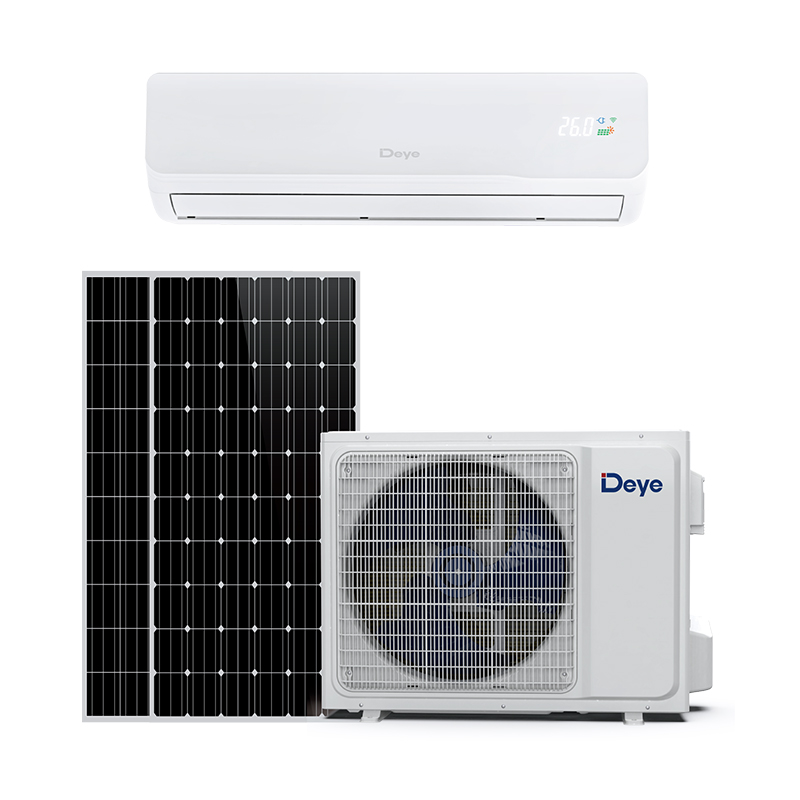
-1.jpg)

Content
- 1 The Short Answer: Solar Panel Counts for a 2-Ton AC
- 2 What a 2-Ton AC Actually Draws
- 3 How Much Power One Solar Panel Can Produce
- 4 The Formula for Calculating Your Panel Count
- 5 Scenario A: Grid-Tied Solar for Daytime Cooling
- 6 Scenario B: Off-Grid with Battery Storage
- 7 Scenario C: Hybrid AC/DC Solar Air Conditioners
- 8 Real-World Factors: Climate, Insulation and Usage Habits
- 9 Cost and Payback: What You Are Really Paying For
- 10 Frequently Asked Questions
- 10.1 Can a 2-ton AC run on 4 solar panels?
- 10.2 How many solar panels for a 2-ton AC with battery for whole-day running?
- 10.3 How many solar panels for a 2-ton AC in India?
- 10.4 What is the difference between a hybrid AC/DC solar AC and an off-grid DC solar AC?
- 10.5 Can a 2-ton AC run on a 3kW solar system?
- 10.6 How many watts does a 2-ton solar AC use per hour?
- 10.7 Do I need batteries to run a solar-powered AC?
- 10.8 Are fewer larger panels better than more smaller panels?
Your 2-ton air conditioner can easily become the largest load on a solar array. In a typical house it accounts for 40 to 60 percent of summer electricity use, so getting the panel count right has an outsized impact on both comfort and cost.
The short answer to "how many solar panels for a 2 ton AC" is: between 4 and 16 panels of 400W to 550W, depending on how the system is designed. A grid-tied daytime setup for a modern inverter unit lands at 5 to 8 panels. Adding battery backup pushes that to 9 to 14 panels, because the array must both run the AC and recharge the storage bank. Hybrid solar air conditioners, which accept DC directly from the PV array, sit in the lower part of that range, because they avoid the losses of a conventional inverter.
This guide explains the calculation in a way you can apply to your own site. It starts with the AC-side load, moves to the production side of solar modules, and then works through four practical scenarios: grid-tied daytime cooling, off-grid with batteries, hybrid AC/DC solar air conditioning, and light commercial installations. The numbers are based on standard HVAC and PV formulas, not on supplier claims, so you can verify them with your own utility bill and local sunshine data.
The Short Answer: Solar Panel Counts for a 2-Ton AC
Before doing the math, it helps to have a target in mind. The table below summarizes typical panel counts for a 2-ton, 24,000 BTU/h air conditioner under different system architectures. The ranges reflect the efficiency of the AC, the wattage of the panels, and the number of cooling hours per day.
| System Architecture | 400W Panels | 550W Panels | What It Covers |
|---|---|---|---|
| Grid-tied, daytime cooling only (6-8 h) | 5-8 | 4-6 | Runs the AC during sunny hours; grid covers night use |
| Grid-tied with battery backup (10-12 h) | 9-12 | 7-9 | Adds evening and morning cooling from stored energy |
| Fully off-grid with battery (10-12 h) | 12-16 | 9-12 | Array sized for both load and battery recharging |
| Hybrid AC/DC, DC direct from PV (8 h) | 4-6 | 3-5 | PV power reaches the compressor with less conversion loss |
Four variables move your result inside or outside this band: the SEER rating of the AC, the wattage of the solar modules, the peak sun hours at your location, and whether you store energy in batteries. The next sections define each one precisely.
What a 2-Ton AC Actually Draws
In air conditioning, "ton" refers to cooling capacity. One ton equals 12,000 BTU/h, so a 2-ton unit delivers 24,000 BTU/h of cooling. What matters for solar sizing is the electrical input, which is determined by the efficiency rating, most commonly SEER, the Seasonal Energy Efficiency Ratio. SEER is the cooling output in BTU/h divided by the electrical input in watts.
So the full-load electrical draw is simple to calculate:
AC power (W) = 24,000 ÷ SEER
The values for common SEER ratings are shown below.
| SEER Rating | Cooling Output | Full-Load Power Draw |
|---|---|---|
| SEER 10 | 24,000 BTU/h | 2,400W |
| SEER 12 | 24,000 BTU/h | 2,000W |
| SEER 15 | 24,000 BTU/h | 1,600W |
| SEER 18 | 24,000 BTU/h | 1,333W |
| SEER 20 | 24,000 BTU/h | 1,200W |
| SEER 22 | 24,000 BTU/h | 1,091W |
| SEER 25 | 24,000 BTU/h | 960W |
Two additional details make the real-world consumption lower than full-load power. First, an inverter compressor adjusts its speed instead of switching on and off at full output. At partial load, which is most of the time, the average running power can be 30 to 50 percent below the rated figure. This is the main reason solar-ready air conditioners use DC inverter drives.
Second, a correctly sized AC does not run continuously. With a thermostat set at 23°C to 25°C, a unit in a shaded, reasonably insulated room may have a compressor duty cycle of 50 to 70 percent over a day. In a poorly insulated metal-roof building or during an extreme heat wave, the duty cycle can reach 85 to 95 percent. Your panel count should be based on the actual duty cycle for your building, not on the rated power alone.
How Much Power One Solar Panel Can Produce
The wattage printed on a solar panel, such as 400W or 550W, is its output under Standard Test Conditions of 1,000W per square meter irradiance and 25°C cell temperature. In real installations, dust, high cell temperature, wire resistance, and controller or inverter losses reduce this figure by 15 to 25 percent. For planning purposes, we apply a derating factor of 0.8.
This gives a practical formula:
Daily energy per panel (kWh) = panel watts × peak sun hours × 0.8 ÷ 1,000
| Panel Rating | 4 Peak Sun Hours | 5 Peak Sun Hours | 6 Peak Sun Hours |
|---|---|---|---|
| 400W | 1.28 kWh | 1.60 kWh | 1.92 kWh |
| 450W | 1.44 kWh | 1.80 kWh | 2.16 kWh |
| 550W | 1.76 kWh | 2.20 kWh | 2.64 kWh |
Peak sun hours vary significantly by region. The term refers to the equivalent number of hours per day when sunlight intensity reaches 1,000W per square meter. A location with 5 peak sun hours receives the same daily solar energy as five hours of full, unobstructed sun.
| Region | Typical Peak Sun Hours |
|---|---|
| Southwestern United States | 5.5 - 6.0 |
| Southeastern United States | 4.5 - 5.2 |
| Midwest / Northeast US | 4.0 - 4.8 |
| India | 4.2 - 5.5 |
| Middle East / Australia | 5.5 - 6.5 |
| Southern Europe | 4.2 - 5.0 |
| Southeast Asia | 3.8 - 4.5 |
Why does this matter? A 400W panel in Phoenix with 6 peak sun hours generates about 1.92 kWh per day, but the same panel in Seattle or Singapore with 4 peak sun hours generates only 1.28 kWh. The difference of 0.64 kWh per panel means that a 7-panel array in one city performs like a 10-panel array in another.
The Formula for Calculating Your Panel Count
Once you know the AC load and the panel production, the sizing calculation becomes a single equation:
Panels needed = (AC full-load watts × run hours × duty factor) ÷ (panel watts × peak sun hours × 0.8)
Let's walk through two worked examples so the formula is clear.
Example 1: Efficient mini-split. A SEER 18 unit draws 1,333W at full load. It runs 8 hours per day with a 60% duty factor. You plan to use 400W panels and your site receives 5 peak sun hours.
- Daily AC energy = 1,333 × 8 × 0.6 = 6,398 Wh ≈ 6.4 kWh
- Daily panel output = 400 × 5 × 0.8 = 1,600 Wh = 1.6 kWh
- Panels needed = 6.4 ÷ 1.6 = 4.0
Four panels are the theoretical minimum. A conservative installer would round up to five panels to cover cloudy days and panel degradation.
Example 2: Older central unit. A SEER 12 central AC draws about 2,000W. It runs 10 hours per day with a 70% duty factor. You choose 550W panels, and the site receives 5 peak sun hours.
- Daily AC energy = 2,000 × 10 × 0.7 = 14,000 Wh = 14 kWh
- Daily panel output = 550 × 5 × 0.8 = 2,200 Wh = 2.2 kWh
- Panels needed = 14 ÷ 2.2 = 6.4
That rounds to six or seven panels. If the same 14 kWh load used 400W panels instead of 550W units, the count would rise to about nine. Simply upgrading from 400W to 550W modules reduces the number of panels by nearly one-third and cuts racking, wiring, and installation labor at the same time.
In both examples, the duty factor is the variable most people get wrong. Always measure duty factor in the hottest month, because an AC sized to local cooling loads will cycle differently in spring and summer.
Scenario A: Grid-Tied Solar for Daytime Cooling
A grid-tied system has no battery. During the day, the solar array feeds the AC and any surplus goes to the grid. At night, the building draws from the grid as usual. This is the most economical architecture, because the grid acts as an infinite battery with no capital cost.
For a 2-ton AC used mainly during sunny hours, the panel count depends almost entirely on the unit's efficiency. The chart below compares daily panel requirements for the same 8-hour cooling window at 5 peak sun hours using 400W panels.
The pattern is clear: the more efficient the cooling system, and the more directly it uses DC power, the smaller the array. For a typical home with a decent-quality inverter AC, a 3.2kW to 4kW array of eight to ten 400W panels is the most common size for a 2-ton load.
Scenario B: Off-Grid with Battery Storage
Running a 2-ton AC off-grid is a different problem. The battery bank must store enough energy for evening and morning cooling, and the array must be large enough to run the AC while simultaneously recharging the battery. In practice, this adds 25 to 35 percent to the PV array size compared with a grid-tied system.
Battery capacity is calculated as follows:
Battery capacity (kWh) = daily AC energy ÷ (inverter efficiency × depth of discharge)
For a 12 kWh daily load, a 90% inverter efficiency and an 80% depth of discharge for lithium batteries, the storage requirement is 12 ÷ (0.9 × 0.8) = 16.7 kWh, which works out to roughly 350Ah at 48V. The table below gives practical combinations for a 2-ton AC.
| Daily AC Energy | Battery Bank (48V) | Minimum Solar Array | 400W Panels |
|---|---|---|---|
| 6 kWh | 8.3 kWh / 175Ah | 1.95 kW | 5 panels |
| 10 kWh | 13.9 kWh / 290Ah | 3.25 kW | 8-9 panels |
| 14 kWh | 19.4 kWh / 404Ah | 4.55 kW | 11-12 panels |
| 18 kWh | 25.0 kWh / 520Ah | 5.85 kW | 14-15 panels |
There is also a seasonal dimension. In northern climates, winter solar production can fall 30 to 50 percent below the summer average. If the AC is only used in summer, this is not a problem; if the cooling load runs year-round, you need to size for the worst month.
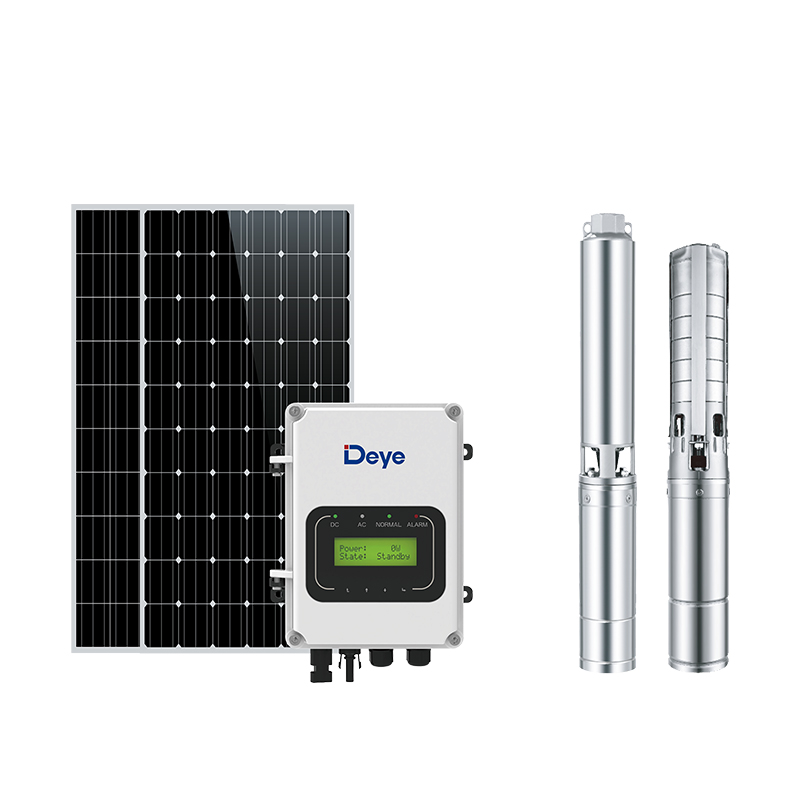
A Simpler Off-Grid Path: DC 48V Solar AC
One way to reduce the battery burden is to run the AC directly from a 48V DC bus instead of converting battery DC back to grid AC. This removes an entire inversion step and makes the system easier to service in remote locations. Deye's off-grid wall-mounted series does exactly this, using R410A refrigerant and a DC compressor drive.
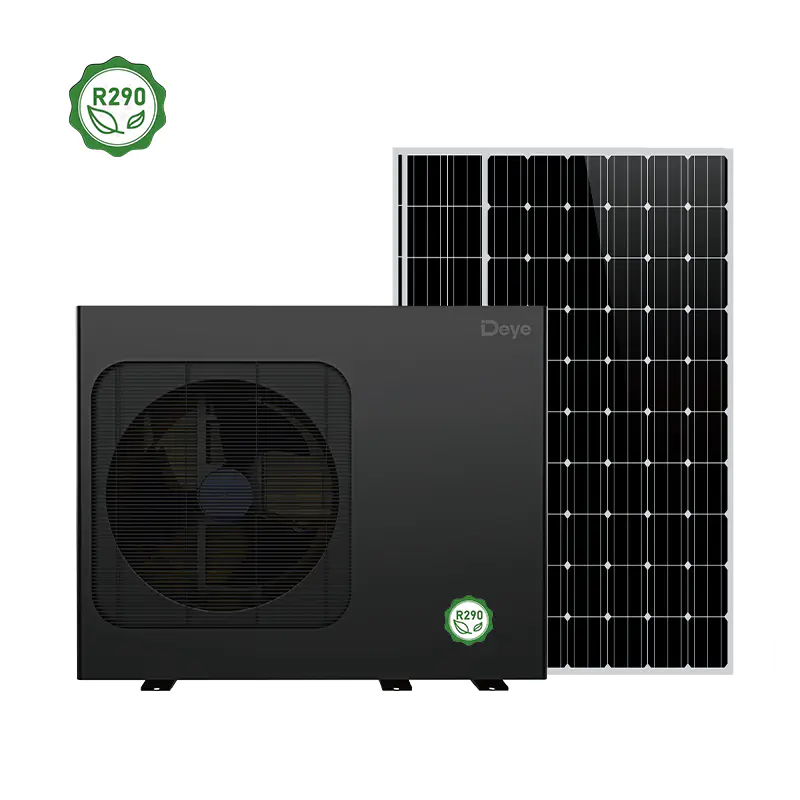
DEYE Wall-Mounted Off-Grid Solar AC, DC 48V, R410A Built for sites with no grid or frequent power cuts. Connects directly to a 48V battery bank and PV array, avoiding a separate inverter. View ProductScenario C: Hybrid AC/DC Solar Air Conditioners
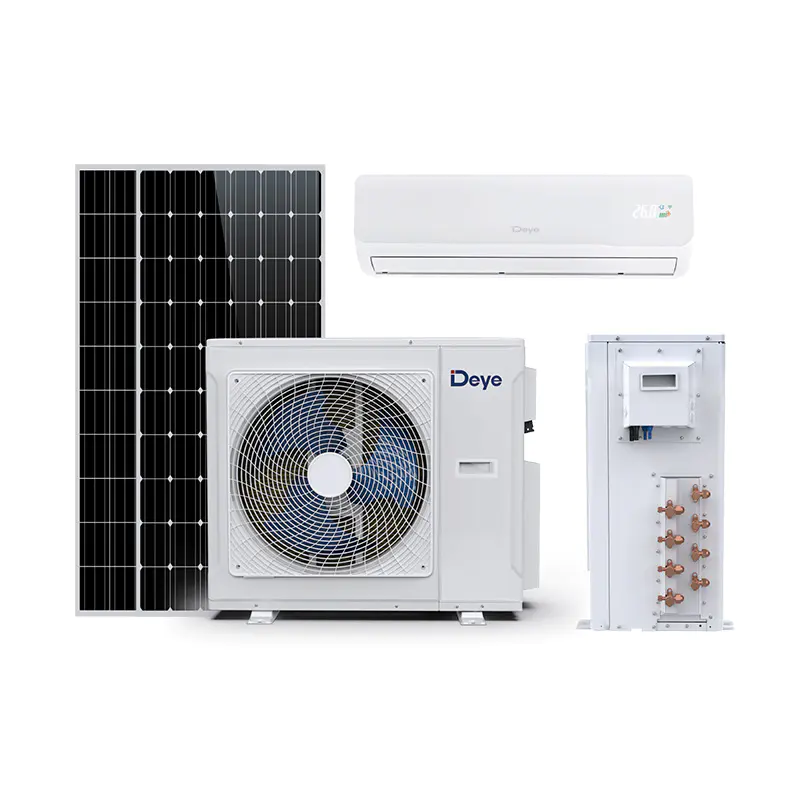
Hybrid AC/DC solar air conditioners are the fastest-growing category for good reason: the unit itself contains both an AC input from the grid and a DC input from the solar array. The controller decides in real time how much compressor power comes from the PV side and how much from the grid. During the day, nearly all energy can be drawn from the panels; when clouds pass or the sun sets, the controller blends in grid power without interrupting cooling.
This architecture lowers the panel count in two ways. First, PV energy is consumed inside the unit, avoiding the 5 to 10 percent losses of a central grid-tied inverter. Second, the DC input can operate over a wide voltage range, so the AC starts earlier in the morning and runs later into the afternoon with the same array. In practice, a 5-panel array with a hybrid unit delivers daytime coverage that would require 7 or 8 panels with a conventional AC plus inverter. The control strategy is worth studying in detail in our technical overview of hybrid AC/DC solar air conditioning.
Combined with a small battery of 5 to 10 kWh, a hybrid unit can also stretch into the evening hours. This is the interface between the grid-tied and off-grid worlds, and it is the configuration that gives the lowest panel count for the longest daily runtime.
This category is a core focus at Deye, where the design priorities come from a company background in DC inverter control that began in 2007 and later expanded into integrated solar air conditioning systems.
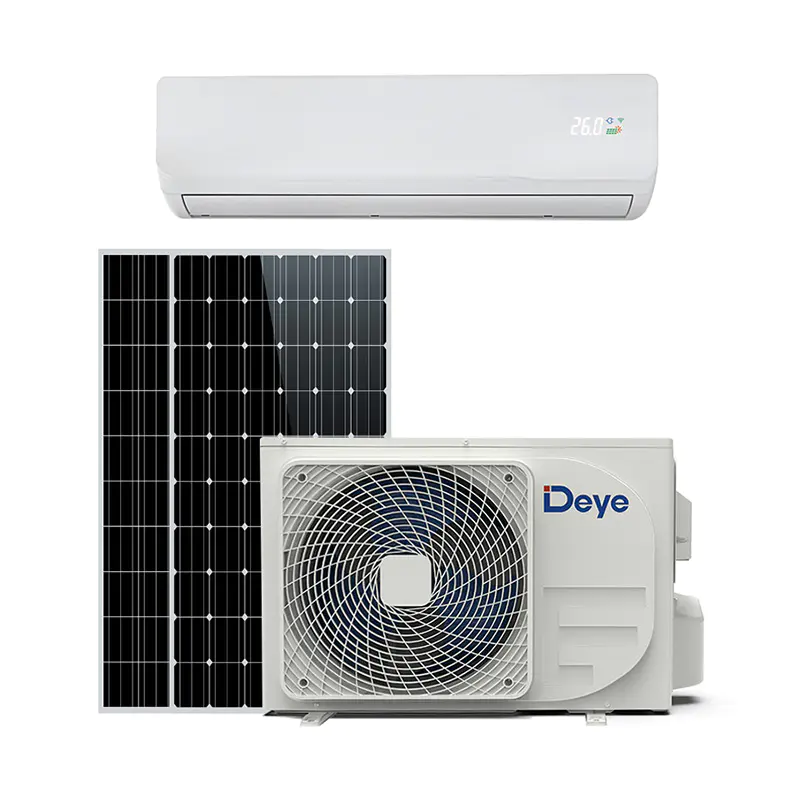
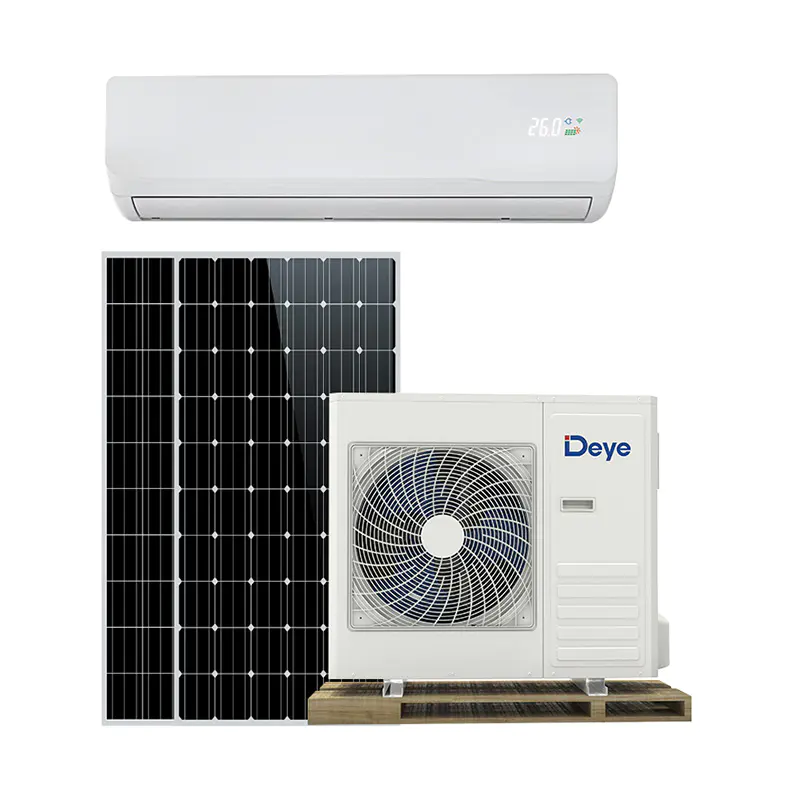
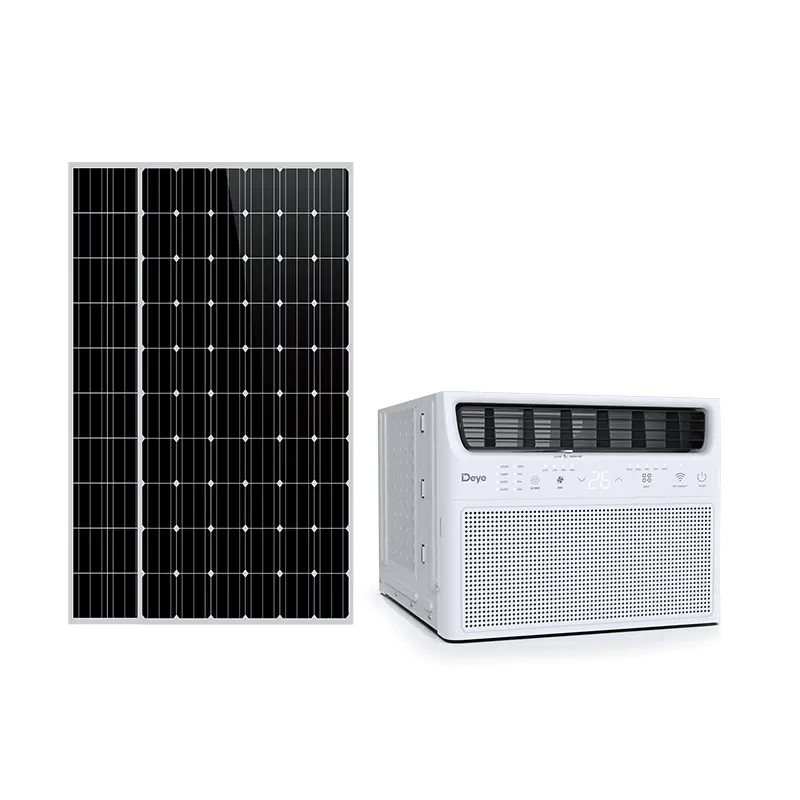
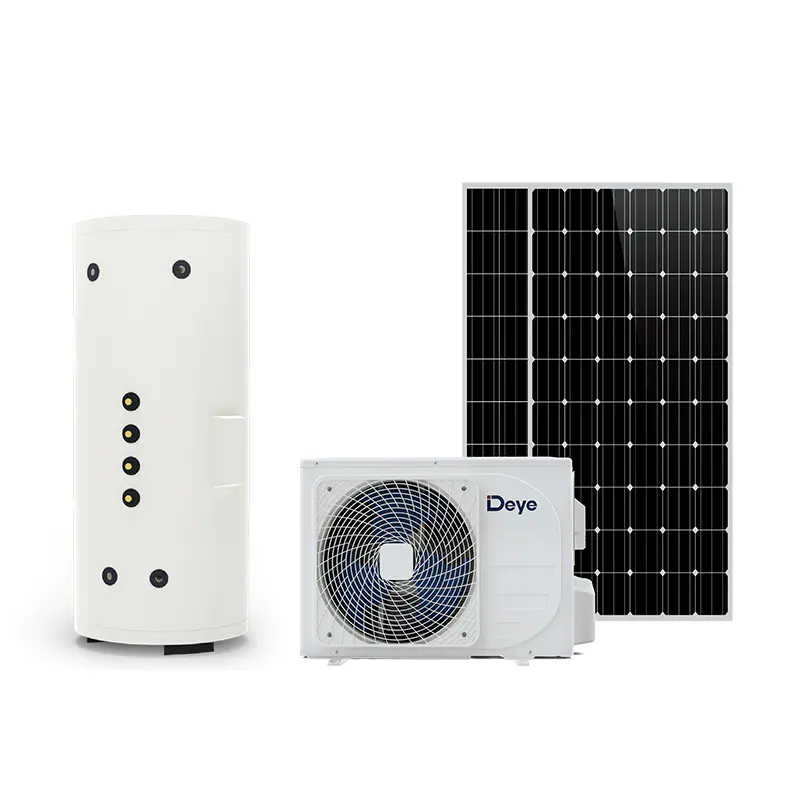
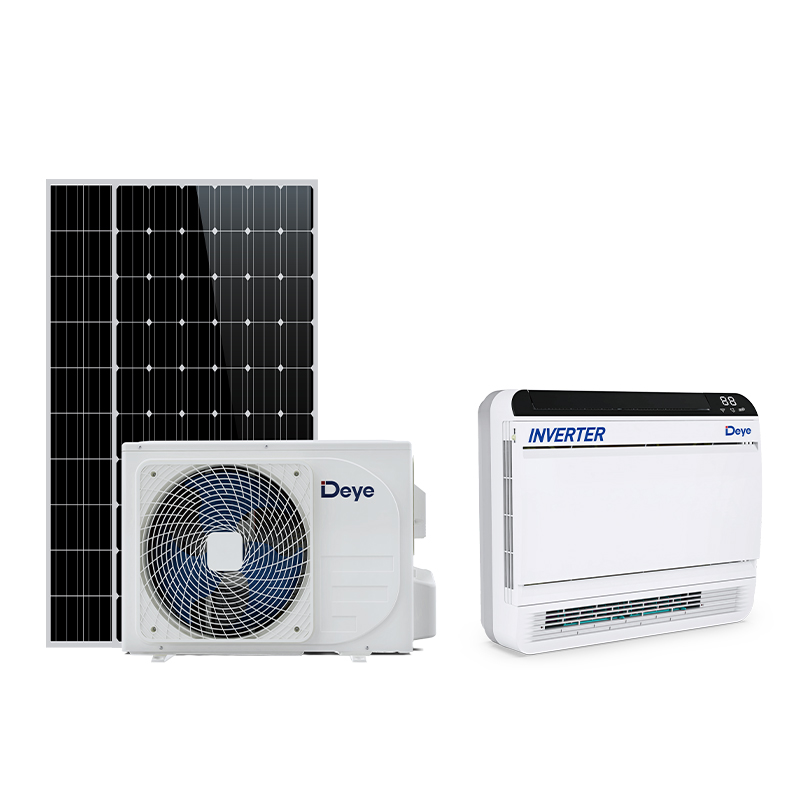
DEYE Wall-Mounted Solar AC, Hybrid AC/DC, R410A/R32 Accepts grid AC and solar DC in one unit. The compressor prioritizes direct PV power during the day and switches to grid only when solar is insufficient. View ProductFor an installer, one practical advantage is the reduced balance-of-system cost. There is no separate grid-tied inverter to buy, no DC-to-AC-to-DC conversion loss to design around, and the system can use standard PV modules without specialized optimizers. The project gets simpler, and the customer keeps the energy yield of the array.
Real-World Factors: Climate, Insulation and Usage Habits
The formula gives you a baseline, but the building itself changes the result. The most important factor is the compressor duty factor, which is influenced by insulation, window area, roof construction, and the thermostat setpoint.
| Building Condition | Duty Factor | Effect on Panel Count |
|---|---|---|
| Well-insulated, shaded, setpoint 25°C | 40-50% | Reduce count by 20-30% |
| Average home or office, setpoint 23°C | 55-65% | Baseline for sizing |
| Poor insulation, direct sun, 40°C ambient | 75-90% | Increase count by 30-50% |
Beyond the building envelope, four simple habits reduce the panel requirement noticeably:
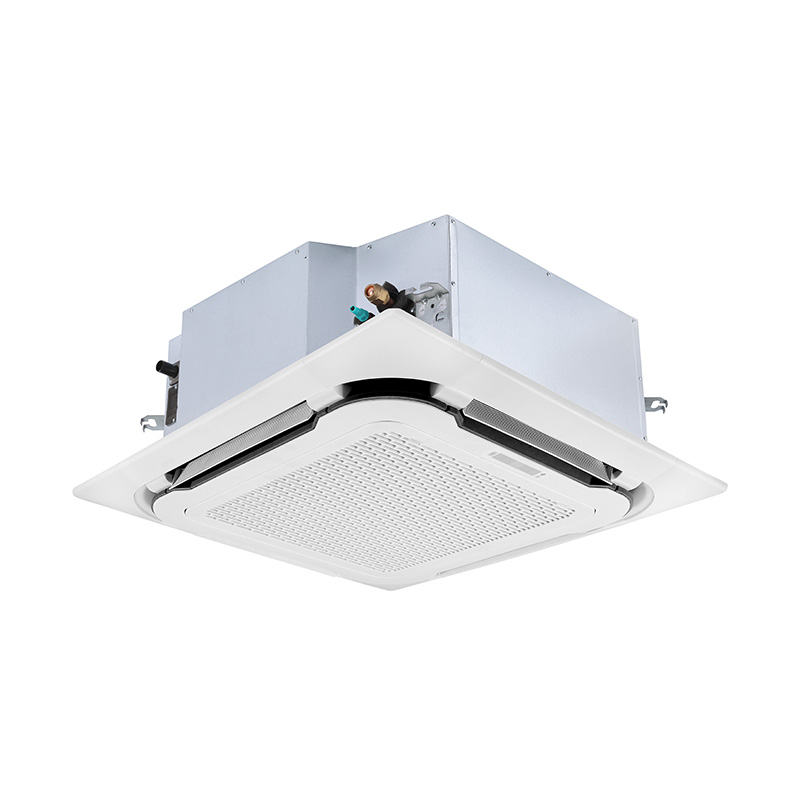
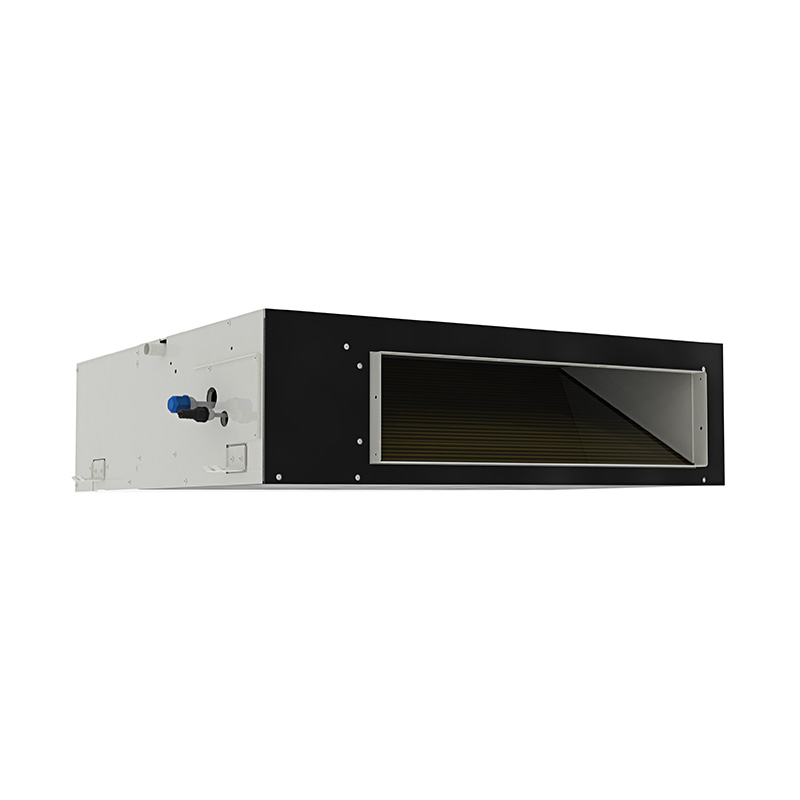
For light commercial interiors such as shops, meeting rooms and small offices, the cooling load profile is different. Glass facades, equipment heat, and high occupancy raise the duty factor during business hours. In those spaces, a ceiling cassette diffuses air across the room more evenly than a wall-mounted unit, which lowers stratification and shortens the compressor runtime for the same comfort level.
DEYE Light Commercial Solar AC, Cassette Type, R410A/R32 Ceiling cassette format for shops, offices and similar spaces. Hybrid AC/DC input suited to light commercial solar installations. View ProductCost and Payback: What You Are Really Paying For
Pricing varies by market and by whether you buy modules only or a complete installed system. As a reference, PV modules currently trade at roughly $0.60 to $1.00 per watt, and lithium battery banks at about $300 to $500 per kilowatt-hour of usable capacity. A 3.2kW array of eight 400W modules therefore costs about $2,000 to $3,200 for hardware; mounting, cabling and labor add a market-dependent amount.
A simple payback example clarifies the numbers. A SEER 18 2-ton AC running 8 hours per day with a 60% duty factor consumes about 6.4 kWh per day. Over a 180-day cooling season at a $0.20 per kWh tariff, the annual electricity cost is 6.4 × 180 × 0.20 = $230. A solar array that offsets 80% of that load saves about $184 per year. If the hardware cost of that array is $2,500, simple payback works out to roughly 13.6 years; with local incentives reducing the net cost to $1,800, it drops to under 10 years.
Adding batteries extends the payback period because storage hardware is expensive, but it buys resilience. In regions with frequent outages, better solar self-consumption, or time-of-use tariffs with high evening rates, the battery case becomes stronger. Where the grid is stable, a grid-tied array remains the most cost-effective option.
For a hybrid AC/DC system, the money you would otherwise spend on a central inverter and its wiring moves into the AC unit itself. In many projects this produces a similar total system cost with better solar utilization, because the AC consumes the DC power directly instead of paying the conversion penalty.
Frequently Asked Questions
Can a 2-ton AC run on 4 solar panels?
Four 400W panels form a 1.6kW array. That is enough to cover the running load of a very efficient 2-ton unit with a SEER rating of 20 or above, but only during the middle of the day. For a normal-efficiency unit, or if you need more than six hours of cooling, four panels is too few. Treat four to five panels as the absolute minimum only when a hybrid AC/DC unit is used and the grid is available as backup.
How many solar panels for a 2-ton AC with battery for whole-day running?
Whole-day running with battery backup usually means 12 to 16 panels of 400W, plus a lithium battery bank of roughly 48V 300 to 400Ah. The higher number covers the extra energy needed to recharge the battery after evening use. With 550W panels, the same system needs only 9 to 12 modules.
How many solar panels for a 2-ton AC in India?
Most of India receives between 4.2 and 5.5 peak sun hours. For a grid-tied system with a SEER 18 to 20 unit, plan on 5 to 8 panels of 400W. For night operation through batteries, 9 to 14 panels plus a 48V battery bank is typical. Hybrid AC/DC models match well with the Indian climate because high daytime solar radiation feeds the compressor directly.
What is the difference between a hybrid AC/DC solar AC and an off-grid DC solar AC?
A hybrid AC/DC unit has two power inputs, grid AC and solar DC, and the controller blends them in real time. An off-grid DC 48V unit operates only from a DC bus connected to the battery and PV array, so it is the right choice for sites with no grid. If your building has a stable grid, hybrid is the more practical option; far from an electrical network, the off-grid DC unit is simpler to install and maintain.
Can a 2-ton AC run on a 3kW solar system?
A 3kW solar array can power a high-efficiency 2-ton AC for about 6 to 8 hours on a sunny day. For a standard SEER 13 to 15 unit, or for a longer cooling window, the array will fall short. If you add a battery, the same 3kW array will cover the daytime load and recharge the battery, but you should limit night consumption accordingly.
How many watts does a 2-ton solar AC use per hour?
At full load, a 2-ton AC uses about 1,100 to 1,600W for a high-efficiency inverter unit and about 2,000 to 2,400W for an older or low-SEER unit. The exact value equals 24,000 BTU divided by the SEER. In normal thermostat cycling, the average hourly consumption is 40 to 70% of the full-load value.
Do I need batteries to run a solar-powered AC?
Only when you need cooling after the sun goes down, or when the grid is unreliable. A grid-tied system with net metering delivers the lowest cost per panel because the grid acts as an infinite battery. Batteries extend the operating window but add significant cost, so make the decision based on outage frequency rather than habit.
Are fewer larger panels better than more smaller panels?
Larger panels, such as 550W instead of 400W, reduce the number of modules, the amount of racking, the wiring connections, and the installation labor for the same total kilowatt capacity. On an open roof, going larger is usually more economical. On a roof with complex geometry or multiple roof planes, smaller modules may fit better in the available spaces.
