

 Español
 русский
 Français
 Português
 Deutsch
 عربى
عربى italiano
-1.jpg)

Content
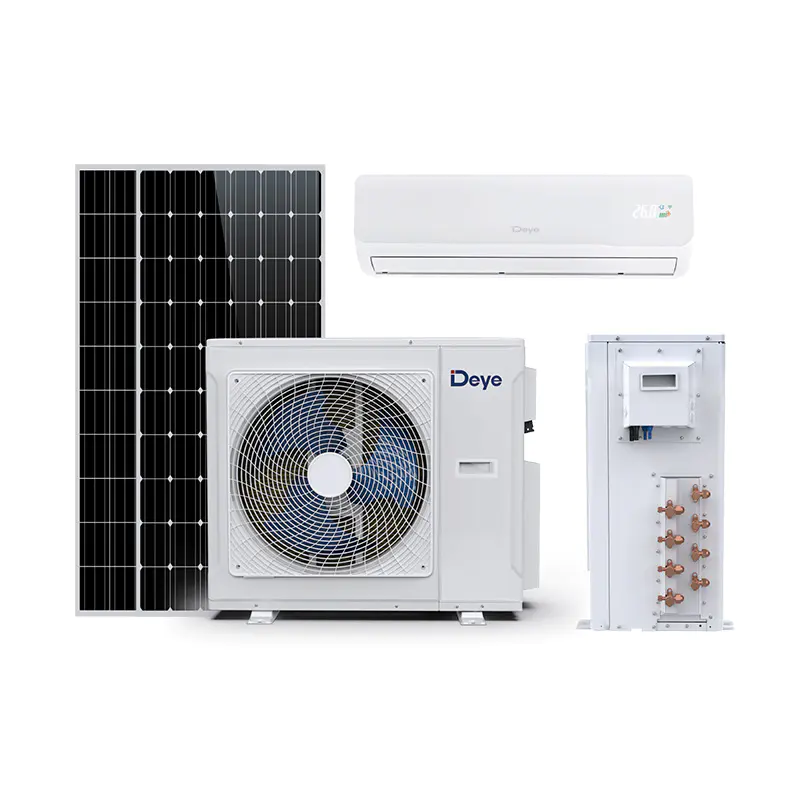
In the context of increasing global climate volatility in 2026, the Hybrid ACDC Solar Window AC has become a preferred choice for green building. However, these devices rely heavily on the energy input from the PV Array. Environmental factors, specifically Dust accumulation and Rainy/Cloudy conditions, have a significant impact on the Performance Ratio of the system. This article provides a professional analysis of the specific efficiency losses caused by these two weather types from an electrical and meteorological perspective.
Obscuration Effects of Dust Accumulation on PV Conversion Efficiency
For a Hybrid AC that relies on direct DC power, dust represents a typical "soft shading" issue. Particles deposited on the glass surface alter the path of incident light, leading to a substantial drop in Short-circuit Current (Isc).
Spectral Attenuation and Hot Spot Effects: Dust not only blocks visible light but also absorbs infrared radiation, causing localized temperature increases in the modules. Research data indicates that in arid regions such as the Middle East or the Southwestern United States, the loss in Energy Yield typically ranges between 15% and 25% if panels are not cleaned for four consecutive weeks. In cases of severe sandstorms, losses can exceed 35%.
MPPT Tracking Precision Loss: This loss is directly fed back to the MPPT controller inside the air conditioner. Non-uniform dust accumulation causes distortion in the I-V Curve, making it difficult for the controller to lock onto the Maximum Power Point, resulting in secondary energy waste. For a compact Window AC system, any fluctuation on the DC side forces the system to draw power from the AC Grid more frequently, thereby reducing the overall energy-saving rate.
Impact of Rainy Weather on Irradiance and Spectral Composition
The impact of rainy weather on Hybrid ACDC systems is primarily reflected in the sharp decrease of Solar Irradiance and the spectral shift toward blue-green light.
Power Gaps Under Low Irradiance: In completely overcast conditions, vertical irradiance can plummet from 1000W/m² on a sunny day to 100W/m² or less. At this point, the PV Input power may fail to reach the minimum startup threshold for the compressor. In such scenarios, the Auto-Balance technology of the Hybrid System intervenes, and approximately 80% to 90% of the driving force switches to the AC side. This means that while the AC remains operational, the "Solar Contribution Ratio" is extremely low.
Utilization of Diffuse Radiation: It is worth noting that modern high-efficiency PERC or TOPCon panels exhibit strong low-light response. Even in light rain, by receiving Diffuse Radiation, the system can still maintain the operation of control circuits and the BLDC Fan Motor, typically reducing the grid load by 5% to 10%. Compared to traditional AC units, this remains a significant efficiency advantage.
Compensatory Effects of Humidity and Temperature Drop on Compressor Load
Although rainy days reduce the power supply, the meteorological environment provides some positive compensation for the Cooling Load.
Condenser Heat Exchange Efficiency: Temperature drops brought by rain are beneficial for the Condenser heat exchange. During rainfall, ambient temperatures usually drop by 5°C to 10°C, which significantly lowers the Compression Ratio of the compressor, improving the COP (Coefficient of Performance) of the air conditioner even in AC-driven mode.
Increase in Latent Heat Load: High Humidity on rainy days increases the Latent Heat Load of the AC. The Hybrid ACDC system must consume more energy for dehumidification rather than just sensible cooling. Therefore, the comprehensive efficiency loss on rainy days is a dual result of "decreased PV output" and "increased dehumidification demand."
Efficiency Loss Forecast by Climate Zone
Arid Regions: Losses mainly stem from dust. Without regular cleaning, the annual operational efficiency of the Hybrid System can drop by more than 12% due to accumulation.
Monsoon Regions: Losses mainly stem from continuous rain. During the rainy season, the Solar Self-consumption rate of the system may drop from over 90% on sunny days to around 10%.
