

 Español
 русский
 Français
 Português
 Deutsch
 عربى
عربى italiano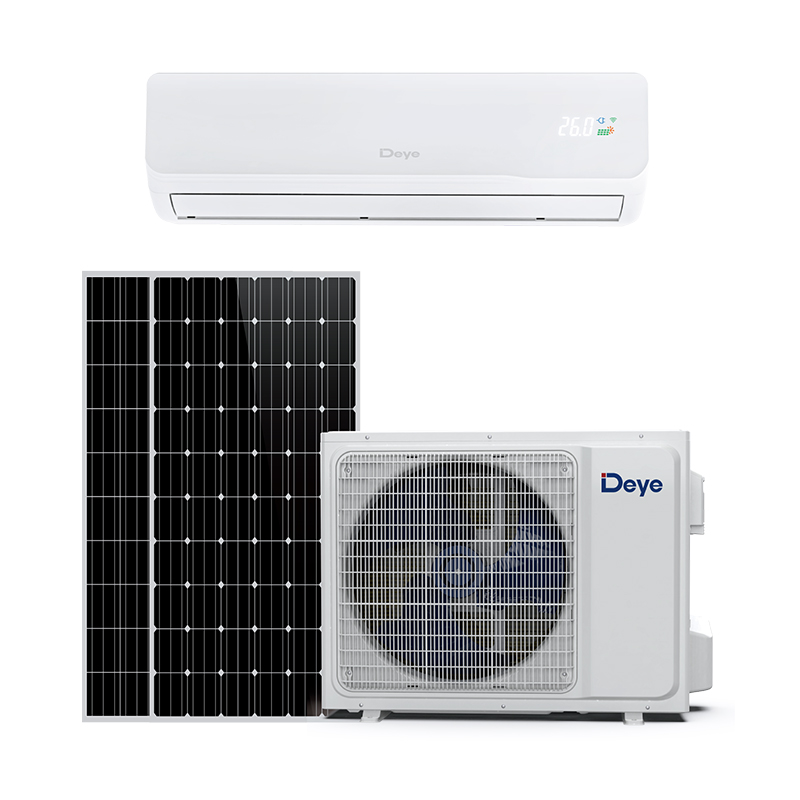
-1.jpg)

Content
- 1 What Is a Solar Air Conditioner?
- 2 Three Ways to Run an Air Conditioner on Solar Power
- 3 Do Solar Air Conditioners Actually Save Money?
- 4 Key Factors to Consider Before Buying a Solar Air Conditioner
- 5 Solar Air Conditioner vs. Solar + Standard AC: Which Is Right for You?
- 6 Real-World Applications: Where Solar AC Makes the Most Sense
- 7 Conclusion: Is a Solar Air Conditioner Worth It?
Every summer, someone with high electricity bills looks for a way to cool a room without paying the utility for every kilowatt-hour. A solar air conditioner sounds simple, but the category is broader than most buyers expect. Depending on the technical route, it can act like a solar-assisted conventional unit or a fully off-grid appliance. This choice affects savings, installation, and grid-outage behaviour. Here is how to compare the main options.
What Is a Solar Air Conditioner?
A solar air conditioner is any cooling system that uses solar energy to drive the refrigeration cycle. The category includes passive solar design, solar thermal conversion, and photovoltaic (PV) conversion. Passive design relies on shading; solar thermal systems use heat to drive absorption chillers. Both are rare in the residential market. The products you will evaluate are PV-driven active systems, where panels generate DC electricity for the compressor.
The technical route shapes every later decision. A PV-driven solar AC is not automatically better than a standard unit; it is better in specific conditions. High rates, strong sun, and cooling loads overlapping daylight hours strengthen the case. If you cool mainly at night, you need battery storage, and the cost equation changes.
Three Ways to Run an Air Conditioner on Solar Power
Almost every solar cooling project falls into one of three configurations.
Whole-Building Solar with a Standard AC
The most common route for homeowners who already have rooftop solar. A PV array feeds an inverter, the inverter supplies AC to the house, and a conventional air conditioner runs like any other appliance. Net metering covers night-time use and exports surplus solar during the day.
The weak points are conversion efficiency and grid dependence. Panels produce DC; the inverter converts it to AC; the air conditioner converts that AC back to DC inside the unit. Most grid-tied inverters also shut down during outages for safety, so cooling disappears with the grid. This route makes sense if the PV system already exists; starting from zero to cool one or two rooms is expensive.
Hybrid AC/DC Solar Air Conditioners
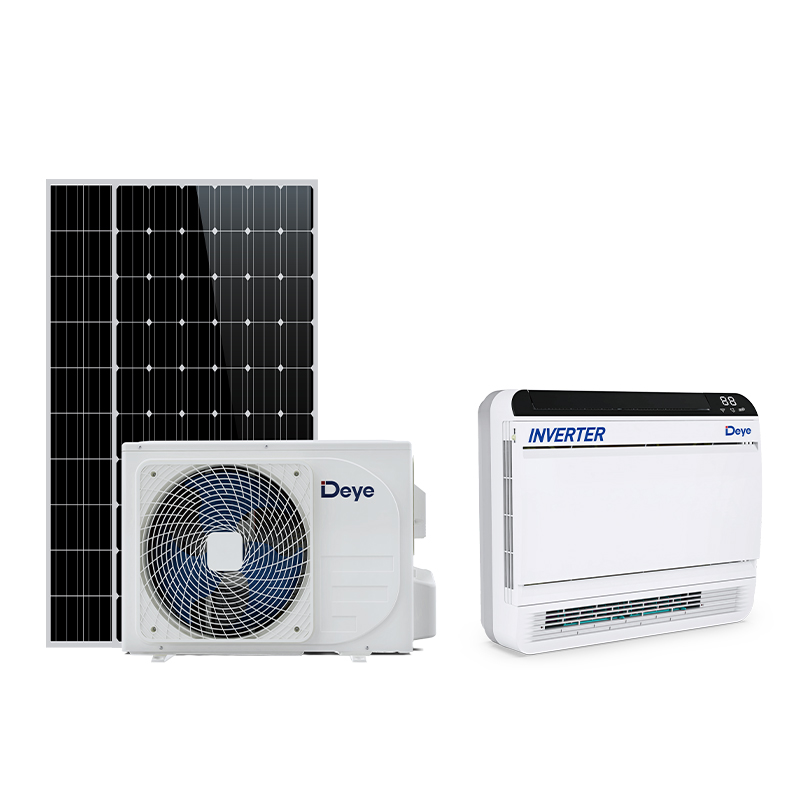
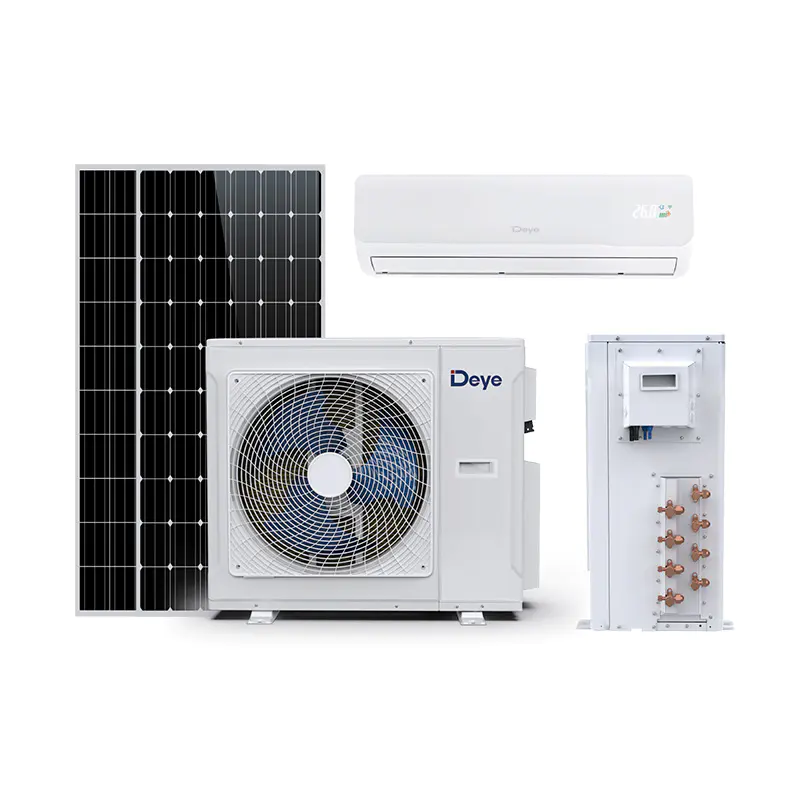
A hybrid AC/DC solar air conditioner accepts DC from the PV array and AC from the grid, with internal switching logic. Solar has priority; when clouds or evening cut PV output, the unit draws the shortfall from the grid without interruption.
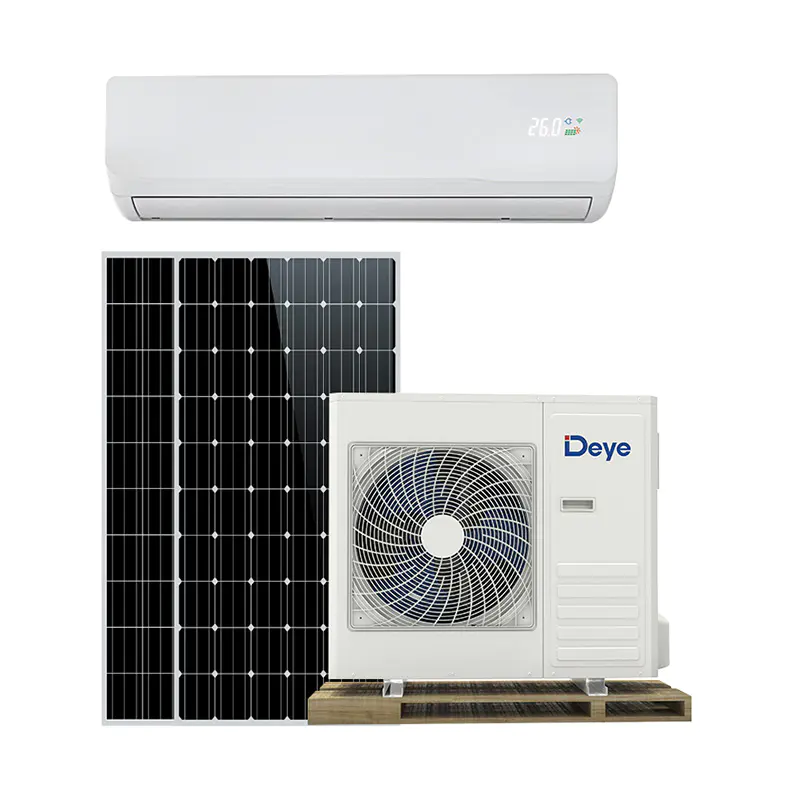
This architecture removes the double conversion, because panel DC feeds the compressor drive directly. It also improves resilience: during a daylight outage, the unit can keep cooling while the sun is up. For homes and small commercial spaces with unreliable grid supply, this is the most balanced route. Deye builds a wall-mounted model on this principle; review it in our hybrid AC/DC wall-mounted solar air conditioner.
 Dga2-Acdcblw-12k Wall Mounted Solar AC-Hybrid ACDC Solar Air Conditioner R410A/ Zhejiang Deye HVAC Technology Co., Ltd. is China Dga2-Acdcblw-12k hybrid ACDC solar air conditioner manufacturers and suppliers, our fact...View Product →
Off-Grid DC Solar Air Conditioners
Off-grid DC solar air conditioners are built for sites with no grid connection or with supply so unstable that it cannot serve as a backup. They typically run on a 48V DC bus and require a correctly sized PV array plus a battery bank. Common locations include remote farms, telecom shelters, stables, and cabins.
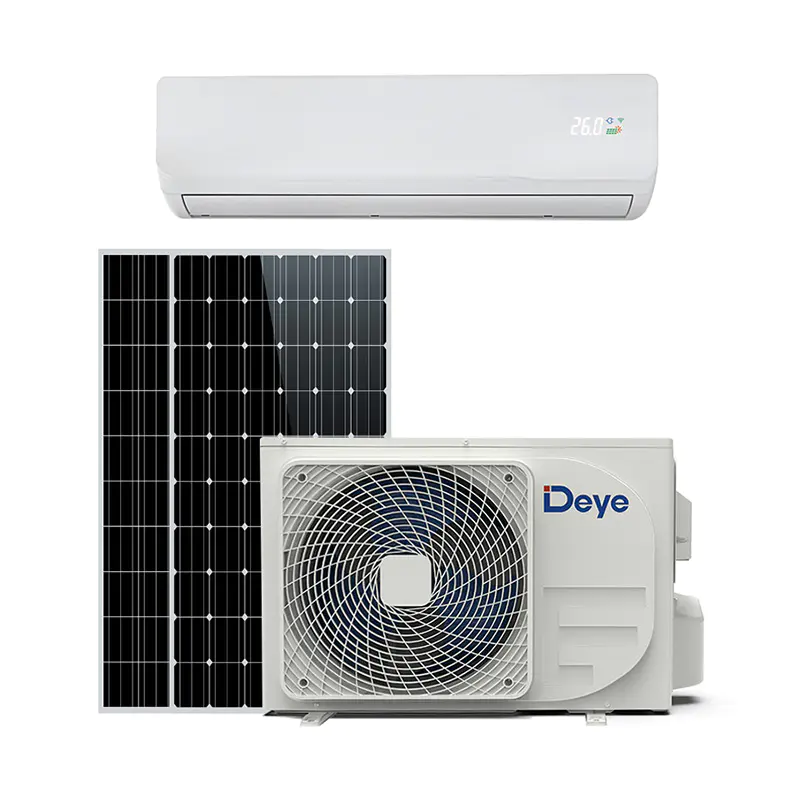
DIY communities often ask whether a small array, say 400 to 600 watts, can run a window unit. The honest answer: sizing depends on compressor running current, starting surge, daily cooling hours, and site sun hours. There is no universal wattage, only correct sizing. If you have no grid and need dependable cooling, investigate a 48V DC system. Deye's product in this category is the 48V DC off-grid solar air conditioner, designed for continuous grid-free operation.
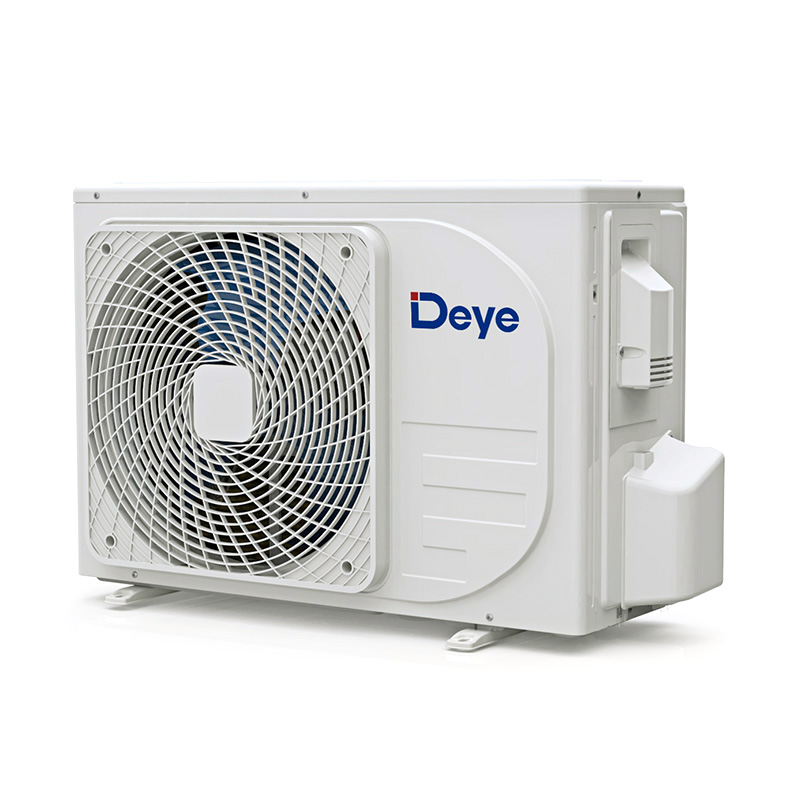
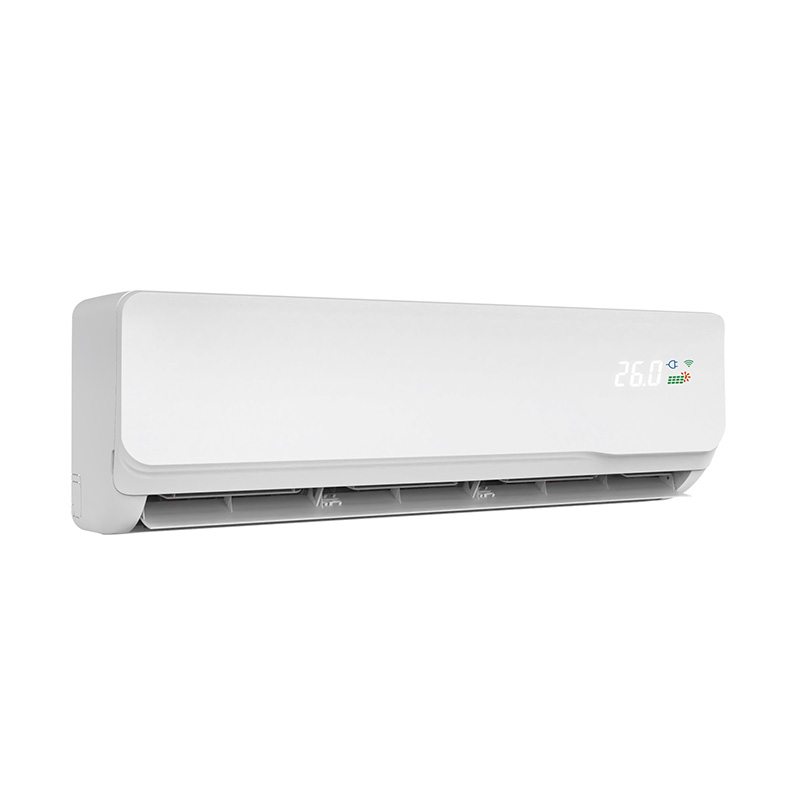 OEM/ODM Wall mounted Solar AC-Off grid DC 48V R410A Manufacturers, Suppliers, FaZhejiang Deye HVAC Technology Co., Ltd. is China OEM/ODM Wall mounted Solar AC-Off grid DC 48V R410A suppliers and Wall mounted Solar AC-...View Product →
Do Solar Air Conditioners Actually Save Money?
They can, but savings depend on three variables: electricity rate, effective sun hours, and daily cooling load. There is no universal payback period, because the inputs vary by location and usage.
Use this framework with your own numbers:
- Estimate daily cooling consumption in kilowatt-hours from the unit's rated input power and operating hours.
- Multiply by your marginal electricity rate - for example, 0.20 US dollars per kWh.
- Estimate the solar coverage fraction: the share of cooling hours that PV, with or without battery, actually powers.
- Daily savings = kWh × rate × coverage fraction.
- Break-even = extra cost of the solar AC versus a comparable standard AC, divided by daily savings.
The higher your rate and the more you cool during daylight, the faster the payback. If you cool mainly at night, a large battery bank to shift solar power can delay payback substantially. Run it with your own assumptions; what works for one household may not work for yours.
Key Factors to Consider Before Buying a Solar Air Conditioner
Once you narrow down the technical route, four factors separate a good fit from an expensive mistake.
Refrigerant Type: R32 vs. R410A vs. R290
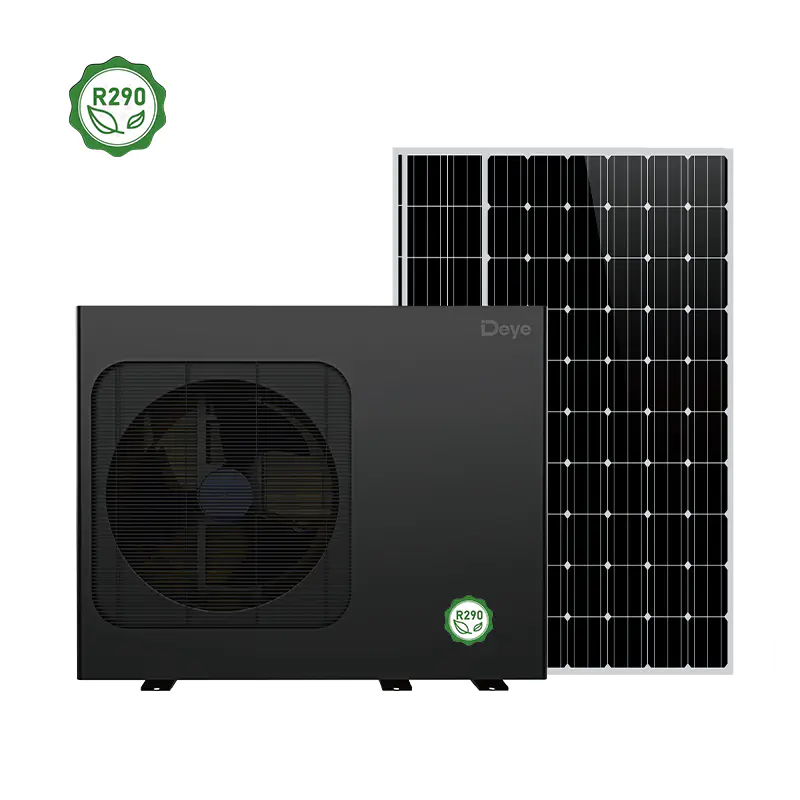
The refrigerant sets system pressure, efficiency, and environmental impact. R32 has a lower global warming potential than R410A and higher volumetric cooling capacity, so a smaller charge delivers the same duty; it is becoming the default in new split systems. R410A remains common in existing installations. R290 (propane) appears mainly in integrated heat-pump units, but flammability requires strict installation standards. Deye's line covers all three, so the choice follows local regulations and service networks.
Power Supply Flexibility
Match the power architecture to your supply. With a stable grid, a hybrid AC/DC model combines solar priority with grid backup. With no grid, a 48V DC system with batteries is the robust answer. With an existing whole-home inverter and battery, a standard AC may integrate more cleanly. None is universally best.
Installation Environment
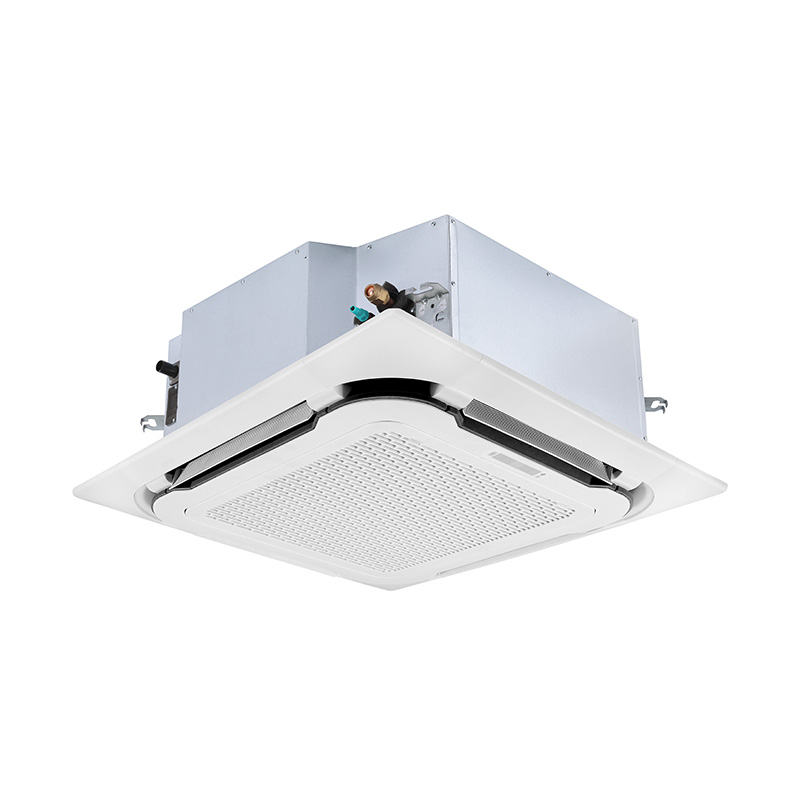
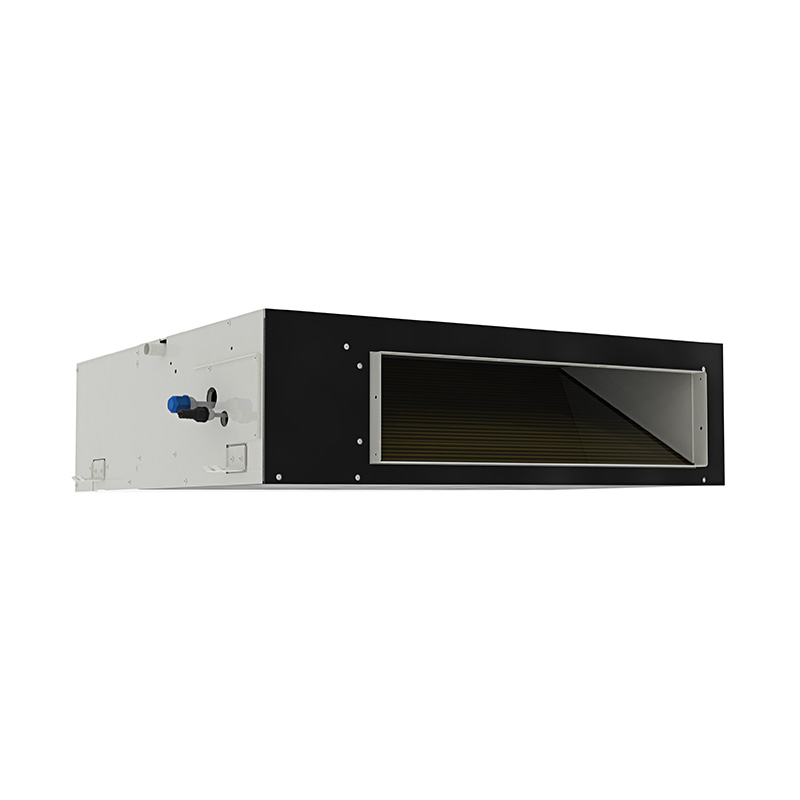
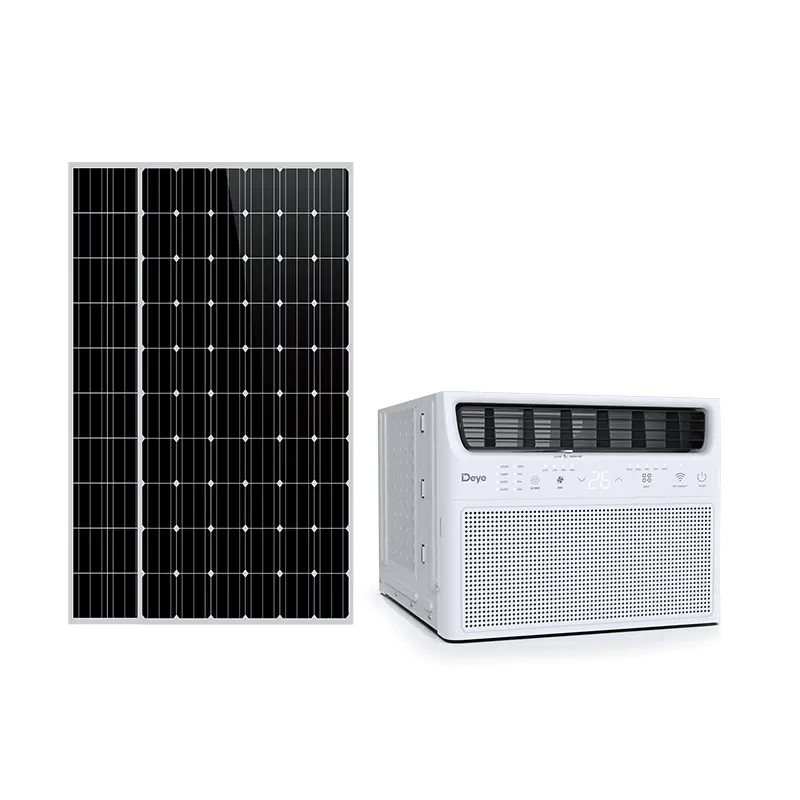
Physical space drives the format. Wall-mounted splits suit bedrooms, living rooms, and small offices. Ceiling cassettes distribute air evenly and keep floors and walls clear, which suits restaurants, convenience stores, clinics, and other light commercial spaces; buyers planning that installation should compare light commercial solar AC cassette units. Ducted systems fit larger open layouts. Window units work in rented properties and small sheds, though solar-ready window models are less common.
 Light Commercial Solar AC Cassette Type R410A/R32 Manufacturers, Suppliers, FactZhejiang Deye HVAC Technology Co., Ltd. is China light commercial solar AC cassette type manufacturers and suppliers, our factory custom ...View Product →
Operating Temperature Range
Every unit has an operating envelope. A condenser on a dark roof in Phoenix faces conditions very different from a coastal site, and a Montana cabin needs operation at temperatures that would strain a tropical-rated unit. Confirm minimum and maximum outdoor temperatures on the datasheet. Deye's range includes low-temperature models, but verify the exact limits for your unit.
Solar Air Conditioner vs. Solar + Standard AC: Which Is Right for You?
This is the most common decision point for homeowners. If you already own a rooftop PV system with net metering, keeping your existing standard AC makes sense. Starting from zero, a dedicated solar air conditioner needs fewer panels, simpler wiring, and no separate inverter.
The table below summarises the trade-offs.
| Factor | Whole-building solar + standard AC | Dedicated solar air conditioner |
|---|---|---|
| Initial scope | Full PV array, inverter, and grid connection | Fewer panels; no separate inverter for DC-fed models |
| Installation complexity | Licensed electrical work, permits, net-metering agreement | Simpler for single-zone projects; electrical work still required |
| Grid outage behaviour | Grid-tied systems shut down unless battery storage is added | Hybrid can run on PV by day; off-grid DC runs with batteries |
| Conversion path | DC to AC to DC, through two conversions | Direct DC path from panels to the compressor drive |
| Best-fit scenario | Existing solar owners with net metering and a stable grid | High rates, weak grid, or no grid; single-zone cooling |
Both routes are valid but answer different questions. Whole-building solar is a whole-house strategy, while a dedicated solar air conditioner is a zone-level strategy. If the goal is to cut the cooling cost of one frequently used room - a living room in a hot climate, or a clinic with rolling blackouts - the dedicated route is faster to install and easier to justify.
Real-World Applications: Where Solar AC Makes the Most Sense
Most successful installations fall into three scenarios.
- High electricity rates plus strong sun, residential. In the U.S. South and the Middle East, long cooling seasons overlap with peak sun hours. A hybrid AC/DC unit covers much of the demand directly from PV, with the grid topping up the rest - no battery required.
- Unstable grid, light commercial. Restaurants, convenience stores, and clinics cannot suspend cooling during an outage. A hybrid cassette or ducted system keeps the space usable in daylight outages and reduces generator runtime, a major operating cost.
- No grid at all, off-grid facilities. Farms, telecom shelters, stables, and remote cabins have no grid to fall back on. A 48V DC off-grid system is the only route that avoids a generator. Panel wattage, battery capacity, and runtime must match building load and local sun data.
Alignment is the common thread: the technical route must match supply conditions and usage patterns. No single product wins everywhere; the market offers several configurations.
Conclusion: Is a Solar Air Conditioner Worth It?
A solar air conditioner is worth considering when your site meets at least two of three conditions: strong annual sun, electricity rates above the national average, and an unreliable grid or a preference for energy independence. The more conditions you meet, the stronger the case.
The decision sequence is simple. First, evaluate your site: sun hours, roof orientation, electricity rate, and cooling hours. Second, choose the technical route: hybrid AC/DC for grid-connected or weakly grid-connected sites, off-grid 48V DC for sites without a grid, and a standard high-efficiency AC if you already operate a whole-home solar system. Third, compare specific products within that route.
Used in the right conditions, a solar air conditioner turns your largest energy expense into a controllable one. Start with your site, not the product, and the selection becomes much easier.
